

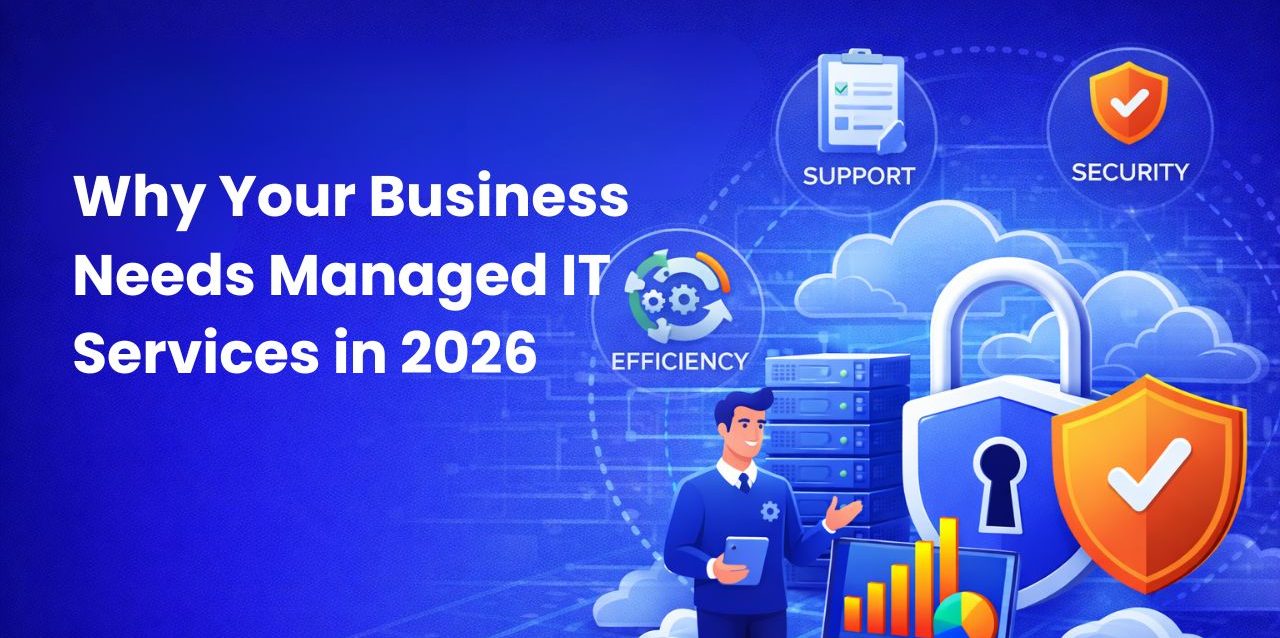
IT complexity is growing faster than most teams can hire. Kubernetes clusters, multi-cloud deployments, and CI/CD pipelines demand specialized expertise that’s expensive to build and even harder to retain—yet the cost of downtime keeps climbing.
Managed IT services offer a different path: proactive monitoring, security, and support delivered by an external partner who handles operational burden so your team can focus on building. This guide covers what managed services actually include, why in-house IT often falls short, and how to evaluate whether an MSP fits your organization’s needs.
What Are Managed IT Services
Managed IT services deliver proactive monitoring, specialized cybersecurity, and 24/7 support through an external partner called a managed services provider, or MSP. Instead of waiting for something to break, an MSP continuously watches your infrastructure, applies security patches, and resolves issues before they disrupt operations. This approach replaces the traditional break/fix model, where you call for help only after a problem has already affected your business.
The distinction matters more now than it did five years ago. Modern infrastructure—Kubernetes clusters, multi-cloud deployments, CI/CD pipelines—generates complexity that reactive support simply cannot keep up with. An MSP brings monitoring, security, cloud operations, and technical support together under a single, ongoing relationship.
Common managed IT service types include:
- Proactive monitoring: Continuous oversight of infrastructure health, performance metrics, and system availability
- Security management: Firewalls, vulnerability scanning, patch management, and threat detection
- Cloud operations: Migration planning, architecture optimization, and multi-cloud support across AWS, Azure, and GCP
- Help desk and support: On-demand technical assistance for day-to-day issues and incident escalation
Why Managed Services Matter for Modern Businesses
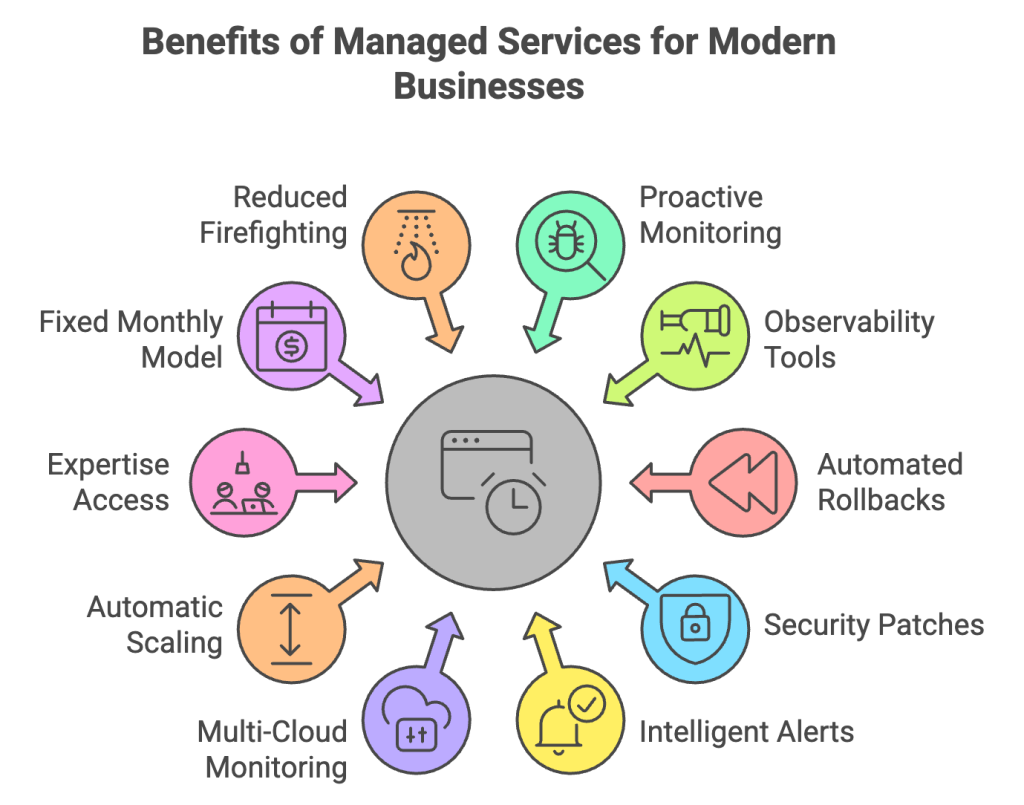
The question isn’t whether your infrastructure will face problems. It’s whether you’ll catch them before users do. Managed services shift the operational model from reactive firefighting to proactive prevention, which directly impacts uptime, security posture, and team productivity.
Modern environments are distributed, containerized, and constantly changing. A Kubernetes deployment might span multiple availability zones. A CI/CD pipeline might push dozens of releases per week. Traditional IT support, designed for static on-premises systems, struggles to keep pace with this velocity.
Proactive maintenance catches anomalies early. Specialized expertise fills skill gaps that are expensive and time-consuming to address through hiring. Predictable monthly costs replace the budget surprises that come with emergency repairs and unplanned outages.
Why In-House IT Teams Fall Short
In-house IT teams are often stretched thin—not because they lack talent, but because the scope of modern infrastructure exceeds what any small team can cover. Cloud-native technologies like Kubernetes, infrastructure as code, and observability platforms require specialized skills that take years to develop.
Alert fatigue is another challenge. When monitoring tools generate hundreds of notifications daily, critical signals get lost in the noise. Internal teams end up spending more time triaging alerts than solving root causes.
Around-the-clock coverage presents a staffing problem too. Production incidents don’t wait for business hours, yet maintaining 24/7 on-call rotations requires significant headcount. Meanwhile, security threats evolve faster than most internal teams can track, leaving gaps that attackers exploit.
| Capability | In-House IT | Managed Services Provider |
|---|---|---|
| 24/7 monitoring | Limited by staffing | Continuous coverage |
| Cloud/Kubernetes expertise | Requires ongoing training | Built-in specialization |
| Security updates | Reactive patching | Proactive threat management |
| Scalability | Constrained by headcount | Elastic support model |
Key Benefits of Managed IT Services
The value of managed IT services extends across reliability, security, cost efficiency, and strategic focus. Each benefit builds on the others, creating a compounding effect that improves operational outcomes over time.
1. Enable Proactive Monitoring and Observability
Proactive monitoring catches issues before users notice them. Rather than waiting for a support ticket, an MSP detects performance degradation, resource exhaustion, or service anomalies in real time.
Observability takes this further by unifying metrics, logs, and traces into a single view. This approach answers not just “is the system up?” but “why is the system behaving this way?” Smart alerting filters out noise, surfacing only the signals that require human attention. The difference between basic monitoring and true observability often determines how quickly teams can resolve incidents.
2. Minimize Downtime and Disruptions
Downtime costs money, erodes customer trust, and distracts engineering teams from strategic work. Proactive monitoring directly reduces downtime by enabling faster detection and response.
Automated remediation handles routine recovery tasks without human intervention. When incidents do occur, root-cause analysis becomes faster because the observability data already exists. Teams spend less time guessing and more time fixing.
3. Strengthen Security and Compliance
Cyber threats are increasing in sophistication and frequency. Managed services providers offer specialized security capabilities that most internal teams cannot maintain alone: managed firewalls, vulnerability scanning, patch management, and regular security audits.
Compliance support is equally important. Whether your organization faces HIPAA, SOC 2, or GDPR requirements, an MSP can help maintain audit readiness and implement controls that satisfy regulatory obligations. Security and compliance work hand in hand—you can’t have one without the other.
4. Access Specialized DevOps and Cloud Expertise
MSPs employ specialists in CI/CD pipelines, infrastructure as code, Kubernetes orchestration, and SRE practices. You gain immediate access to current skills without the recruiting, training, and retention burden.
This expertise accelerates projects that would otherwise stall. A migration to Kubernetes, for example, benefits from engineers who have completed similar migrations dozens of times and understand the common pitfalls. You’re not paying for someone to learn on the job.
5. Accelerate Cloud and Multi-Cloud Adoption
Cloud migration is rarely straightforward. Architecture decisions made early in the process have long-term implications for performance, cost, and operational complexity.
An MSP with multi-cloud expertise provides guidance across AWS, Azure, and GCP. This reduces vendor lock-in risk and ensures consistent security, monitoring, and operations regardless of where workloads run. The flexibility to move workloads between providers becomes a strategic advantage rather than a technical headache.
6. Scale Infrastructure on Demand
Business growth doesn’t follow a predictable schedule. Traffic spikes, product launches, and seasonal demand require infrastructure that scales elastically.
Managed services providers adjust support levels as workloads grow or shrink. You avoid the hiring and training cycles that slow down internal scaling, and you don’t carry excess capacity during quieter periods. The support model flexes with your business.
7. Reduce Operational Costs
The fixed monthly fee model replaces unpredictable break/fix expenses with predictable operational costs. Budgeting becomes simpler when you know what IT support will cost each month.
Beyond the direct fee, managed services eliminate hidden costs: recruiting, onboarding, training, benefits, and turnover. Organizations often find that the total cost of ownership is lower than maintaining equivalent capabilities in-house, though the exact savings depend on your current setup and scale.
8. Receive 24/7 Support and Incident Response
Production systems run around the clock, and incidents don’t wait for convenient hours. An MSP provides continuous coverage across time zones, ensuring that someone is always watching.
Triage, escalation, and resolution happen according to defined processes. Critical issues get immediate attention, while lower-priority items are queued appropriately. This structure reduces mean time to resolution and prevents small problems from becoming major outages.
9. Focus on Core Business Objectives
Every hour your engineering team spends on infrastructure firefighting is an hour not spent on product development, customer features, or competitive differentiation.
Offloading IT complexity to a managed services partner frees internal resources for strategic work. Teams shift from reactive operations to proactive innovation—which is where the real business value lies.
How to Evaluate a Managed Services Provider
Not all MSPs are equal. The right partner integrates seamlessly with your existing stack and brings capabilities that complement your internal team rather than duplicate them.
Key evaluation criteria include:
- Integration capability: Seamless connection with existing tools like Kubernetes, CI/CD pipelines, monitoring stacks, and cloud platforms
- Observability depth: Unified dashboards and intelligent alerting, not just basic uptime monitoring
- Security posture: Enterprise-grade practices, compliance support, and data protection
- Scalability: Ability to grow with your infrastructure without renegotiating contracts
- Open-source foundation: Cost-effective, flexible tooling that avoids vendor lock-in
Tip: Ask potential providers how they handle alert noise. A good MSP reduces false positives through intelligent correlation rather than forwarding every notification to your team.
Signs Your Organization Needs Managed IT Services
Recognizing the right time to engage an MSP can prevent small problems from becoming major operational challenges. Consider managed services if you’re experiencing:
- Alert fatigue overwhelming your team with notifications that lack context
- Frequent incidents with unclear root causes and slow resolution times
- Difficulty hiring or retaining DevOps, SRE, or cloud engineering talent
- Scaling challenges during growth periods or traffic spikes
- Security concerns outpacing internal expertise and tooling
- Cloud costs spiraling without a clear optimization path
Any one of these signals suggests that internal capacity is stretched. Multiple signals indicate that the gap between operational demands and available resources is widening.
How Obsium Delivers Managed IT Services
Obsium approaches managed IT services as a partnership rather than a vendor relationship. Our foundation combines AI-driven observability, open-source tooling, and deep expertise in Kubernetes and multi-cloud environments.
We unify metrics, logs, traces, and alerts into a single dashboard that provides actionable insights rather than raw data. Smart alerting reduces noise by correlating signals and surfacing only what matters. Our 24/7 managed monitoring service handles incident triage and response, so your team can focus on building rather than firefighting.
Core capabilities include:
- Unified observability: Consolidated metrics, logs, traces, and alerts in one view
- Smart alerting: Noise reduction through intelligent correlation and context
- Kubernetes expertise: Enterprise-grade container orchestration and cluster management
- 24/7 managed monitoring: Expert-led incident triage, escalation, and response
- Open-source tooling: Flexible, cost-effective infrastructure built on Prometheus, Grafana, and Loki
The result is faster delivery, fewer incidents, and infrastructure that scales with confidence.
Contact Us to discuss how Obsium can support your managed IT services strategy.
Frequently Asked Questions about Managed IT Services
What is the difference between managed IT services and traditional IT support?
Managed IT services provide proactive, ongoing monitoring and maintenance under a fixed agreement. Traditional IT support, often called break/fix, responds reactively to problems as they occur and bills per incident. The managed model prevents issues before they impact users, while break/fix addresses problems only after damage is done.
How are managed IT services typically priced?
Most managed services providers use a fixed monthly fee based on scope, number of endpoints, or service tier. This model replaces unpredictable per-incident billing with predictable operational expenses, making budgeting straightforward and eliminating surprise costs.
What is the purpose of IT service management in an MSP relationship?
IT service management, or ITSM, provides the structured processes—incident handling, change management, service requests—that MSPs use to deliver consistent, measurable support. ITSM frameworks ensure that issues are tracked, escalated appropriately, and resolved according to defined service levels.
Can managed IT services integrate with existing DevOps and CI/CD workflows?
Yes. Qualified MSPs connect directly with your existing pipelines, infrastructure as code, Kubernetes clusters, and monitoring tools. The goal is seamless integration rather than replacement, preserving your team’s existing investments and workflows.
How do managed services providers handle multi-cloud environments?
MSPs with multi-cloud expertise provide unified observability and management across AWS, Azure, GCP, and hybrid infrastructures. This ensures consistent security, monitoring, and operations regardless of where workloads run, reducing complexity and vendor lock-in risk.