
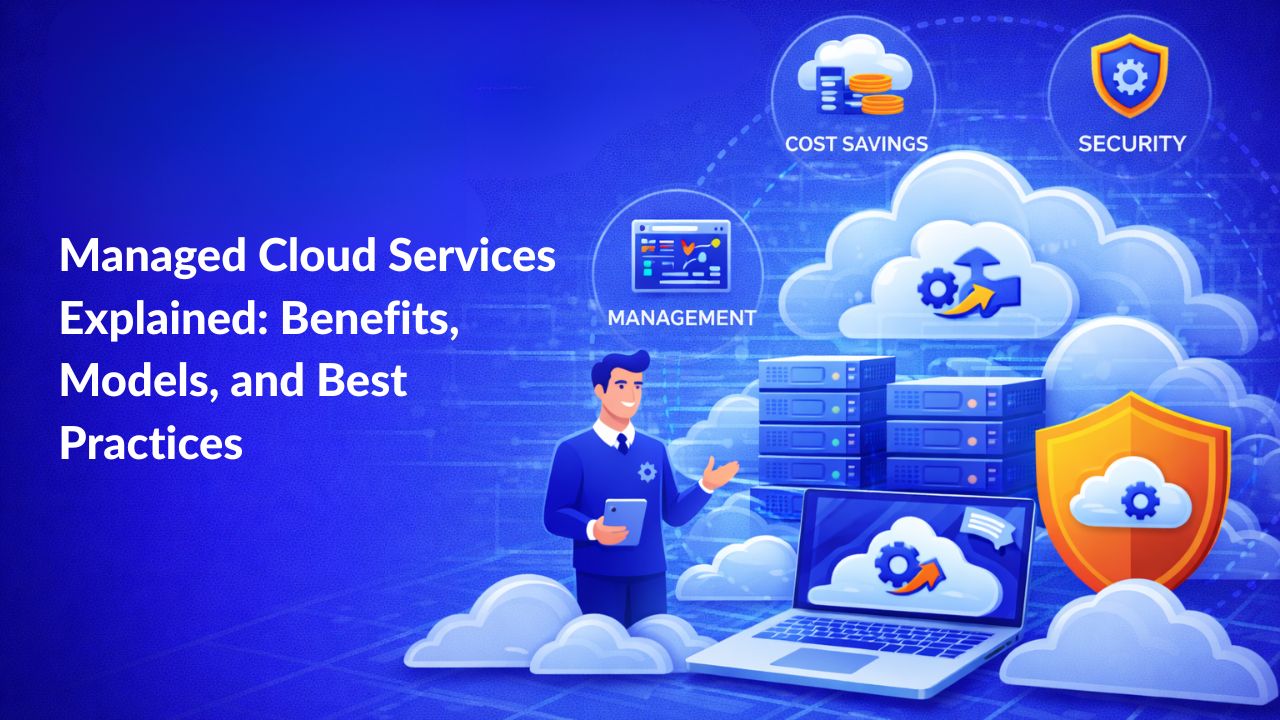
Managed Cloud Services: What They Are and How They Help
Managed cloud services are the partial or complete outsourcing of your cloud infrastructure management to a third-party provider. Instead of your team handling server configuration, security monitoring, backups, and performance tuning, a specialized partner takes on that operational burden across public, private, or hybrid environments.
This model has become the default for organizations scaling on Kubernetes and multi-cloud architectures, where the complexity of day-to-day operations often outpaces internal capacity. Below, we'll cover how managed cloud services work, the different types available, key benefits and tradeoffs, and how to evaluate providers for your specific requirements.
What are managed cloud services?
Managed cloud services involve outsourcing the daily management, maintenance, and optimization of your cloud infrastructure to a third-party provider called a Managed Cloud Service Provider (MCSP). The provider takes responsibility for servers, storage, and networks across public, private, or hybrid cloud environments. Your teams can then focus on building products and serving customers while experts handle the operational complexity.
The scope of what gets "managed" varies by provider and contract, but typically covers:
- Server configuration: Setting up and maintaining compute resources to match workload requirements
- Data backup: Automated, scheduled backups with defined retention policies
- Disaster recovery: Failover planning, testing, and recovery procedures
- Security monitoring: Continuous threat detection, vulnerability scanning, and incident response
- Performance tuning: Optimizing resource allocation and application responsiveness
Here's a useful way to think about it: cloud computing gives you the infrastructure, while managed cloud services give you the expertise to run that infrastructure well. Organizations gain access to certified professionals who specialize in Kubernetes, CI/CD pipelines, observability, and cloud-native technologies without the time and cost of building that expertise internally.
How do managed cloud services work?
The operational model is built around a partnership. Your organization hands off specific cloud management tasks to a managed cloud provider, and the provider monitors, manages, and reports on those tasks using specialized tooling and around-the-clock coverage.
Most engagements follow a predictable sequence:
- Assessment: The provider evaluates your current infrastructure, workloads, and goals
- Migration: Existing systems move to the managed environment with minimal disruption
- Ongoing monitoring: Continuous observability across metrics, logs, and traces
- Optimization: Regular tuning for performance, security, and cost efficiency
- Reporting: Dashboards and periodic reviews keep you informed
Providers typically integrate with your existing stack rather than replacing it entirely. Many also manage workloads across multiple clouds—AWS, Azure, Google Cloud—through unified tooling. This multi-cloud managed services approach prevents dependence on a single vendor while centralizing operations under one partner.
Types of managed cloud services
Several service models define what specifically gets managed. Understanding the differences helps you match provider capabilities to your actual requirements.
1. Infrastructure as a service management
With IaaS management, the provider handles servers, storage, networking, and virtualization layers. You keep control over operating systems and applications, but the underlying infrastructure—patching, scaling, availability—becomes the provider's responsibility.
This model works well for organizations that want to offload hardware concerns while maintaining flexibility over their software stack.
2. Platform as a service management
PaaS management extends coverage to the runtime, middleware, and operating system. Development teams benefit most from this model since they can focus entirely on application code while the provider manages everything beneath it.
3. Software as a service management
SaaS management covers the entire application stack. The provider handles updates, security, and availability for the software itself. This is the most hands-off model from your perspective.
4. Managed cloud hosting services
Managed services cloud hosting focuses specifically on the hosting environment. The provider ensures uptime, handles patching and backups, and manages the infrastructure that keeps your applications accessible to users.
5. Cloud security managed services
Cloud security managed services address security monitoring, threat detection, compliance management, and incident response. Given the complexity of modern threat landscapes, many organizations find this specialized coverage essential—particularly in regulated industries like healthcare and finance.
Managed cloud services vs cloud computing
The distinction between managed services and cloud services often causes confusion, so let's clear it up.
Cloud computing is the on-demand delivery of infrastructure and platforms. Managed cloud services are the management layer on top of that infrastructure. You can use cloud computing without managed services, but you'll carry the full operational burden yourself.
| Aspect | Cloud Computing | Managed Cloud Services |
|---|---|---|
| What it is | Infrastructure and platform delivery | Management of that infrastructure |
| Responsibility | Your organization manages operations | Provider manages operations |
| Example | An AWS EC2 instance | A provider monitoring and optimizing that EC2 instance |
Think of it like renting an apartment versus hiring a property manager. The apartment is the cloud. The property manager is the managed service.
Benefits of using managed cloud services
Managed cloud services deliver value across several dimensions, and the benefits tend to compound as your infrastructure grows more complex.
1. Reduced operational burden
Outsourcing infrastructure maintenance frees your internal teams to focus on work that differentiates your business. Instead of firefighting incidents at 2 AM, your engineers can build features and improve products.
2. Access to specialized cloud expertise
You gain immediate access to certified professionals who specialize in Kubernetes, DevOps, SRE practices, and cloud-native technologies. Building this expertise in-house takes years and significant investment. A managed cloud computing company brings it from day one.
3. Scalability for growing workloads
A managed cloud platform offers flexibility that matches real-world demand. Providers scale your resources up or down based on traffic patterns, seasonal spikes, or growth trajectories—without requiring you to predict capacity months in advance.
4. Enhanced security and compliance
Providers bring deep expertise in security best practices and compliance frameworks like SOC 2, ISO 27001, and HIPAA. Continuous threat monitoring, regular audits, and established incident response procedures create a stronger security posture than most organizations achieve independently.
5. Cost optimization and predictable spending
Managed cloud solutions help achieve cost efficiency by optimizing resource usage and reducing waste. Many providers offer predictable pricing models that simplify budget planning—a welcome change from the surprise bills that often accompany self-managed cloud environments.
6. Improved reliability and uptime
A managed cloud environment delivers improved reliability through 24/7 monitoring, proactive issue detection, and robust disaster recovery capabilities. Problems get caught and resolved before users notice them.
Disadvantages of managed cloud services
A balanced evaluation requires acknowledging the tradeoffs. Managed services aren't the right fit for every situation.
1. Reduced direct control
You'll have less hands-on control over day-to-day infrastructure decisions and configurations. For organizations with highly specialized requirements or strong internal expertise, this loss of control can feel limiting.
2. Potential vendor lock-in
Depending heavily on a single provider's tools and processes can make switching difficult later. Evaluate providers based on their use of open standards and portable technologies to reduce this risk.
3. Variable pricing complexity
Some pricing models are complex, and costs may vary significantly with usage. Ask for clear pricing documentation and historical examples before committing to a contract.
How to choose a managed cloud service provider
Selecting the right managed cloud service provider requires evaluating several criteria. The cheapest option rarely delivers the best long-term value.
1. Technical expertise and certifications
Look for official certifications from major cloud platforms (AWS, Azure, GCP) and demonstrated expertise in Kubernetes, DevOps, and SRE. Ask about the team's background and how they stay current with evolving technologies.
2. Security and compliance capabilities
Evaluate security practices, compliance certifications, and data handling policies. If you operate in a regulated industry, verify that the provider understands your specific requirements.
3. Integration with your existing stack
Assess the provider's ability to work with your current tools, platforms, and workflows. Seamless integration is critical—you don't want to rip and replace everything just to get managed services.
4. Support model and response times
Understand the Service Level Agreement (SLA) commitments, including support tiers, escalation paths, and 24/7 availability options. When production goes down at midnight, response time matters.
5. Transparency and reporting
Look for clear dashboards, regular performance reports, and full visibility into operations and spending. You're outsourcing management, not visibility.
Tip: Request a trial period or proof-of-concept engagement before signing a long-term contract. Real-world experience reveals more than any sales presentation.
When to use managed cloud services
Managed cloud services make sense in several common scenarios.
Consider this approach if you're:
- Scaling rapidly without the ability to add headcount
- Lacking in-house cloud or DevOps expertise
- Running critical workloads that require high availability
- Managing complex multi-cloud or hybrid cloud environments
- Operating in industries with strict security and compliance requirements
Organizations experiencing alert fatigue, deployment bottlenecks, or difficulty pinpointing root causes often find that managed services provide the expertise and tooling to break through operational challenges.
How Obsium delivers fully managed cloud solutions
Obsium delivers fully managed cloud solutions through an AI-driven approach that combines cloud consulting, DevOps, Kubernetes, and observability into a unified operating model. Rather than offering isolated services, we build cohesive platforms that accelerate delivery while maintaining reliability.
Our approach includes:
- Unified metrics, logs, and traces: Complete visibility across your entire stack using open-source tools like Prometheus, Grafana, and Loki
- Smart alerting: Noise reduction that surfaces what actually matters, so your team isn't drowning in false positives
- 24/7 managed monitoring: Certified experts handling incidents around the clock
- Open-source foundations: Cost-effective, flexible tooling without vendor lock-in
- Seamless integration: Works with your existing Kubernetes clusters, CI/CD pipelines, and cloud platforms
The result is fewer blind spots, faster incident resolution, and infrastructure that scales with confidence.
Contact Us to discuss your managed cloud requirements.
FAQs about managed cloud services
What is the difference between managed services and cloud services?
Cloud services refer to the underlying infrastructure, platforms, or software delivered via the cloud. Managed services involve a third-party provider actively managing, monitoring, and optimizing those cloud resources on your behalf. You can use cloud services without managed services, but you'll carry the full operational responsibility.
How do managed cloud service providers typically structure their pricing?
Providers commonly use subscription-based models, consumption-based pricing, or tiered packages that bundle specific services. Costs vary based on scope, resource usage, and support levels included. Ask for detailed pricing documentation and examples of typical monthly costs for organizations similar to yours.
Can managed cloud service providers support multi-cloud environments?
Yes, many providers specialize in multi-cloud managed services, managing workloads across AWS, Azure, Google Cloud, and other platforms through unified tooling and centralized monitoring. This approach provides flexibility while avoiding dependence on any single cloud vendor.
What SLAs can organizations expect from a managed cloud provider?
Expect SLAs covering uptime guarantees (often 99.9% or higher), response times for incidents by severity level, escalation procedures, and reporting frequency. Specifics vary based on service tier and provider—review the details carefully before signing.
How do managed cloud services handle Kubernetes workloads?
Providers with Kubernetes expertise deploy, monitor, and scale containerized applications while handling cluster management, observability, security, and integration with CI/CD pipelines. This allows your teams to focus on application development rather than cluster operations.
Recent Posts


Ready to Get Started?
Let's take your observability strategy to the next level with Obsium.
Contact Us