The cloud sits at the heart of modern business today. It is no longer a glimmering upgrade but the very scaffolding that holds digital products upright. Industry analysts expect global cloud spending to reach 723 billion dollars in 2025 and to cross one trillion dollars in the next two years.
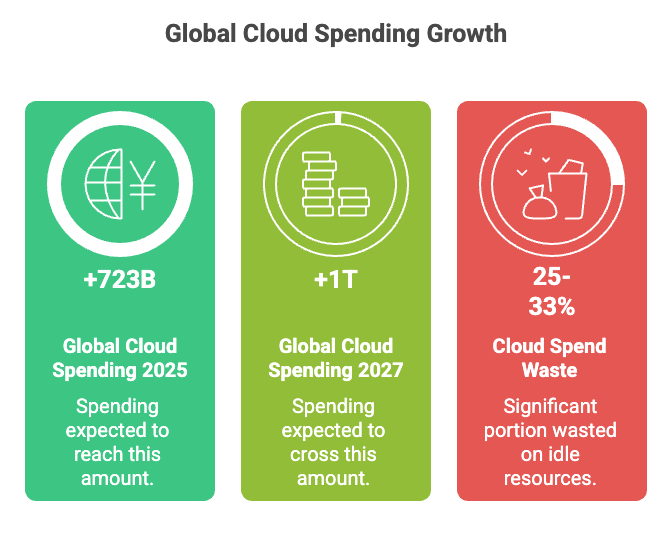
Yet behind this dramatic rise hides an uncomfortable reality. Many organizations are quietly losing control of their cloud environments. Research shows that a quarter to nearly a third of cloud spend goes to waste. Idle clusters run through the night, oversized virtual machines consume resources they do not need, and forgotten workloads continue to bill long after their purpose has faded.
This creates a modern paradox. The cloud is simple to begin with but difficult to run well at scale. What starts as a playground of possibility often evolves into a maze of microservices, permissions, kubernetes clusters, audit requirements, and cost mysteries.
Teams that once spun up new environments with excitement now find themselves tiptoeing through cost dashboards like archaeologists dusting off ancient ruins in search of the cause behind last month’s unexpected invoice spike. 🌩️
Within this rising complexity, a persistent question emerges for every engineering leader.
Should we continue managing our cloud internally, or is it time to bring in a Managed Cloud Services Provider?
This article aims to give you a clear, practical way to answer that question. By understanding how each model works, recognising where your organisation stands today, and applying a simple decision framework, you can choose the approach that supports your goals without overspending or overburdening your teams.
Self-Service Cloud and Managed Cloud Services Provider: What They Actually Mean
Before comparing strategic approaches, it is essential to establish a clear, shared understanding of what "Self-Service" and "Managed Cloud" truly mean in practice. These are not just technical labels; they represent fundamentally different philosophies about where an organization should focus its resources, talent, and energy. These definitions form the basis for the strategic analysis that follows.
The Self-Service Model: Total Control, Total Responsibility
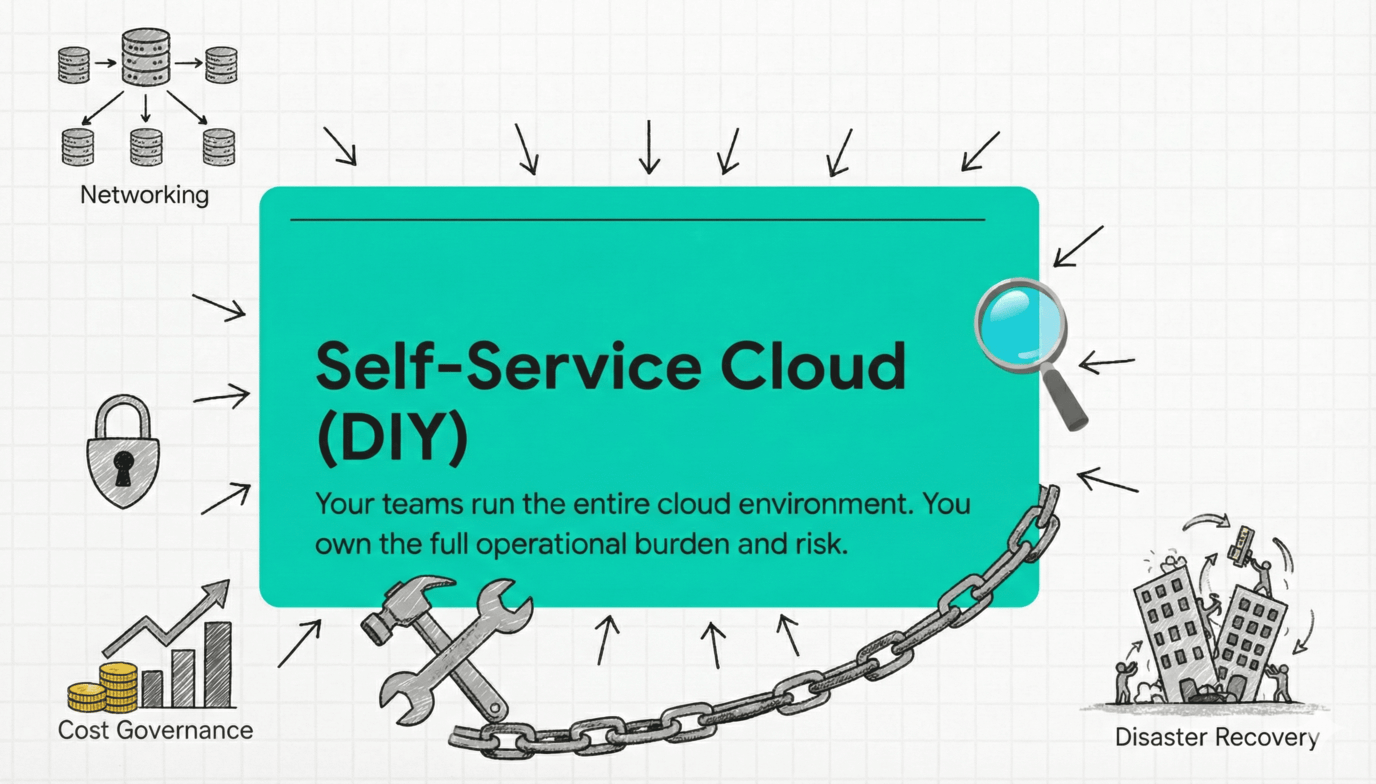
In a self-service model, an organization's internal teams run the entire cloud environment themselves. A dedicated Platform or DevOps team acts as the internal engine room, managing every layer of the technology stack.
Their responsibilities are comprehensive and include:
• Account creation and maintenance
• Identity and access controls
• Network architecture and security
• Kubernetes cluster management
• Logging and monitoring pipelines
• Backup and disaster recovery processes
• Cost governance and optimization policies
• CI and CD pipelines
• Secret management
• Monitoring
The appeal of this model is clear: it offers maximum control, flexibility, and autonomy. Teams can build the exact tooling and automation needed for their specific development workflows. The challenge is equally clear: the organization carries the full operational burden and the full risk that comes with it.
The Managed Services Model: Shared Responsibility, Strategic Focus
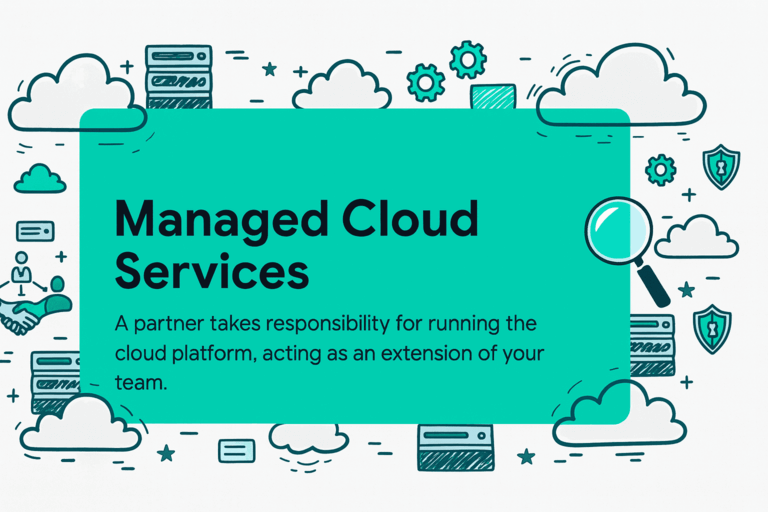
A Managed Cloud Services Provider is a partner that takes responsibility for designing, implementing, and running the cloud platform itself. A provider like Obsium, for example, brings a dedicated team of cloud architects, security engineers, DevOps specialists, Kubernetes experts, and Site Reliability Engineering (SRE) professionals who work as an extension of the client's organization.
This partner sets up and operates the core foundation of the cloud environment.
This typically includes foundational elements such as:
• Infrastructure design and architecture
• Hardened security baselines
• Identity architecture and controls
• Observability tooling and platforms
• Application platform components
• Reliability engineering aligned to agreed service levels (SLAs)
The core value proposition is one of strategic focus. The client concentrates on building its applications and achieving its business goals, while the provider ensures the underlying platform is fast, secure, compliant, cost-efficient, and always available.
The Essential Difference
Self service means you own all of the complexity. Every outage, every cost spike, every kubernetes issue, every compliance audit, every late night page rests on your team.
A managed approach means you own strategy and applications, while Obsium owns the heavy lifting that does not differentiate your business. The plumbing is handled by platform specialists, and your engineers are free to build features rather than manage infrastructure.
This distinction often becomes the turning point for organisations deciding how to scale their cloud in a sustainable way.
Which Model Wins on What
Once you understand the two approaches, the real question becomes simple. How do they perform when placed side by side in the areas that matter most to engineering leaders. Cost control, reliability, speed, skills, and the day-to-day experience of your teams.
| What You Care About | Self Service Cloud (DIY) | Managed Cloud with Obsium |
|---|---|---|
| Getting started quickly | Good for small teams and simple environments. | Strongest for complex setups where proven blueprints save weeks of effort. |
| Keeping cloud costs under control | Often difficult. Waste grows with scale and limited oversight. | Consistently strong. Obsium applies cost governance and continuous optimisation. |
| Hiring or keeping skilled cloud engineers | Challenging and expensive. Requires broad in-house expertise. | Easier. Obsium supplies a full cloud, DevOps, security, and SRE team. |
| Reliability during rapid growth | Risky. Incidents increase when internal tools do not evolve fast enough. | Stable. Obsium delivers managed observability and SRE practices with clear SLAs. |
| Security and compliance | Depends on internal maturity and discipline. Gaps appear easily. | Strong. Obsium provides hardened security baselines and audit ready foundations. |
| Developer productivity | Can slow down as infrastructure complexity rises. | Higher. Developers rely on reliable self service backed by Obsium’s platform. |
| Where your engineers spend their time | On infrastructure maintenance, firefighting, and platform upkeep. | On building products, shipping features, and moving the business forward. |
Real World Scenarios: Understanding Where Your Organisation Stands
Cloud decisions rarely happen in ideal conditions. They usually emerge in moments when systems slow down, incidents increase, budgets tighten, or teams realise that their current way of operating is becoming difficult to sustain.
The examples below reflect situations many organisations encounter as they expand.
Scenario One: The Fast Growing SaaS Company
Consider a SaaS product that is gaining users quickly. New features are released often, and engineering teams work with a clear sense of urgency. Behind the scenes, a very small platform group is responsible for the entire cloud environment. They maintain kubernetes clusters, CI pipelines, networking, monitoring, incident response, and cloud cost governance.
In the early stages, self service functions well. Developers can deploy freely, experiment easily, and maintain high delivery speed.
As growth accelerates, complexity increases. A sudden traffic increase exposes a weak configuration. A node behaves unpredictably. Best practices begin to slip as teams rush to deliver. People are paged more often. The monthly cloud bill arrives with numbers no one expected.
Organisations at this point typically pause to reassess their model. They ask whether they should continue running everything internally, expand the platform team, or bring in managed expertise to stabilise the environment while they grow.
Scenario Two: The Fintech or Healthcare Organisation
In regulated industries, expectations are different. Data must remain protected. Access must be properly controlled. Logging must be complete and reliable. Audit cycles occur regularly and require thorough preparation.
Under a purely self service model, each team builds and configures its own infrastructure. Some are meticulous, others focus more on speed. Over time, environments become inconsistent. Compliance reviews turn into demanding exercises that consume significant organisational time.
This is usually when leaders begin rethinking whether a fully self directed model still serves the organisation well. Some decide to strengthen internal governance and standardisation. Others consider introducing managed support with deeper experience in secure and regulated cloud operations.
Scenario Three: The Established Enterprise With Ambitious Plans
Larger enterprises often have well prepared platform teams and a clear architectural vision. They may be planning to expand into new regions, adopt more reliable kubernetes operations, improve observability, or streamline the developer experience.
The real challenge becomes capacity. Daily operational tasks consume time. Incidents interrupt strategic work. Internal tooling does not keep up with the speed of the product organisation. The platform team becomes essential, but also overextended.
At this stage, leadership typically evaluates three paths. Continue with a fully internal model. Increase hiring. Or shift parts of the operational responsibility to a managed partner while keeping core architectural control within the organisation.
The right choice depends on the company’s priorities, risk tolerance, and the scale of its ambitions.
Where Most Organisations Recognise Themselves
When teams take an honest look at their cloud environment, a pattern usually becomes clear.
If the platform team feels stretched, if incidents consume more attention than they should, if cloud costs frequently exceed expectations, or if compliance requires disproportionate effort, the organisation has likely reached a decision point.
Some choose to strengthen their internal capabilities and continue with full self service. Others find that sharing responsibility with a managed cloud partner allows them to focus on innovation while maintaining a stable and predictable foundation.
In either case, recognising the situation accurately is the first important step toward choosing the model that supports long term growth.
Here is a revised version of the Decision Framework section, written in a clear, steady, experienced voice similar to the haptics explanation you shared. The tone is simple, authoritative, and free from jargon and embellishment. It reads like a CEO explaining a complex decision in straightforward terms.
A Practical Decision Framework: Six Questions to Guide Your Choice
Selecting between a self service cloud model and a managed cloud approach does not need to be complicated. When you strip away terminology and assumptions, the decision often comes down to a few straightforward questions. These questions help you understand what your organisation needs today and what it will need as it grows.
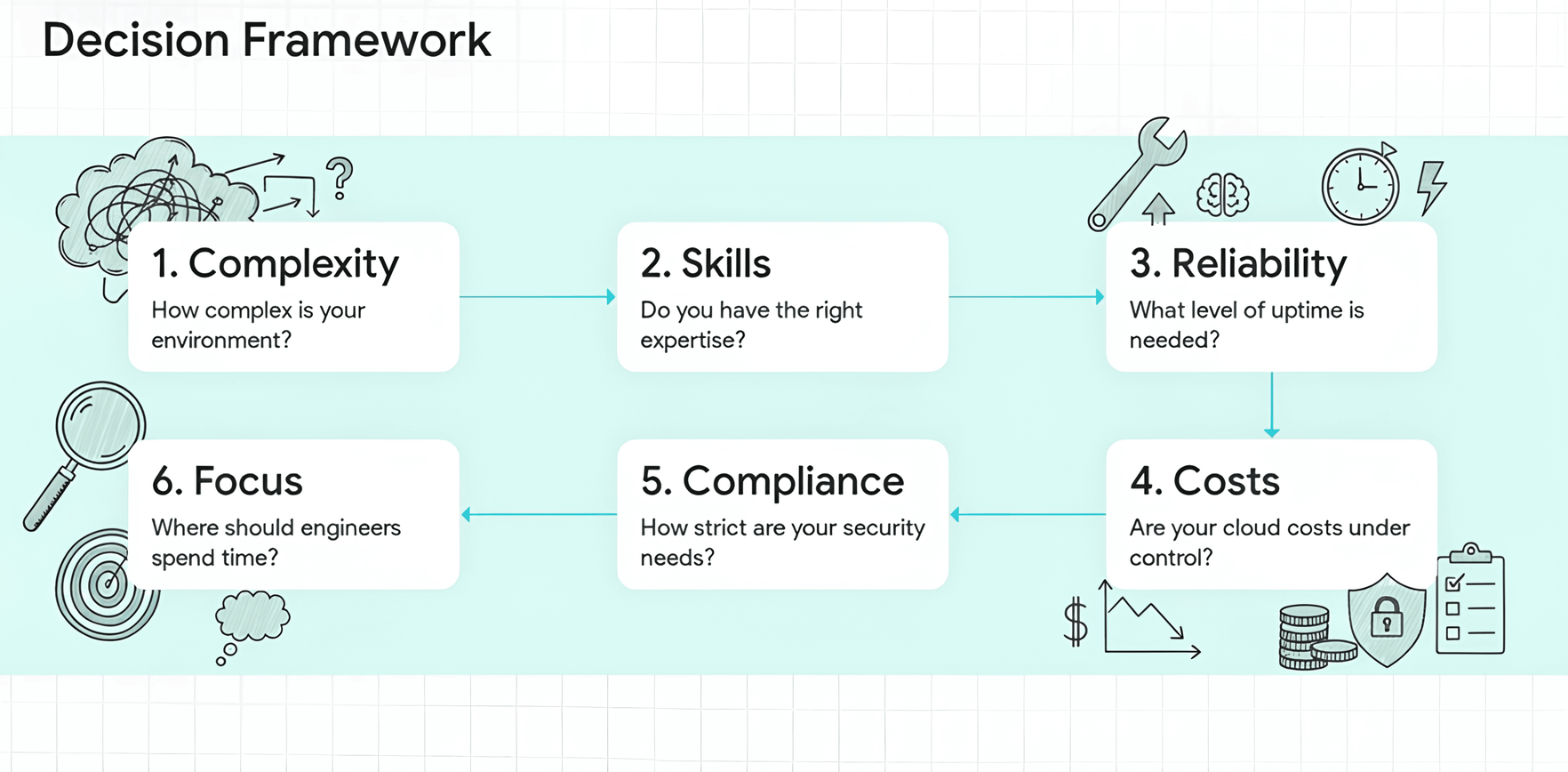
One. How complex is your cloud environment right now?
If your systems are simple and easy to manage, self service may work well. But as you add more applications, introduce kubernetes, operate in multiple environments, or start navigating regulatory requirements, the level of complexity increases. Greater complexity requires a more structured approach to avoid operational friction.
Two. Do you have the internal skills required to run everything reliably?
A well run cloud depends on several specialised skills. Cloud engineering, security, kubernetes operations, observability, and reliability engineering are all part of the equation. Some organisations can maintain a team with this expertise. Others find that staffing, training, and retaining such talent becomes a challenge. Understanding your internal capabilities is an important step.
Three. What level of reliability do your customers expect?
If your users depend on high availability and fast incident response, you need a strong operational foundation. Achieving this internally requires a mature SRE function and disciplined processes. Some organisations build this themselves. Others decide that a managed model is more practical because reliability practices are already built in.
Four. How well do you manage cloud costs today?
Cloud costs can rise quickly if they are not monitored carefully. Idle systems, oversized resources, and unused services are common. If you have strong FinOps practices in place, a self service approach can work. If cost surprises are a recurring issue, shared responsibility or external oversight may help maintain financial control.
Five. How strict are your security and compliance needs?
If your industry handles sensitive data or operates under regulatory guidelines, your cloud environment must follow clear and consistent security standards. Some organisations manage this internally with ease. Others find that enforcement becomes difficult as teams grow and infrastructure expands. In these situations, a more managed approach may offer better assurance.
Six. Where do you want your engineering teams to focus their time?
This is often the deciding factor. Some companies want to invest heavily in cloud operations and maintain full ownership. Others prefer their engineers to spend more time on product development and less time on infrastructure upkeep. There is no right or wrong answer. It simply depends on where you want to direct your resources.
How to Use This Framework
If most of your answers point to simplicity, available talent, and a desire to keep full control, self service may be the right path.
If your answers highlight growing complexity, rising operational demands, or a need for more predictable reliability and cost management, a managed or hybrid model may serve you better.
The goal is not to force a choice but to give your organisation a clearer view of its needs so you can move forward with confidence.
Conclusion: Choosing the Model That Supports Your Growth
As organisations expand, the cloud stops being a collection of technical decisions and becomes a core part of how the business operates. It affects reliability, delivery speed, financial discipline, and the ability of teams to focus on meaningful work.
A self service model can be highly effective when systems are simple and internal teams have the capacity to manage them well. It offers flexibility and direct control, and many companies rely on it successfully in their early stages.
However, as environments grow more complex, the demands on engineering teams increase. Reliability expectations rise. Security and compliance become more important. Costs need closer oversight. At this point, many organisations find that they need a stronger operational foundation than self service alone can provide.
This is where the value of a managed partner becomes clear. A partner like Obsium supports the underlying cloud environment, brings structure to day-to-day operations, and helps maintain reliability and cost stability. This allows internal teams to stay focused on product development and long term strategy rather than carrying the full operational load.
There is no single model that fits every organisation. The right approach is the one that aligns with your goals, your talent, and the pace at which you intend to grow. By understanding your current reality and planning for what lies ahead, you can choose a cloud operating model that gives your teams the clarity and confidence they need to perform at their best.