In the early days of DevOps, the mantra was straightforward: “You build it, you run it.” That approach worked when systems were smaller, and complexity was manageable. But as organizations moved into large scale Kubernetes environments and highly distributed microservices, that once simple idea turned into a heavy operational burden.
Today, the DevOps landscape has naturally evolved into two distinct yet deeply connected disciplines: Site Reliability Engineering (SRE) and Platform Engineering.
At Obsium, we regularly see teams struggle not because they lack skills, but because these boundaries aren’t clearly defined. One question sits at the center of this confusion: are you building a product for your end users, or are you building a platform for your internal developers?
Here’s a cleaner, more authoritative rewrite that reads well for senior engineers and leaders, while setting up the table naturally.
The Core Difference: Who Is the Customer?
The simplest way to understand the difference between SRE and Platform Engineering is to ask one question: who are they building for?
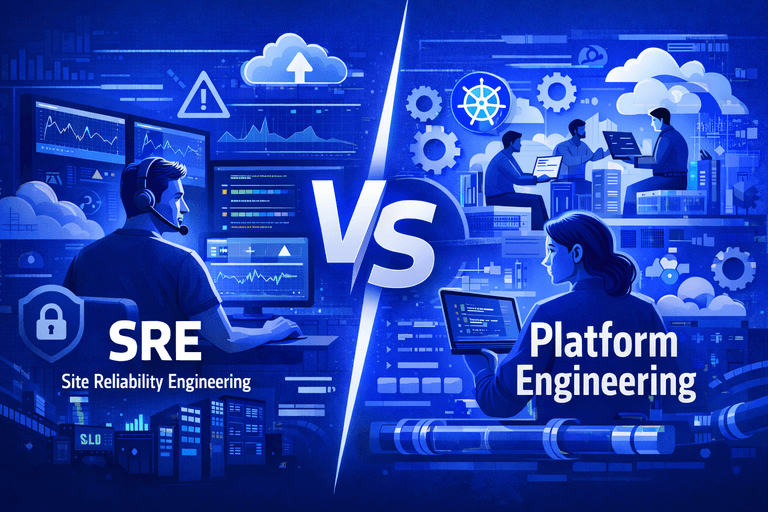
Both teams work on infrastructure and operations, but their focus points in very different directions. SREs are accountable to the end user. Platform engineers serve internal developers. That single distinction shapes how each team defines success, prioritizes work, and measures impact.
| Feature | Site Reliability Engineering (SRE) | Platform Engineering |
|---|---|---|
| Primary Customer | End users | Internal developers |
| Primary Goal | System reliability and uptime | Developer velocity and self service |
| Success Metrics | SLOs, error budgets, MTTR | Lead time, deployment frequency |
| Core Question | Is the service healthy for users | Is the platform easy for developers |
This difference explains why SRE teams obsess over stability and risk, while Platform teams focus on abstraction, automation, and paved paths. They solve different problems, but neither can succeed in isolation.
Site Reliability Engineering: The Protectors of Production
Site Reliability Engineering applies software engineering principles to operations with one clear priority: keeping production reliable for end users. SRE teams look outward. Their responsibility begins where customer experience begins and ends where user trust is won or lost.
Rather than reacting to outages, SREs design systems that fail predictably, recover quickly, and surface problems before users feel them. At the center of this discipline is the Service Level Objective (SLO). SLOs translate vague ideas like “high availability” into measurable promises such as latency, error rates, or uptime.
For example, an SRE team may define an SLO stating that 99.9 percent of user requests must complete in under 300 milliseconds over a rolling 30-day window. That single number becomes the contract that guides engineering decisions, release velocity, and risk tolerance.
When we work with teams at Obsium, our SRE approach typically focuses on three core areas.
1. Observability Over Monitoring
Traditional monitoring answers the question “is the system up or down.” Observability answers a far more important question: why is the system behaving the way it is.
Instead of relying on static alerts and dashboards, SRE teams instrument systems with deep telemetry across metrics, logs, and traces. This allows engineers to understand performance bottlenecks, cascading failures, and user impact in real time.
For example, rather than receiving a generic alert that a service is slow, an observability-driven SRE setup can reveal that latency is increasing only for users in one region, triggered by a downstream database lock. This level of insight reduces mean time to recovery and avoids guesswork during incidents.
2. Error Budgets
Error budgets introduce a healthy tension between reliability and speed. They define how much unreliability the system can tolerate while still meeting its SLOs.
If a service has an SLO of 99.9 percent uptime, it has an error budget of roughly 43 minutes of downtime per month. That budget becomes a shared resource between development and operations.
For example, if the team is well within its error budget, developers can ship features more aggressively. If the error budget is exhausted, feature releases pause and the focus shifts to stability improvements. This replaces emotional debates with objective, data-driven decisions.
3. Toil Reduction
Toil is repetitive, manual, and low-value work that does not scale. SRE treats toil as a defect.
If an engineer repeatedly has to log in at midnight to restart a service or manually rebalance traffic, the problem isn’t the engineer, it’s the system. SRE teams actively identify these patterns and automate them away.
For example, instead of manually scaling services during traffic spikes, an SRE team may implement autoscaling tied to real user demand and latency metrics. The goal is simple: humans should design systems, not babysit them.
Platform Engineering: The Architects of the Golden Path
Platform Engineering focuses inward. Its mission is to make life easier for developers by removing infrastructure complexity and standardizing how software is built and shipped.
Modern cloud environments are powerful, but they are also chaotic. Without a platform, every team ends up solving the same problems repeatedly: CI pipelines, Kubernetes manifests, security configurations, logging, networking, and access control.
Platform teams solve this by building an Internal Developer Platform (IDP). The platform becomes a product, and developers become its customers.
At Obsium, we see the most successful Platform teams excel in three areas.
1. Self Service Infrastructure
Developers should not need to understand cloud internals to get their work done. Provisioning infrastructure should be fast, predictable, and standardized.
For example, instead of filing a Jira ticket to request a database, a developer can provision one through a self-service portal or a simple configuration file. The platform handles networking, backups, security, and monitoring automatically.
This reduces wait times, eliminates bottlenecks, and allows teams to move independently.
2. Golden Paths
Golden paths are opinionated workflows that represent the safest and most efficient way to build and deploy software inside an organization.
A golden path might include a pre-approved CI pipeline, secure container images, standardized deployment patterns, built-in observability, and compliance controls. Developers are free to innovate, but if they follow the golden path, they get reliability and security by default.
For example, a new service created through the platform may automatically include logging, metrics, alerts, and security scans without the developer needing to configure any of it manually.
3. Abstraction
Platform Engineering shields developers from the underlying complexity of cloud providers and orchestration systems.
Instead of dealing directly with Kubernetes YAML, IAM policies, or cloud networking, developers interact with higher-level abstractions that match how they think about their work.
For example, a developer might define a service in terms of “public API,” “background worker,” or “scheduled job,” while the platform translates those intentions into the required infrastructure across AWS, GCP, or Azure.
Why You Need Both (and Why They Overlap)
Platform Engineering enables speed by paving the road for developers. SRE ensures reliability by making sure the system stays on track in production.
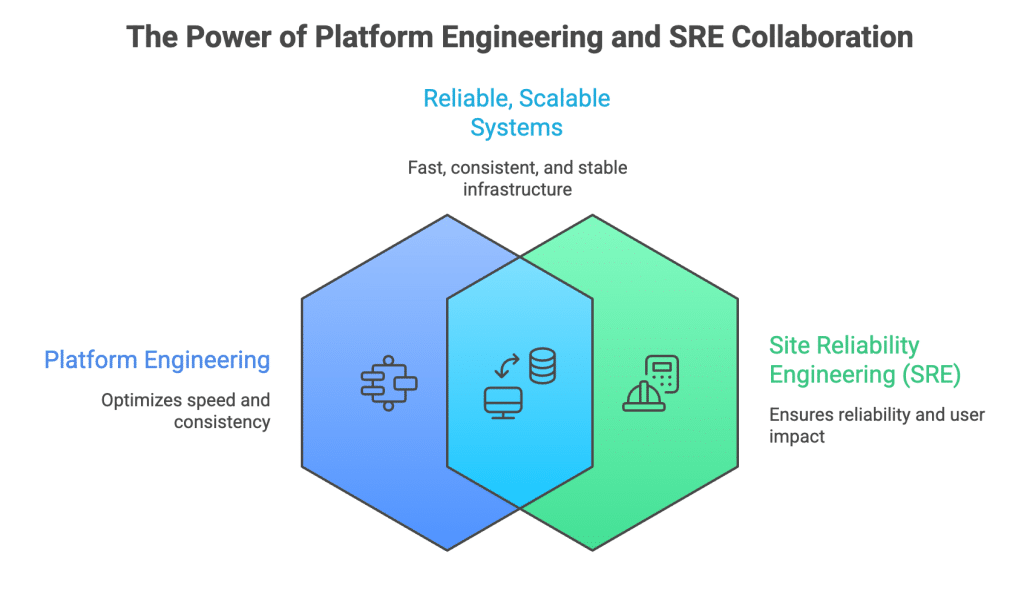
Modern teams need both. Platform Engineering focuses on developer velocity and standardization, while SRE focuses on user impact and system stability. Problems arise only when the boundaries are unclear.
The overlap is most visible around shared infrastructure like Kubernetes. A practical split is simple: Platform teams own how the platform runs, including cluster health and operations. SRE teams define what reliability looks like through SLOs, quotas, and disruption budgets.
When these roles work together, teams move faster without sacrificing reliability.
The Obsium Perspective
Without a unified observability strategy, both SRE and Platform Engineering fall short. SRE teams get overwhelmed by alert noise without enough context, while Platform teams struggle to understand whether their golden paths actually perform under real production load.
Obsium helps teams bridge this gap by designing shared observability foundations using open-source tools like Prometheus, Grafana, and Loki. This gives SRE teams the signals they need to protect user experience, and Platform teams the feedback loops required to continuously improve developer platforms.
The result is fewer blind spots, faster recovery, and platforms that scale with confidence.
Final Thoughts
Don’t choose between SRE and Platform Engineering. Define the boundary and let both thrive.
If developers are spending more time managing YAML than building features, Obsium helps you design platforms that remove friction. If your systems appear healthy but users are still unhappy, Obsium helps you embed SRE practices that turn reliability into a measurable, manageable outcome.
Build faster. Stay reliable. Scale with Obsium.