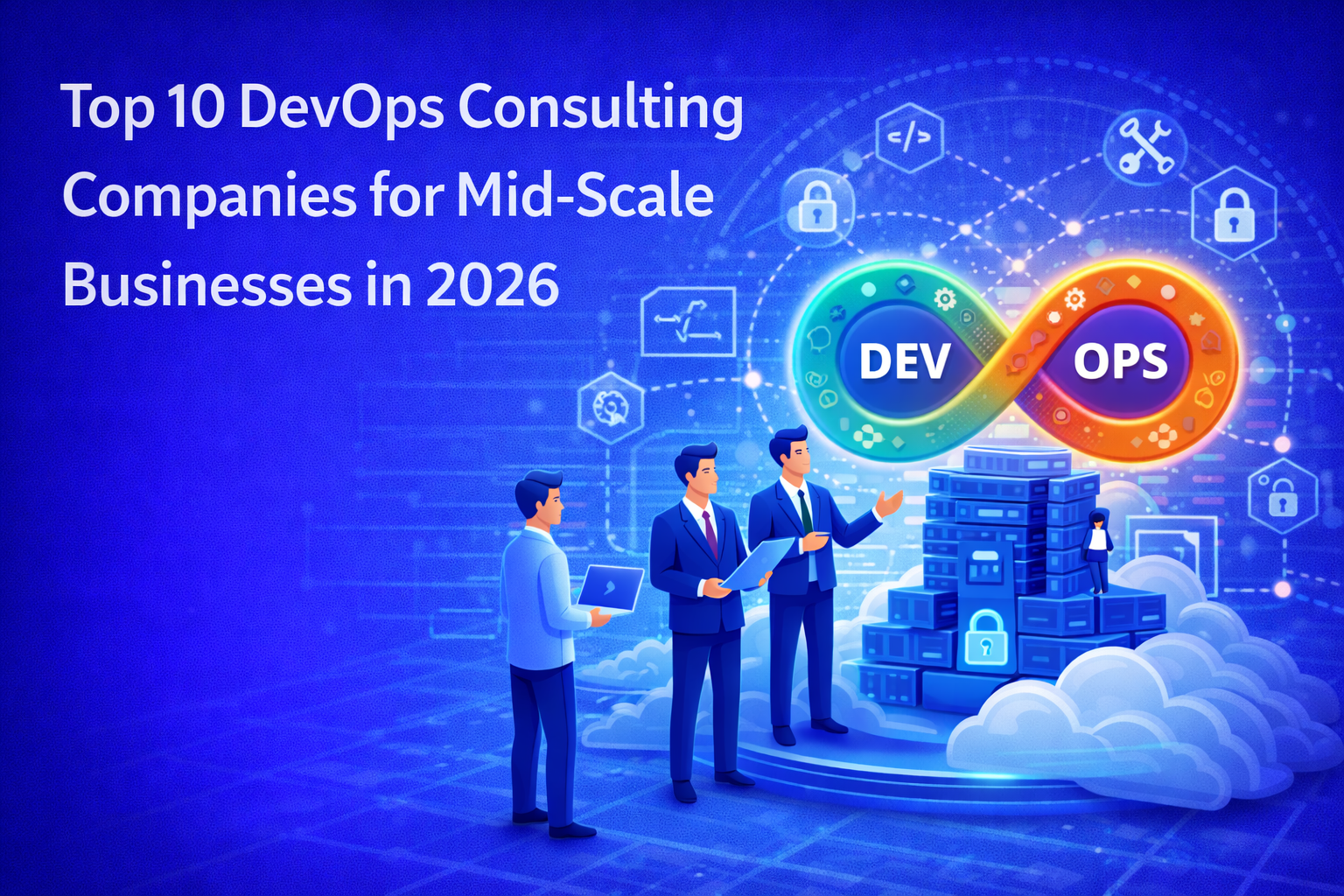
Top 10 DevOps Consulting Companies for Mid Scale Businesses in 2026
Finding the right DevOps consulting partner can compress months of internal trial-and-error into weeks of focused implementation. For mid-scale companies, that acceleration matters even more—you're past the point where manual processes work, but you don't have the headcount for a dedicated platform team.
This guide breaks down what DevOps consulting actually delivers, how to evaluate firms for mid-scale needs, and profiles ten companies worth considering in 2026.
What Is DevOps Consulting?
DevOps consulting helps businesses automate software delivery, modernize cloud infrastructure, and improve reliability without building a full platform team internally.
In 2026, leading firms focus on multi-cloud architecture (AWS, GCP, Azure), Kubernetes orchestration, cost optimization through FinOps, and secure, automated CI/CD pipelines. The advantage is speed: experienced consultants apply proven implementation patterns, reducing risk and accelerating results.
Most engagements cover CI/CD automation, Infrastructure as Code, observability, and container orchestration—core foundations for scalable growth.
Top 10 DevOps Consulting Companies for Mid-Scale Businesses
This list focuses on firms well-suited for mid-market organizations. Each company brings different strengths, so the right choice depends on your specific situation.
1) Obsium
For mid-scale businesses looking to professionalize delivery without building a large internal DevOps department, Obsium provides structured, automation-first DevOps solutions.
Their DevOps services focus on:
- CI/CD pipeline implementation to automate build, test, and deployment workflows
- Infrastructure as Code (IaC) to create consistent, version-controlled environments
- Release automation and GitOps to make deployments predictable and traceable
- Observability integration including monitoring, logging, and alerting
- QA automation and testing to improve release stability
- DevSecOps practices with automated security checks embedded into pipelines
- DevOps engineers on demand, embedded into client teams and supported by senior specialists
Obsium typically begins with a discovery and assessment phase, develops a tailored DevOps roadmap, and then moves into implementation and automation. They can continue as an ongoing DevOps partner, helping teams refine workflows and scale operations sustainably.
For mid-market organizations, this structured yet flexible approach is especially valuable—improving delivery speed, reducing operational bottlenecks, and strengthening reliability without requiring a full in-house platform engineering team.
2) Gart Solutions
Gart Solutions is an Eastern European consultancy known for CI/CD implementation and cloud migration. They focus on creating tailored DevOps roadmaps and offer flexible engagement models that adapt to the client’s delivery style. Their FinOps experience is also a differentiator, helping organizations optimize cloud usage and reduce ongoing infrastructure spend.
3) N-iX
N-iX supports large-scale DevOps transformation with strong experience in regulated industries such as finance and healthcare. They’re a good match for mid-scale companies preparing for rapid growth, expanding into multiple regions, or operating under strict compliance requirements. Their delivery model is geared toward scaling practices across teams without losing governance.
4) Ciklum
Ciklum emphasizes agile DevOps as part of digital transformation efforts, often working with product organizations that are scaling engineering velocity. Their approach typically combines operational improvements with developer experience enhancements—helping teams ship faster while also improving reliability, feedback loops, and engineering workflows.
5) Svitla Systems
Svitla Systems offers full-cycle DevOps services with nearshore delivery, with a strong focus on automation and infrastructure optimization. They commonly support teams looking to standardize deployment, improve release consistency, and strengthen environments through Infrastructure as Code. Their pricing approach often aligns well with mid-scale budget realities.
6) ELEKS
ELEKS delivers secure, enterprise-grade DevOps with a strong emphasis on compliance and governance. They’re especially relevant for fintech and healthcare organizations where regulatory requirements influence tooling, access controls, auditability, and release processes. Their work often includes designing DevSecOps pipelines and secure platform foundations.
7) ThoughtWorks
ThoughtWorks is a premium consultancy known for engineering rigor and DevOps thought leadership. They’re typically best for complex transformations where strategy and architecture matter as much as tooling changes. Costs can be higher, but their depth in modern engineering practices and organizational change can be worth it for high-impact programs.
8) Sigma Software
Sigma Software is strong in modernization and CI/CD at scale, particularly when legacy systems are involved. They help organizations transition from older infrastructure and monolithic applications toward modern cloud-native architectures. This often includes pipeline redesign, containerization, and progressive migration strategies that reduce risk.
9) ClickIT
ClickIT is an AWS-focused DevOps consultancy that fits well for startups and mid-scale SaaS companies running primarily on AWS. Their specialization tends to deliver deeper expertise within that ecosystem, especially around AWS-native architectures, infrastructure automation, and reliability practices tailored to AWS services.
10) Infopulse
Infopulse provides structured DevOps services for telecom and automotive sectors, where process maturity, documentation, and compliance can be as important as speed. They often perform well in regulated or operationally strict environments that require clear governance, repeatable workflows, and robust controls alongside delivery automation.
Comparison Table of Top DevOps Consulting Companies
| Company | Primary Focus | Cloud Expertise | Engagement Models | Best For |
|---|---|---|---|---|
| Obsium | AI-driven DevOps, Observability, Kubernetes | Multi-cloud (AWS, GCP, Azure) | Consulting, Managed Services | Mid-scale teams needing integrated observability and SRE |
| Gart Solutions | CI/CD, Cloud Migration, FinOps | AWS, Azure | Project-based, Staff Augmentation | Companies starting DevOps transformation |
| N-iX | Enterprise DevOps Transformation | Multi-cloud | Long-term partnerships | Regulated industries, rapid growth |
| Ciklum | Agile DevOps, Digital Transformation | AWS, GCP, Azure | Team augmentation | Product companies scaling engineering |
| Svitla Systems | Automation, Infrastructure Optimization | Multi-cloud | Nearshore delivery | Budget-conscious mid-scale companies |
| ELEKS | Secure DevOps, Compliance | AWS, Azure | Project-based, Managed | Fintech, healthcare verticals |
| ThoughtWorks | Strategic DevOps, Engineering Excellence | Multi-cloud | Advisory, Implementation | Complex transformations |
| Sigma Software | Legacy Modernization, CI/CD | AWS, Azure | Project-based | Companies with legacy infrastructure |
| ClickIT | AWS DevOps | AWS | Project-based, Managed | AWS-native SaaS companies |
| Infopulse | Structured DevOps, Compliance | Multi-cloud | Long-term partnerships | Telecom, automotive industries |
How to Evaluate DevOps Consulting Companies?
| Area | Key Criteria |
|---|---|
| Kubernetes & Multi-Cloud Expertise | Demonstrated hands-on experience with Kubernetes and deployments across AWS, GCP, and Azure; relevant certifications; proven success with similar infrastructure environments |
| Open-Source Toolchain Compatibility | Strong proficiency with open-source tools such as Prometheus, Grafana, ArgoCD, and Terraform; avoids unnecessary reliance on proprietary platforms |
| Flexible Engagement Models | Offers project-based consulting, staff augmentation, and managed services; aligns engagement structure with budget and internal capacity |
| DevSecOps & Security Practices | Integrates automated security scanning into CI/CD pipelines; applies policy-as-code and shift-left security principles |
| Managed Services & Ongoing Support | Provides post-implementation support, including monitoring, incident response, continuous optimization, and optional 24/7 coverage |
Best DevOps Consulting Services and What They Include
Understanding what services to expect helps you evaluate proposals and spot gaps in coverage.
CI/CD Pipeline Design and Implementation
A well-designed CI/CD pipeline automates the path from code commit to production deployment. This includes selecting the right tools (Jenkins, GitLab CI, GitHub Actions, ArgoCD), designing the pipeline architecture, integrating automated testing, and implementing deployment patterns like blue-green or canary releases.
Infrastructure as Code and Automation
Infrastructure as code treats cloud resources as version-controlled artifacts rather than manually configured systems. Consultants typically implement Terraform, Pulumi, or CloudFormation to enable repeatable provisioning, drift detection, and environment consistency across development, staging, and production.
Kubernetes Deployment and Cluster Management
Kubernetes consulting covers cluster design, Helm chart development, multi-cluster strategies, security hardening, and integration with CI/CD workflows. For mid-scale companies, this often includes guidance on managed Kubernetes services (EKS, GKE, AKS) versus self-managed clusters.
Observability and Unified Monitoring Solutions
Modern observability goes beyond basic monitoring to provide unified visibility across metrics, logs, and traces. Consultants implement tools like Prometheus, Grafana, Loki, and OpenTelemetry to create dashboards that surface actionable insights rather than raw data dumps.
Site Reliability Engineering Practices
SRE consulting includes defining Service Level Objectives (SLOs), implementing error budgets, establishing incident management processes, and automating reliability improvements. The goal is measurable reliability rather than vague uptime promises.
Platform Engineering and Internal Developer Platforms
Platform engineering creates self-service tooling that removes friction for developers. This might include golden paths for common workflows, developer portals using tools like Backstage, and abstractions that hide infrastructure complexity from application teams.
Why Mid-Scale Businesses Need DevOps Consulting Services
Mid-scale companies sit in an awkward spot. They've grown past the point where manual deployments and ad-hoc infrastructure work, but they don't have the budget or headcount for a dedicated platform team. That gap creates real friction.
You might recognize the symptoms. Release cycles slow down because every deployment requires manual intervention. Engineers spend more time fighting fires than building features. Alerts pile up from five different monitoring tools, and nobody knows which ones actually matter.
DevOps consulting companies fill this gap by bringing specialized knowledge without permanent overhead. A focused engagement can compress six months of internal trial-and-error into six weeks of structured implementation.
The pain points that typically drive mid-scale companies toward consulting include:
- Scaling bottlenecks: Processes that worked fine at 10 engineers break down at 50
- Alert fatigue: Too many notifications from disconnected systems, making it impossible to identify real problems
- Talent constraints: DevOps and SRE engineers are expensive and hard to retain
- Cost pressure: The need for enterprise-grade reliability without enterprise-grade budgets
DevOps Trends That Impact Mid-Scale Companies
Staying current with industry trends helps you evaluate whether a consulting partner is forward-thinking or stuck in outdated practices.
AI-Driven DevOps and Intelligent Automation
AIOps and intelligent alerting use machine learning to reduce noise, correlate events, and accelerate root-cause analysis. For mid-scale teams drowning in alerts, this capability can dramatically improve incident response times.
Shift-Left Security and DevSecOps Adoption
Security scanning integrated into CI/CD pipelines catches vulnerabilities before they reach production. This includes SAST/DAST tools, container image scanning, and policy-as-code for compliance automation.
GitOps and Declarative Infrastructure Management
GitOps uses Git as the single source of truth for infrastructure and application state. Tools like ArgoCD and Flux enable declarative management with built-in auditability and easy rollback when deployments go wrong.
Platform Engineering and Developer Experience
The rise of internal developer platforms reflects a shift toward treating infrastructure as a product. This trend reduces cognitive load for engineering teams and standardizes how software gets built and deployed across an organization.
How to Choose the Right DevOps Solution Provider
The right partner depends on your specific context, not just their general capabilities.
Aligning Your Business Goals with Consultant Capabilities
Map your pain points to consultant specializations. A firm excellent at greenfield Kubernetes implementations may not be the best choice for legacy modernization. Be specific about what you're trying to solve.
Evaluating Budget and Expected ROI
Pricing models vary: fixed-price projects, time-and-materials, or monthly retainers. Assess value against concrete outcomes like deployment frequency improvements, incident reduction, or developer productivity gains rather than abstract promises.
Assessing Communication and Cultural Fit
Timezone overlap, communication cadence, and engagement style matter more than many teams realize. Some consultants work collaboratively alongside your team while others deliver finished work with handoff documentation. Neither approach is universally better.
Selecting the Right Enterprise DevOps Consulting Company for Growth
The right DevOps consulting partner combines technical depth with an understanding of mid-scale constraints. Look for firms that bring integrated capabilities across CI/CD, Kubernetes, observability, and SRE rather than narrow specializations that create gaps.
For teams ready to accelerate delivery with unified DevOps, Kubernetes, and observability expertise, contact Obsium to discuss how we can help you move from reactive operations to confident, measurable performance.
FAQs about DevOps Consulting Companies
How much do DevOps consulting services typically cost for mid-scale businesses?
Pricing varies based on engagement type, scope, and consultant expertise. Expect project-based engagements ranging from focused assessments to multi-month transformations, with costs scaling to complexity and duration. Managed services typically use monthly retainer models.
What is the difference between a DevOps consulting firm and a managed services provider?
Consulting firms focus on strategy, implementation, and knowledge transfer. Managed services providers take ongoing operational responsibility for infrastructure, monitoring, and incident response. Many firms offer both.
Can mid-scale companies transition from DevOps consulting to an in-house team?
Yes, many consultants build internal capabilities through knowledge transfer, documentation, and training as part of their engagement. The goal is often to make the client self-sufficient over time.
What certifications indicate a qualified DevOps consultant?
Look for AWS, GCP, or Azure certifications, Certified Kubernetes Administrator (CKA), and HashiCorp certifications for Terraform. Practical experience matters more than certifications alone, but credentials indicate baseline competency.
How long does a typical DevOps consulting engagement last for mid-scale companies?
Engagements range from short assessments of a few weeks to multi-month transformation projects, depending on scope and organizational readiness. Managed services relationships often extend indefinitely.
Recent Posts
Ready to Get Started?
Let's take your observability strategy to the next level with Obsium.
Contact Us