
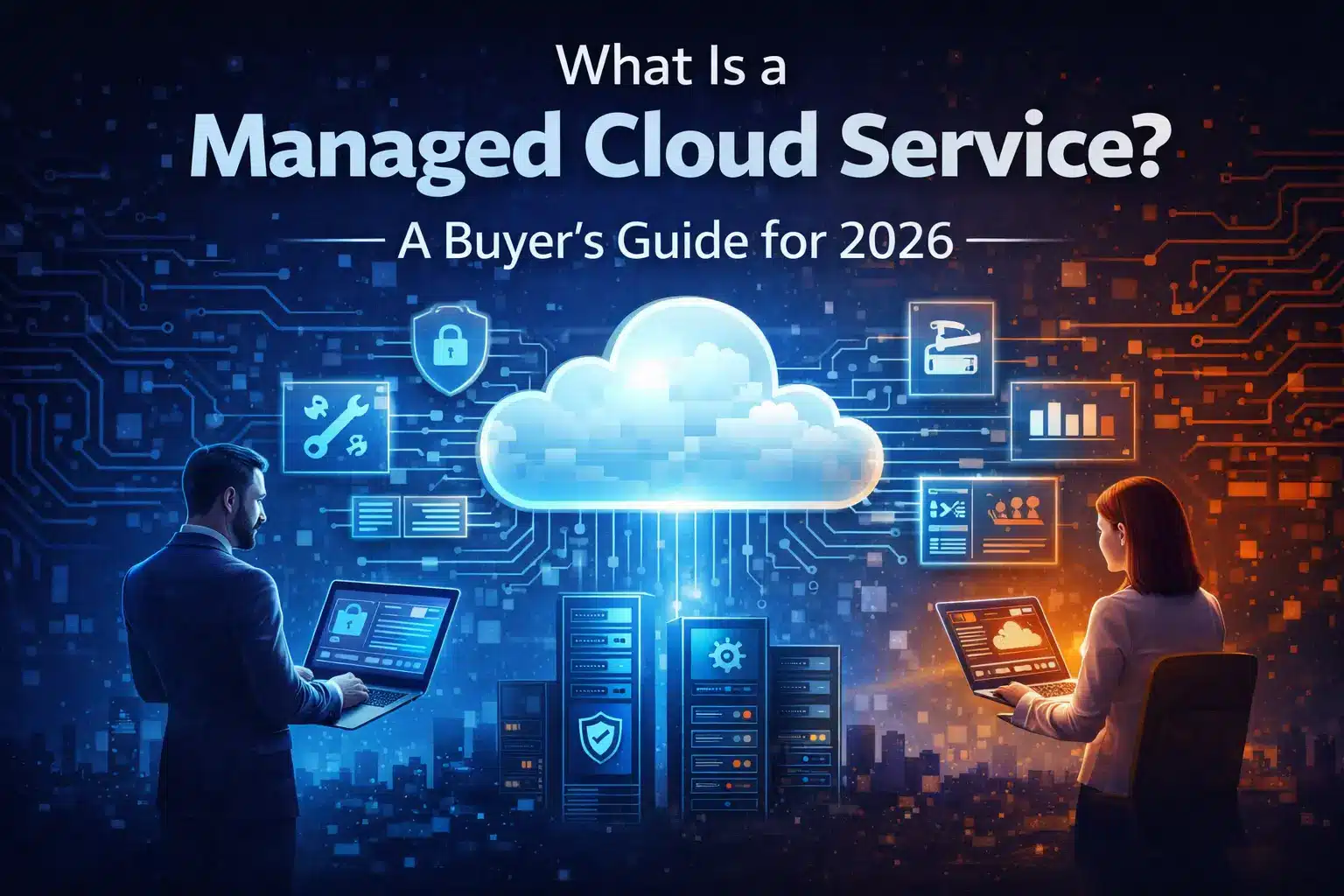
What Is a Managed Cloud Service? A Buyer’s Guide for 2026
If you are running production workloads, this question becomes about ownership pretty fast. Who monitors your infrastructure? Who patches it? Who secures it? And who fixes things when something breaks at 2 a.m.?
A managed model can reduce your operational load. But only if responsibilities, controls, and SLAs are written down and agreed upon, not assumed.
What it actually covers
A managed cloud service is a cloud offering where a provider operates part or all of your cloud environment, including monitoring, patching, backups, and incident response, under a defined scope and SLA.
You keep business ownership and key decisions. The provider handles the operational grind. Your team ships features and decides what the product does. The managed provider keeps the lights on, the nodes patched, and the alerts triaged.
What "day-to-day" typically means:
- 24/7 monitoring and on-call response so your engineers are not getting paged at 3 a.m. for a disk filling up
- OS and Kubernetes patching on a defined cadence, not whenever someone remembers
- Vulnerability management, including triage, remediation tracking, and exception handling
- Backup and restore, with actual tested recovery, not just a cron job nobody has verified in months
- Cost controls and right-sizing, because cloud bills have a way of growing faster than headcount
The exact bundle varies by provider and tier. Some cover only infrastructure. Others go deeper into platform operations, compliance, or even release support.
The important distinction: "managed" does not mean "hands-off." It means the work is shared under a contract.
Three layers of ownership you need to understand
To make this concrete, think about three layers:
1. Cloud provider (AWS, Azure, GCP): They own the physical data centers and the core cloud services. If an availability zone goes down, that is their problem. If you misconfigure a security group, that is yours.
2. Managed service provider: They own operational tasks on top of the cloud layer. Maintaining clusters, hardening configurations, handling incidents, running upgrades. The scope depends on what you negotiate.
3. Your internal team: You still own application code, business logic, data classification, and acceptance of risk. Nobody else should be making those decisions for you.
Here is a practical example: Your team runs a customer-facing API on Kubernetes. The managed provider patches nodes monthly, rotates certificates, monitors latency and error rates, and pages an engineer if SLOs breach. Your team ships features and decides when to change the API contract.
NIST put it plainly back in 2012, and it still holds: the client is responsible for understanding the risks and responsibilities associated with cloud computing (NIST SP 800-146). The goal is fewer surprises in production, not fewer decisions.
Why this market is exploding
This stopped being a niche service category a while ago.
The global managed services market hit roughly $380 billion in 2025, and multiple research firms project it will cross $1 trillion by the mid-2030s, growing at 12-15% annually. Cloud managed services specifically were valued at around $134-155 billion in 2024-2025, with a projected CAGR of 13-15% through 2030.
A few things are driving this:
- Hybrid and multi-cloud complexity: Over 91% of global enterprises now run multi-cloud or hybrid cloud setups. Managing that internally requires deep, specialized expertise that most teams simply do not have enough of.
- Security pressure: Managed security services (MSSP/MDR) are the fastest-growing segment at roughly 17.8% CAGR. Ransomware, compliance mandates, and the sheer volume of CVEs are more than most internal teams can absorb.
- Talent shortages: 65% of companies are now deploying AI-enhanced managed services partly because they cannot hire enough people with the right skills. The gap between what teams need to do and what they have bandwidth for keeps widening.
- The economics of downtime: Over 90% of mid-size and large enterprises report that a single hour of downtime costs more than $300,000. For financial services, the numbers can reach $5-7 million per hour during trading windows. When the cost of being down is that high, paying someone to keep things running around the clock starts making obvious sense.
Automation now handles about 38% of managed service delivery tasks, up from 22% in 2023, covering ticket routing, patch deployment, alerting, and basic remediation. The providers who invest in automation deliver faster, more consistent results.
Who this is for (and who it is not for)
Managed cloud services fit teams that have production workloads and limited ops bandwidth. They are especially useful when reliability and security requirements are growing faster than your headcount.
You should consider managed services if:
- Your DevOps or platform team spends more time on tickets, upgrades, and on-call rotations than on building things that matter
- Your SRE org wants to improve SLO compliance but your engineers are drowning in alert noise
- Your security team needs a consistent patching cadence, hardened configurations, and audit trails they can actually show to auditors
- Leadership wants predictable operational coverage and costs, not "it depends on who is available this sprint"
It may be a poor fit if:
- Your organization has deep customization requirements that no external provider can realistically support
- You have strict data residency constraints a vendor cannot meet
- You already run mature internal operations with strong automation, tooling, and staffing
A fintech with 99.95% availability targets and weekly releases might use managed Kubernetes operations to reduce upgrade risk. A hyperscale team with bespoke tooling and hundreds of engineers probably keeps operations in-house.
The deciding factor is usually this: Is operational toil blocking your roadmap delivery? If yes, you are probably a good candidate.
Must-have features (non-negotiables)
Must-have features define whether a managed cloud service is operationally safe. Not whether the pitch deck looks impressive.
Focus on scope clarity, security controls, reliability practices, and measurable outcomes. If a provider cannot show you runbooks, escalation paths, and evidence of past incident handling, you are buying uncertainty.
Here is how to prioritize:
What you absolutely need (must have)
- 24/7 monitoring and paging with defined time-to-acknowledge targets
- A documented incident process covering severity levels, communication templates, and post-incident reviews (RCAs)
- A patching policy that covers OS, Kubernetes, and managed databases, with a defined cadence and exception process
- A security baseline including IAM policies, network segmentation, and encryption defaults
- Backup and restore with tested RTO/RPO (tested being the operative word here. Backups nobody has ever restored from are not a strategy.)
What you should have
- Change management with maintenance windows, approval workflows, and emergency change rules
- Cost optimization and FinOps reporting so you are not surprised by a 40% cloud bill spike
- Infrastructure as Code support so changes are reviewable, repeatable, and version-controlled
What is nice to have
- Compliance mapping to SOC 2, ISO 27001, HIPAA, or whatever your audit cycle requires
- Multi-cloud coverage, if you run workloads across more than one provider
If the provider cannot commit to incident response and patching, stop the evaluation. Nothing else matters if those are missing.
Ownership boundaries matter more than you think
The number one source of friction between teams and managed providers is unclear ownership during incidents.
You want a written RACI that covers: monitoring, triage, remediation, postmortems, and changes.
Ask this question early: if the managed provider detects rising 5xx errors on your API, do they roll back your deployment, or do they just notify you? The answer needs to be documented per service. Not assumed. Not "we will figure it out when it happens."
On-call coverage should match your risk profile. "24/7" needs to mean something specific: time-to-acknowledge, escalation tiers, and how the provider communicates during an incident.
Ask for sample incident timelines and redacted postmortems. Look for disciplined process: clear severity definitions, stakeholder communication templates, and follow-up actions.
Security is shared, but accountability is not
Microsoft's own cloud guidance says it directly: security is a shared responsibility between you and the cloud provider. That is true for managed providers too.
What you need from them:
- Least privilege access with no standing admin credentials
- Multi-factor authentication is enforced for anyone touching production
- Secure key and secret handling (no keys in Slack channels, no shared passwords)
- Audited access logs showing who accessed what, when, and why
- Break-glass procedures for emergency access, with review after every use
Ask for audit-friendly evidence, not verbal assurances. If they cannot show you logs, access reports, and control documentation, the controls probably are not there.
Test your restores. Seriously.
This comes up in almost every post-incident review we have seen: the backups existed, but nobody had actually tested restoring from them. Everyone assumed it worked. It did not.
For a managed PostgreSQL setup, define your RPO (how many minutes of data loss you can tolerate) and your RTO (how quickly the service needs to be back). Then validate those numbers with quarterly drills.
Ask your provider:
- How often are restores tested?
- Which systems are covered by backups?
- Who executes restores during an actual incident?
- Can you see evidence from the last quarter's drill?
Nice-to-have features (after the basics are solid)
Once your foundation is reliable, these extras can make a real difference.
Golden paths and pre-configured Kubernetes clusters reduce time-to-first-deployment for new teams. SLO dashboards with alert tuning cut noise and improve signal. Policy-as-code catches misconfigurations before they reach production.
Deployment verification and rollback automation reduce release risk. And FinOps coaching helps you forecast cloud spend before the CFO starts asking pointed questions.
If a provider helps you set SLOs and error budgets, you will probably see fewer pages and better availability numbers within the first quarter. That is a concrete way to measure whether the extras are earning their cost.
Evaluation checklist
A structured evaluation keeps you from buying an SLA with hidden exclusions. Use this in discovery calls and in your written requirements.
If it is not in writing, it is not included.
- Scope: Which services are managed? Kubernetes? VMs? Databases? CI/CD pipelines?
- RACI: Who owns monitoring, patching, changes, and incident remediation?
- SLA/SLO: Response times, coverage hours, and excluded activities, all spelled out
- Security: IAM model, MFA requirements, break-glass process, access logging
- Change management: Maintenance windows, approval workflows, emergency change rules
- Backups/DR: RPO/RTO targets, restore test cadence, and who runs the drills
- Tooling: How do tickets, alerts, and runbooks integrate with your existing workflow?
- Reporting: Monthly ops reports, incident summaries, cost optimization findings
- Exit plan: Data portability, documentation handoff, and termination support
Here is a detail most people miss: if the provider handles Kubernetes patching, confirm whether that includes the control plane, worker nodes, and base images. Each has different risk profiles and timing requirements. Lumping them together leads to gaps.
Questions to ask vendors
Vendor conversations should force specificity. You are looking for operational maturity, not just a list of technical capabilities.
Ask for artifacts: runbooks, sample postmortems, and redacted reports.
The questions that matter
- What exactly is included in "managed," and what is excluded? (The answer to this question will tell you more than anything else in the sales process.)
- Walk me through how you handle an incident end-to-end, including stakeholder communication and the root cause analysis process.
- What is your patch cadence, and how do you handle emergency CVEs? (The answer should include specific timelines, not "as soon as possible.")
- Who has production access, how is it approved, and how is it logged?
- How do you test restores, and can we see evidence from last quarter?
- How will you measure success in the first 30, 60, and 90 days?
- What is the exit plan if we move operations back in-house?
If a vendor says "we handle upgrades," ask what happens when a Kubernetes upgrade fails. Do they roll back? Rebuild? Escalate? How long does that take? The answer reveals a lot about their actual operational depth.
Scoring vendors consistently
Use a weighted scoring approach so tradeoffs are visible:
| Criteria | Weight (1-5) |
|---|---|
| Incident response maturity | 5 |
| Security controls and access governance | 5 |
| Patching and vulnerability management | 4 |
| Backup/restore and DR readiness | 4 |
| Observability and alert quality | 3 |
| Change management discipline | 3 |
| Cost management capability | 3 |
| Documentation and transparency | 3 |
For each criterion, score the vendor 1-5 and document what evidence they provided. Ask these questions in live sessions, then require written follow-up.
Frequently asked questions
Is a managed cloud service the same as SaaS?
No. SaaS is an application you consume (think Slack or Salesforce). A managed cloud service is an operations model for infrastructure or platforms that live inside your cloud accounts. SaaS shifts the whole application. Managed services shift operational responsibilities.
What should be in a managed service SLA?
Response times, coverage hours, escalation rules, and how severity levels are defined. Also spell out exclusions: application code changes, major refactors, and third-party vendor outages are usually not covered. If those boundaries are not clear, you will find out during a crisis, which is the worst time to discover a gap.
Do managed cloud services reduce security risk?
They can, if baseline controls and evidence are built in from day one. If access governance is sloppy, patching is inconsistent, or logging is incomplete, risk actually goes up because now there is a third party with production access and weak controls. Ask for measurable controls and audit artifacts upfront.
How do we keep control if a provider operates our environment?
Three things: a clear RACI, change approval workflows, and visibility into all logs and tickets. Keep architecture decisions and risk acceptance with your internal team. Many organizations also require infrastructure as code with peer review for high-risk changes.
What is the fastest way to evaluate fit?
Run a 30-day pilot with real on-call coverage and at least one patch cycle. Measure response time, quality of communication, and change success rate. A pilot should include at least one planned change and one simulated incident. If the provider will not agree to a pilot, that tells you something.
If you want help scoping responsibilities and building an evaluation scorecard, talk to an expert at Obsium and align on outcomes before you sign anything.
Recent Posts
What Is a Managed Cloud Service? A Buyer’s Guide for 2026

SRE vs DevOps: what modern engineering leaders need to know

What Causes Downtime? 12 Common Reasons and how to Prevent them
Ready to Get Started?
Let's take your observability strategy to the next level with Obsium.
Contact Us