
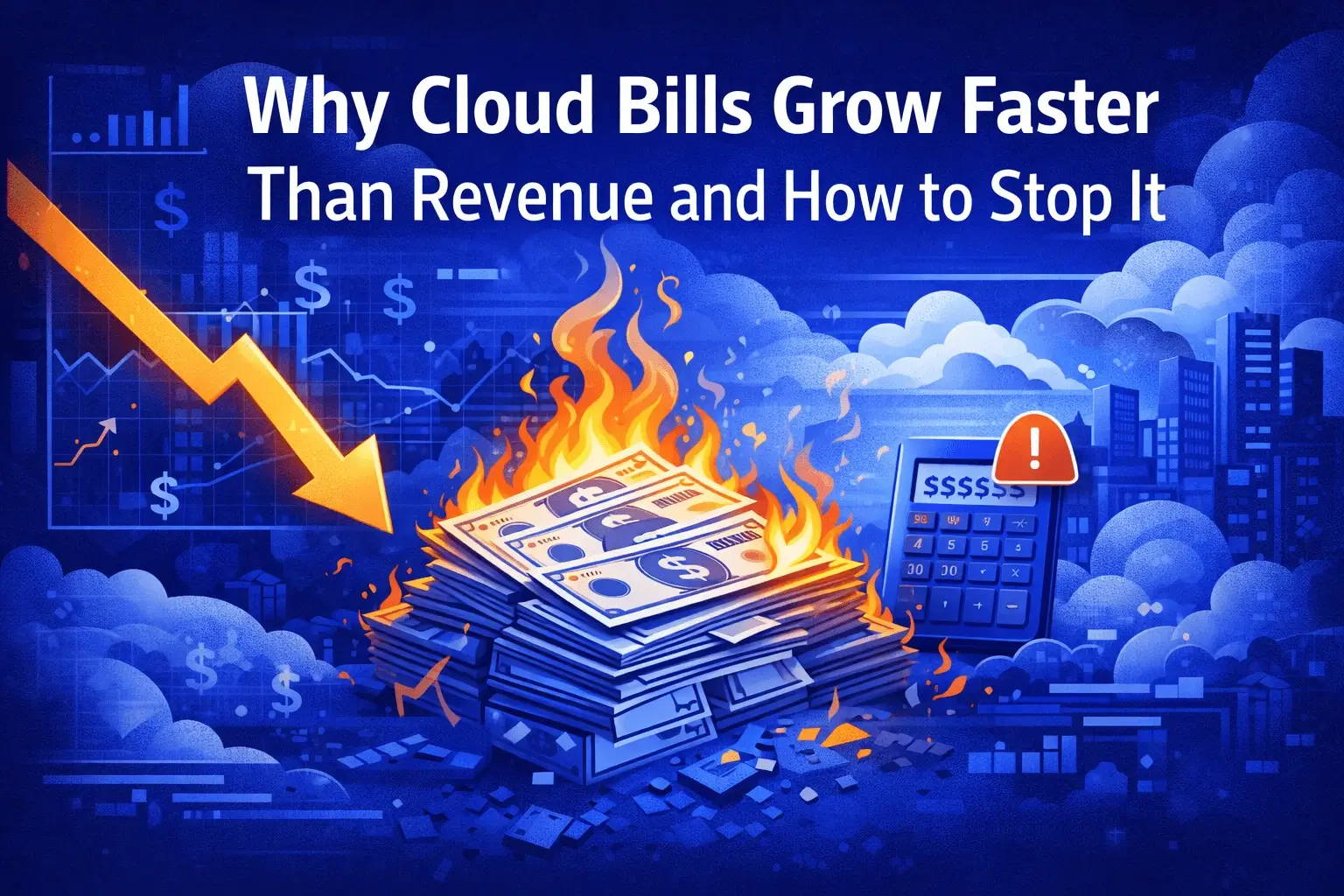
Why Cloud Bills Grow Faster Than Revenue and How to Stop It
You’re well into the fiscal year. Revenue is up 40 percent. The product roadmap is delivering. Customers are engaged. On the surface, everything looks healthy.
Then the CFO asks a simple question:
“Why did our cloud bill just double?”
You open the console. This month: $847,000. Last quarter: $420,000. The quarter before that: $310,000.
Revenue grew steadily. Cloud spend did not.
And when you try to explain the difference, the answers are vague. More traffic. More features. More scale. None of it accounts for the full jump. A large portion of the spend has no clear owner, no clear driver, and no obvious path back to business value.
This isn’t a cloud pricing issue.
It’s a visibility and accountability issue.
It shows up everywhere—from early-stage startups quietly burning runway on idle Kubernetes clusters to public companies watching margins erode as cloud becomes their second-largest expense after headcount.
The real question isn’t whether your cloud bill will grow.
It’s whether it grows intentionally, tied to revenue and outcomes, or accidentally, driven by complexity you can’t see.
The Illusion of "Pay as You Go"
“Pay as you go” was positioned as a direct response to the inefficiencies of on-prem infrastructure. No capacity planning cycles. No idle hardware. No capital tied up in assets you might never fully use.
In theory, it is an elegant model.
In practice, it works well only at small scale.
Early cloud environments are simple. A limited number of compute instances, a managed database, basic storage. Usage patterns are predictable. Costs are easy to reason about. Engineering teams move quickly, and cloud spend remains proportionate to business activity.
As systems grow, that relationship breaks down.
Autoscaling introduces variability that is rarely constrained by cost. Managed services remove operational burden but obscure how pricing accumulates. Supporting services—monitoring, logging, data transfer, networking—are added incrementally, often without a clear understanding of their long-term impact.
Each decision is rational in isolation. Collectively, they create a cost structure that is difficult to interpret and harder to control.
A database instance that appears inexpensive on paper can multiply in cost once backups, replicas, and performance configurations are applied. A Kubernetes cluster intended to improve efficiency can exceed five figures per month when observability, redundancy, and always-on capacity are layered in.
The issue is not misuse.
The issue is that cloud pricing does not scale linearly with usage. It scales with architectural complexity.
And architectural complexity is an unavoidable consequence of growth.
This is where teams working with Obsium tend to recalibrate. By tying cost signals directly to architecture, performance, and real usage patterns, cloud spend becomes an engineering input rather than a billing surprise.
The Real Reasons Cloud Costs Outpace Revenue
Most leaders assume cloud costs grow because usage grows. That's only part of the story. The real drivers are structural—baked into how engineering teams operate, how infrastructure gets provisioned, and how accountability gets diffused across the organization.
1. Overprovisioned Compute and Idle Resources
Engineers provision for peak load, not average load. A service that sees 1,000 requests per second at peak gets sized for 1,500 "just in case." Multiply that across dozens of services and you're paying for 30-50% more capacity than you actually use.
Worse, teams rarely revisit these decisions. An instance type chosen two years ago when traffic patterns were different stays in place because "if it's not broken, don't fix it." Meanwhile, you're running last-gen compute at premium pricing when newer instance families would deliver better performance for half the cost.
2. Storage Sprawl and Forgotten Data
Storage is cheap until it isn't. S3 buckets accumulate years of logs no one reads. Snapshots from long-deleted EC2 instances pile up. Development databases get cloned for debugging and never destroyed.
One company I worked with discovered 340TB of data in S3 that hadn't been accessed in over a year. The monthly bill for storing it? $8,000. The business value? Zero. No one knew it existed until we audited every bucket.
3. Lack of Ownership Across Teams
In traditional IT, someone owned the budget. In cloud environments, ownership is diffused. The platform team provisions infrastructure. Product teams deploy services. The finance team sees the bill. No one feels individually responsible.
This creates a tragedy of the commons. Every team optimizes for their own velocity. No one optimizes for collective spend. A new feature gets shipped with database queries that scan full tables instead of using indexes. No one notices until the RDS bill triples.
4. Poor Observability Into Cost Drivers
Most teams can tell you their application's latency, error rate, and throughput. Few can tell you what each service costs to run, which features drive the most infrastructure spend, or how much a single customer transaction costs in cloud resources.
Without cost observability, optimization is guesswork. You implement caching to reduce database load, but you don't know if it reduced spend by $100 or $10,000. You migrate to serverless to save money, but you don't instrument whether Lambda invocations are costing more than the EC2 instances you replaced.
5. Engineering Speed Rewarded, Efficiency Ignored
Engineering cultures optimize for shipping. That's generally good—velocity matters. But when cost efficiency isn't part of the engineering conversation, it gets treated as someone else's problem.
Developers get rewarded for launching features fast, not for launching them cost-effectively. A service that could run on three optimized instances gets deployed on ten because no one checked. There's no pull request review for "is this the right instance type?" or "could this workload run in spot instances?"
6. Dev and Test Environments Running 24/7
Production infrastructure needs to run continuously. Development and staging environments do not. Yet most companies run dev, staging, and QA environments around the clock, even though they're only actively used 40 hours a week.
Shutting down non-prod environments outside business hours can cut 60-70% of their cost. But it requires automation, discipline, and a willingness to tolerate a five-minute startup delay when engineers arrive Monday morning. Most teams choose convenience over savings.
7. Microservices and Kubernetes Cost Explosion Without Guardrails
Microservices and Kubernetes promised operational efficiency. They delivered architectural flexibility at the cost of infrastructure complexity.
Every microservice needs compute, memory, storage, networking, observability, and redundancy. A monolith running on five instances becomes twenty microservices running on eighty. Each service gets its own database, its own cache layer, its own message queue.
Kubernetes amplifies this. Pods request CPU and memory limits. Without proper resource tuning, teams over-request to avoid throttling. A cluster provisioned for 100 cores ends up using 40. You're paying for 60 cores of idle capacity.
Add in service mesh overhead, monitoring agents, logging collectors, and redundant control planes, and your Kubernetes bill can eclipse the actual application workload it's orchestrating.
Why Traditional Cost Controls Fail?
Finance teams try to impose control in the same way they manage other expenses: budgets, monthly reviews, and alerts when spending crosses thresholds.
It doesn't work.
Cloud infrastructure changes too fast for monthly budget cycles. By the time finance sees last month's overage, engineering has already deployed three new services and spun up two new environments.
Budget alerts don't prevent waste—they just tell you waste happened. An alert fires when spending hits 80% of budget. Then what? You can't shut down production. You can't roll back deployments without business impact. The alert becomes noise.
Cost reports arrive too late and too aggregated to drive action. A line item showing "$45,000 in EC2 spend" tells you nothing about which teams, services, or workloads drove it. Without granular attribution, optimization is random—you guess where to cut instead of knowing where to optimize.
Worse, when finance owns cost management, engineering sees it as a constraint, not a responsibility. Cost becomes a finance problem, not an engineering discipline. And finance can't optimize what they don't understand at a technical level.
Cloud Cost Is an Engineering Problem, Not a Finance Problem
The fundamental insight most companies miss: cloud cost is an architecture and product decision, not a financial one.
Every line of code has a cost. Every database query, every API call, every background job consumes compute, memory, and network resources. The decisions that drive cloud spend happen in pull requests, architecture reviews, and product roadmaps—not in budget spreadsheets.
Finance can track it. Only engineering can control it.
The companies that run efficient cloud infrastructure treat cost the same way they treat performance, reliability, and security—as a first-class engineering metric that gets instrumented, monitored, and optimized continuously.
They don't ask "how do we reduce our AWS bill?" They ask "what are we building, how much does it cost to run, and is that cost justified by the value it delivers?"
This shift in mindset is what separates companies that scale efficiently from those that scale expensively.
How High-Performing Teams Stop Cloud Cost Bleed
Stopping cloud cost bleed isn't about slashing budgets or cutting features. It's about building the systems, culture, and practices that make cost efficiency a natural outcome of good engineering.
Here's the playbook high-performing teams use:
1. Cost Visibility Mapped to Services, Teams, and Business Outcomes
You can't optimize what you can't see. The first step is making cost visible at the level where decisions get made.
Tag every resource with its owning team, service, environment, and cost center. Build dashboards that show not just total spend, but spend per service, per feature, per customer cohort. Make it easy for any engineer to answer: "How much does this service cost to run?" and "Did that optimization actually reduce spend?"
When cost is invisible, optimization is impossible. When cost is visible, it becomes actionable.
2. Rightsizing Based on Real Usage, Not Assumptions
Most infrastructure is overprovisioned because teams guess instead of measure. An engineer provisions a 4xlarge instance because "we might need the capacity." Six months later, CPU utilization averages 15%.
Rightsizing means matching resources to actual demand. Use real telemetry—CPU, memory, disk I/O, network throughput—to size instances appropriately. Start conservatively, measure, and scale up if needed. It's easier to add capacity than to justify removing it.
This applies to databases, caches, message queues, and storage tiers. Are you paying for 10,000 IOPS when your workload uses 2,000? Are you running production-grade RDS instances for development databases? Rightsizing isn't one-time—it's a continuous discipline as workloads change.
3. Turning Off What's Not Used—Automatically
Manual cleanup doesn't scale. Relying on engineers to remember to shut down test environments, delete old snapshots, or remove unused load balancers guarantees waste.
Automate it. Schedule non-production environments to shut down nights and weekends. Set lifecycle policies that archive old logs to cheaper storage tiers and delete them after retention periods expire. Build tooling that identifies orphaned resources—unattached EBS volumes, unused elastic IPs, abandoned load balancers—and flags them for deletion.
The goal isn't to police engineers. It's to make the default behavior cost-efficient without requiring constant vigilance.
4. Using SLOs and Performance Metrics to Guide Spend
Not all workloads need five-nines uptime. Not all services need sub-100ms latency. Yet teams often provision as if they do because it feels safer.
Define service-level objectives for reliability, latency, and availability, then provision to meet those SLOs—not exceed them. If your SLO allows for occasional degradation during traffic spikes, you don't need to overprovision for the 99.9th percentile.
This creates a forcing function: either justify the cost with a business requirement, or accept lower SLOs and reduce spend. A batch processing job that runs overnight doesn't need the same infrastructure as a customer-facing API. Treat them differently.
5. Treating Cost as a First-Class Engineering Metric
What gets measured gets managed. If latency, error rate, and throughput are on every team's dashboard, cost should be too.
Surface cost metrics in the same tools engineers already use. Show cost per deployment in CI/CD pipelines. Display cost trends in service dashboards alongside performance metrics. Make it trivial for any engineer to see how their changes affect infrastructure spend.
When cost is a number in a finance spreadsheet, it's abstract. When it's a graph next to latency and error rate, it becomes real.
6. Continuous Optimization Instead of One-Time Cleanup
Most companies approach cost optimization as a project. The CFO declares a cost-cutting initiative, engineering scrambles to find savings, the bill drops for two months, then gradually creeps back up.
That's not optimization. That's temporary damage control.
Real optimization is continuous. It's baked into architecture reviews, pull request checklists, and post-deployment analysis. It's a standing agenda item in engineering all-hands. It's part of oncall runbooks—when an incident reveals inefficient resource usage, the fix gets prioritized alongside the reliability improvement.
Optimization shouldn't be an emergency response to a budget crisis. It should be how you operate.
From Cloud Chaos to Controlled Scale
The companies that master cloud economics don't have smaller bills than their peers. They have predictable bills. They know what they're spending, why they're spending it, and whether it's worth it.
When revenue grows 40%, their cloud spend grows 40%—not 100%. When they launch a new product, they can forecast its infrastructure cost before writing the first line of code. When an executive asks "can we afford to scale this?" they have data, not guesses.
This level of control doesn't happen by accident. It happens when:
Cost visibility is as good as performance observability. Every team knows what their services cost, and cost trends are monitored like uptime and latency.
Engineering owns cost, not just finance. Developers understand that every architectural decision is a cost decision, and they have the tools and incentives to make good ones.
Optimization is continuous, not episodic. Rightsizing, cleanup, and efficiency improvements are part of regular operations, not emergency firefighting.
Infrastructure is provisioned based on data, not assumptions. Resources are sized to actual usage and SLOs, not over-provisioned for hypothetical scenarios.
Waste gets eliminated automatically. Unused resources, idle environments, and forgotten storage don't accumulate—they get cleaned up by policy and automation.
The result? Cloud spend aligns with business outcomes. You scale confidently. You ship fast without bleeding money. You sleep better knowing that if revenue slows, cloud costs slow with it.
The Bottom Line
Cloud doesn’t have to be expensive.
Unmanaged cloud is.
Cloud was never guaranteed to be cheaper than on-prem. It was designed to give you speed, flexibility, and leverage. Whether it’s economical depends entirely on how intentionally you design and operate it.
Most companies treat cloud cost as a side effect of growth. The best teams treat it as a design constraint—one that leads to better architecture, clearer ownership, and smarter engineering decisions.
This is where Obsium comes in.
Not to chase invoices or negotiate discounts, but to help leadership and engineering teams:
- See what’s really driving cloud spend
- Connect cost to services, performance, and outcomes
- Build systems that scale efficiently, not blindly
The winners in the cloud era won’t be the teams with the biggest budgets.
They’ll be the ones with visibility, ownership, and discipline.
Your cloud bill will grow.
The only question is whether it grows intentionally—aligned with revenue and value—or chaotically, driven by invisible waste.
You decide which story your CFO hears next quarter.
Recent Posts
What Is a Managed Cloud Service? A Buyer’s Guide for 2026

SRE vs DevOps: what modern engineering leaders need to know

What Causes Downtime? 12 Common Reasons and how to Prevent them
Ready to Get Started?
Let's take your observability strategy to the next level with Obsium.
Contact Us