
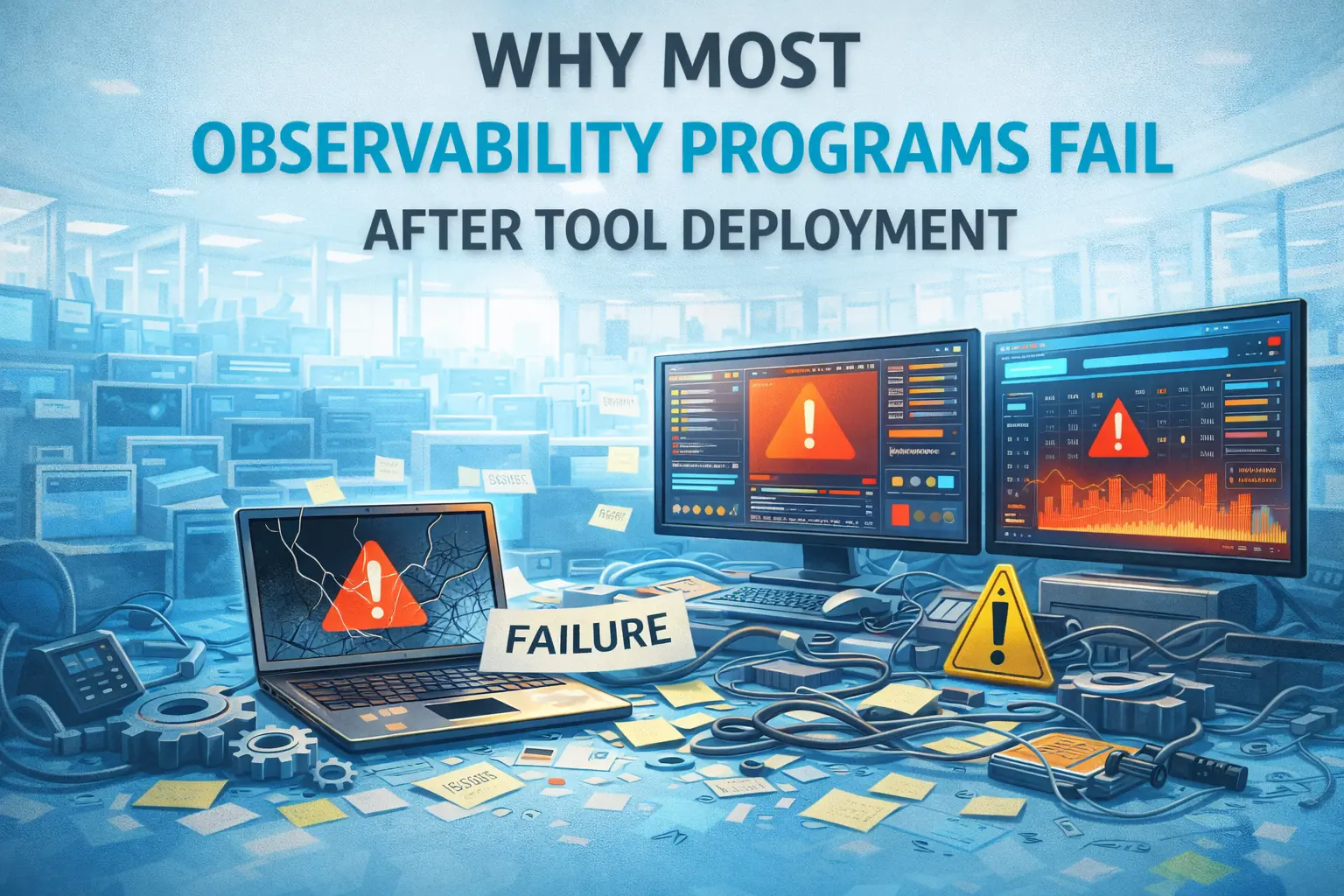
Why Most Observability Programs Fail After Tool Deployment
The observability rollout went smoothly. Prometheus is scraping metrics, Grafana dashboards are live, logs are flowing into your stack. Six months later, engineers still can't explain why the checkout page is slow—and on-call rotations have become a nightmare of ignored alerts.
Most observability programs fail not because the tools are bad, but because teams treat tool deployment as the finish line rather than the starting point. What follows explores the specific failure patterns that derail observability initiatives after rollout, from data hoarding and alert fatigue to missing expertise and Kubernetes complexity, along with practical steps to turn a struggling program around.
Why Deploying Observability Tools Does Not Equal Observability
Observability programs often fail post-rollout because organizations prioritize tool installation over cultural adoption. The result is overwhelming, disconnected data rather than actionable insights. Teams deploy Prometheus, Grafana, Datadog, or Splunk expecting instant visibility, then discover that having tools installed is fundamentally different from having observability.
So what's the actual difference? Observability is the ability to understand a system's internal state from its external outputs. More importantly, it's the ability to ask new questions about system behavior without deploying new code. Monitoring, on the other hand, tracks known failure modes with predefined alerts and thresholds. Tool deployment is simply installing software without operationalizing it.
Tools are infrastructure, not outcomes. A Kubernetes cluster running a full observability stack can still leave teams blind during incidents if no one has instrumented the application properly, correlated signals across services, or built workflows that surface the right information at the right time.
Mistaking Data Collection for Actionable Insight
One of the most common observability failures looks like this: hundreds of metrics, dozens of dashboards, terabytes of logs—and engineers still can't explain why the checkout page is slow. Teams confuse collecting telemetry with gaining understanding, and the gap between data volume and actual insight grows wider over time.
The Just in Case Data Hoarding Problem
Teams often log everything "just in case" without defining what actually matters. This approach creates what practitioners call "data swamps"—massive volumes of telemetry that make debugging feel like archaeology rather than analysis.
The usual culprits include verbose debug logs left enabled in production, custom metrics that no one queries, and traces sampled so aggressively they miss the interesting requests. Storage costs climb while signal quality declines, and the team ends up with more data but less understanding.
Dashboards That Nobody Uses During Incidents
Building dashboards during calm periods is easy. Building dashboards that actually help during a 3 AM outage is hard.
We regularly see teams with beautiful Grafana setups that go completely unused when incidents occur. The dashboards show symptoms—high latency, elevated error rates—without pointing to root causes. Engineers fall back to ad-hoc queries and tribal knowledge instead, which defeats the purpose of having dashboards in the first place.
When More Signals Create More Noise
Additional telemetry sources without proper correlation make troubleshooting harder, not easier. Teams end up with metrics in Prometheus, logs in Elasticsearch, and traces in Jaeger—three separate tools with no easy way to jump between them.
| Data Collection Approach | Outcome |
|---|---|
| Collect everything without filtering | High cost, slow queries, no clarity |
| Collect only infrastructure metrics | Missing application-level context |
| Collect with intent and correlation | Faster root cause analysis, lower noise |
Treating Observability Like Traditional Monitoring
Many teams apply legacy monitoring practices to modern observability tools, which undermines their value entirely. This happens when organizations upgrade their tooling without upgrading their thinking about what observability actually enables.
1. Threshold Alerts Instead of Intelligent Detection
Static thresholds like "alert when CPU exceeds 80%" miss real issues and trigger frequent false positives. A service might run perfectly fine at 85% CPU during peak hours, while a subtle memory leak at 40% CPU slowly degrades user experience.
Modern observability supports anomaly detection and intelligent alerting that identifies meaningful deviations from baseline behavior. Yet most teams never configure these capabilities, defaulting to the same threshold-based alerts they used a decade ago.
2. Infrastructure Metrics Without Application Context
Server-level metrics—CPU, memory, disk, network—fail to explain user-facing issues. Knowing that a pod is healthy tells you nothing about whether users can complete purchases or load their dashboards.
True observability requires application traces and business context. A trace showing that payment processing takes 4 seconds because of a downstream API timeout is infinitely more useful than a dashboard showing all systems green.
3. Reactive Troubleshooting Instead of Proactive Discovery
The most common failure pattern is only opening observability tools after an incident is reported. Teams treat their observability stack like a fire extinguisher—something to grab in emergencies rather than a continuous feedback loop.
Mature observability practices surface performance degradation before customers notice. This requires proactive exploration of telemetry data, not just reactive investigation after something breaks.
Alert Fatigue Erodes Trust in Observability Systems
Poorly configured alerting destroys team confidence faster than almost anything else. When alerts are consistently ignored, real incidents get missed—and the entire observability investment loses credibility with the people who are supposed to rely on it.
1. Why Teams Start Ignoring Alerts After Rollout
The cycle is predictable: too many alerts lead to alert fatigue, which causes teams to mute channels, which results in missed incidents. On-call engineers develop a psychological numbness to notifications that makes the entire system less effective.
We've seen teams with Slack channels receiving hundreds of alerts daily. At that volume, no human can distinguish signal from noise. The rational response is to stop paying attention, which is exactly the opposite of what observability is supposed to enable.
2. The Cost of False Positives and Alert Storms
False positives waste engineering time and create noise that obscures genuine problems. During cascading failures, a single root cause can trigger dozens of separate alerts, overwhelming responders at exactly the moment they need clarity.
One misconfigured alert that fires every five minutes costs more than just annoyance—it trains the team to distrust the entire alerting system. That distrust is hard to reverse.
3. How Noise Masks Real Incidents
Legitimate critical alerts get lost in floods of low-priority or duplicate notifications. A genuine database outage alert buried among 50 "disk space warning" notifications delays incident response and increases customer impact.
Common causes of alert fatigue include:
- Overly sensitive thresholds: Alerts fire for normal variance in system behavior
- No alert grouping: A single root cause triggers dozens of separate notifications
- Missing runbooks: Alerts lack context or instructions for triage
- No ownership: Alerts route to generic channels with no accountable responder
Teams Lack Expertise to Operationalize Observability Tools
Observability tools require specialized skills that most teams don't have. Installing Prometheus is straightforward; instrumenting a distributed system to produce meaningful telemetry is not.
1. Instrumentation Skills Most Teams Do Not Have
Adding meaningful telemetry requires knowledge of distributed tracing concepts, span context propagation, cardinality management, and frameworks like OpenTelemetry. Most developers have never been trained in these areas, and the learning curve is steep.
The result is instrumentation that captures the easy stuff—HTTP request counts, basic latency histograms—while missing the hard stuff that actually explains system behavior during failures.
2. No Dedicated Ownership for Observability Practices
Observability often becomes "everyone's job and no one's job." Without clear ownership, practices degrade over time. Dashboards go stale, alert configurations drift, and new services launch without proper instrumentation.
Teams that succeed typically have either a dedicated observability team or embedded SRE practices that make observability a first-class concern rather than an afterthought.
3. Time Constraints Force Reactive Approaches
Under pressure to deliver features, teams add telemetry only after an incident occurs. They're always instrumenting after the fire rather than building observability into the development lifecycle from the start.
This reactive approach guarantees that the next novel failure mode will be just as opaque as the last one.
Kubernetes and Multi-Cloud Complexity Overwhelms Generic Tooling
Kubernetes and multi-cloud environments require specialized observability approaches that generic, host-based tools don't provide out of the box. The dynamic nature of container orchestration breaks assumptions that traditional monitoring tools were built on.
Why Standard Observability Fails in Distributed Systems
Distributed architectures introduce challenges that traditional monitoring never anticipated: tracing requests across dozens of services, understanding complex dependency graphs, and correlating events across different clusters and cloud providers.
A request that touches fifteen microservices across three availability zones requires observability tooling designed for that reality, not tools designed for static server environments.
Missing Correlation Across Services and Clusters
Connecting metrics from one service to traces in another and logs in a third is extremely difficult without unified tooling. Without correlation, troubleshooting becomes guesswork—engineers manually piece together timelines from disconnected data sources.
Ephemeral Workloads Break Traditional Monitoring Approaches
Short-lived pods, auto-scaling, and dynamic IPs invalidate traditional monitoring assumptions about stable hosts and persistent identities. A pod that exists for thirty seconds and then disappears can't be tracked with approaches designed for long-running servers.
Kubernetes observability requires:
- Pod-level metrics: Resource consumption, restart counts, readiness state
- Service mesh telemetry: Request rates, error rates, latency between services
- Cluster events: Deployments, scaling events, node conditions
- Distributed traces: End-to-end request flow across microservices
Observability Becomes a Project Instead of a Discipline
Observability fails when treated as a one-time deployment project rather than an ongoing operational discipline. The initial rollout is just the beginning, not the finish line.
Tool Deployment Without Process Change
Organizations deploy powerful tools but fail to change their incident response workflows, on-call practices, or development habits. The tool sits unused because no one has integrated it into how work actually gets done day to day.
Vendor Promises Create Unrealistic Expectations
Marketing that promises "AI-powered automatic insights" leads teams to expect magic. When reality doesn't match the hype, disillusionment sets in and tools get abandoned before they've had a chance to prove their value.
How Observability Regresses Without Ongoing Investment
Observability coverage decays without continuous investment. Dashboards go stale as services evolve, alerts become outdated as traffic patterns change, and new services launch without instrumentation.
Six months after rollout, many observability programs have regressed to a state worse than before—now with expensive tooling that no one trusts.
How to Fix a Failing Observability Program
For teams recognizing their program has failed post-rollout, recovery is possible with focused effort and clear priorities.
Audit Your Current Instrumentation and Signal Quality
Start by evaluating what telemetry currently exists, what's missing, and what's just noise. Identify the top business-critical services that lack traces or meaningful metrics.
A practical audit covers:
- Services with no distributed tracing
- Alert history patterns showing frequent false positives
- Dashboard usage analytics during recent incidents
- Custom metrics inventory and actual query frequency
Implement Smart Alerting to Reduce Noise
Alert consolidation, anomaly-based detection, and intelligent routing rules reduce alert volume while maintaining critical coverage. Grouping related alerts and correlating signals transforms alerting from a burden into a useful signal that teams actually trust.
Consider Managed Observability for Capability Gaps
Outsourcing observability operations makes sense for teams lacking 24/7 coverage, specialized expertise, or bandwidth for continuous refinement. This allows engineering to focus on core product development while experts handle operational monitoring.
Ready to fix your observability program? Contact Obsium for an observability assessment or to explore managed monitoring services.
Building Observability That Delivers Reliability and Speed
True observability requires partnership, not just tooling. The path from a failed rollout to operational confidence combines AI-driven insights, unified dashboards that correlate metrics, logs, and traces, smart alerting that reduces noise, and often 24/7 managed monitoring to fill capability gaps.
At Obsium, we help teams move from reactive operations to confident, measurable performance by pairing deep infrastructure expertise with practical automation and monitoring practices. The goal isn't more dashboards—it's faster issue resolution, fewer incidents, and systems that scale with confidence.

Ready to Get Started?
Let's take your observability strategy to the next level with Obsium.
Contact Us