

Most cloud comparison posts read like spec sheets. They list 200 services side by side and tell you, “It depends.” Not very useful when you’re a 15-person startup picking a cloud provider that you’ll still be paying for (and locked into) when you’re a 500-person company.
We’ve helped startups and mid-sized companies architect their cloud infrastructure, migrate between providers, and untangle the mess that comes from picking the wrong one early. This is what we wish someone had told us when we started.
The quick answer
If you want the short version:
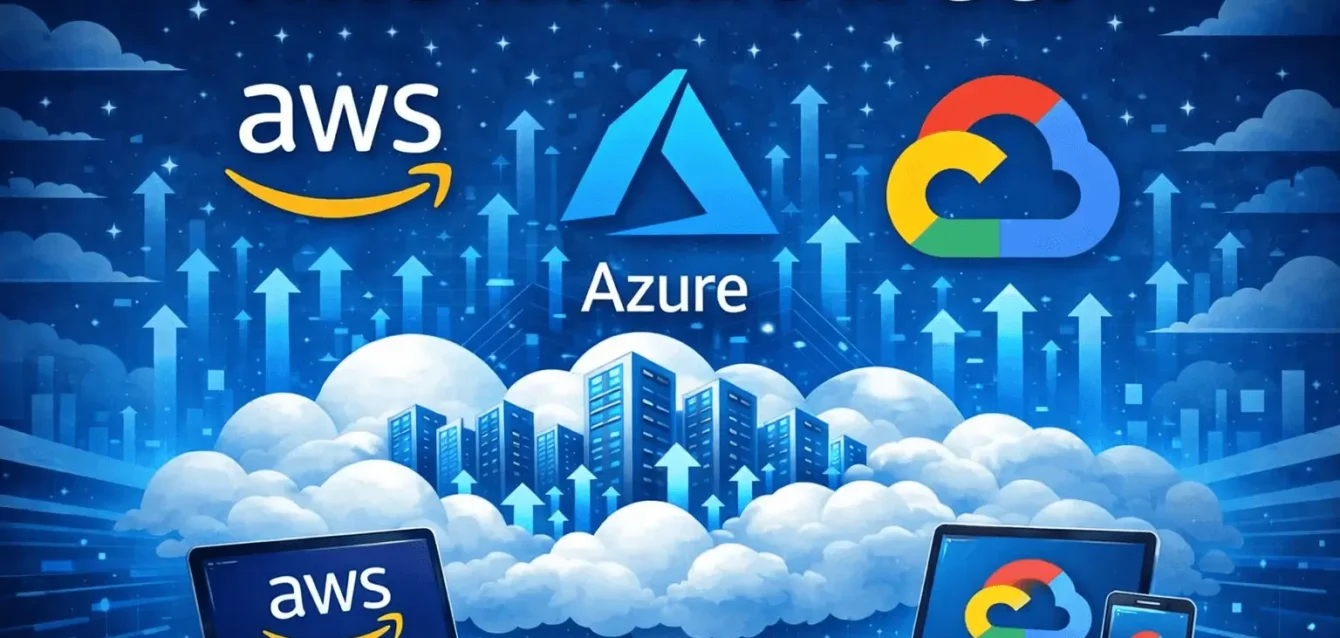
- AWS has the most services, the biggest hiring pool, and the most mature ecosystem. It’s the safe pick that nobody gets fired for choosing. It’s also the easiest to overspend on.
- Azure wins if your company already runs on Microsoft (Office 365, Active Directory, .NET). 85% of Fortune 500 companies use Azure, mostly because of this. If you’re not a Microsoft shop, Azure’s advantages shrink fast.
- GCP is the strongest for data, analytics, and Kubernetes. Google built Kubernetes, and it shows. GKE is still the best managed Kubernetes experience. GCP is also typically 5-10% cheaper on compute.
All three work. The question is which one fits your team, your customers, and the kind of company you’re building.
Market share tells you something useful
Not about which provider is “best,” but about which one will be easiest to hire for and find community support.
| Provider | Market share (Q4 2025) | Annual revenue | Growth rate |
| AWS | ~30% | ~$115 billion | ~18% YoY |
| Azure | ~24% | ~$100 billion | ~25% YoY |
| GCP | ~12% | ~$44 billion | ~28% YoY |
AWS has the most certified engineers in the job market. If you’re a startup in Bangalore or San Francisco, you’ll find 3x more AWS-experienced candidates than GCP ones. That matters when you’re hiring your second or third infrastructure person.
Azure is closing the gap fast, especially in enterprises. GCP is growing fastest in percentage terms but from a smaller base. Its community is strong in data engineering and ML circles.
Startup credits: free money with strings attached
All three providers hand out credits to startups. The amounts have changed recently.
AWS Activate: $1,000 self-serve, up to $100,000 if you’re backed by an accelerator or VC. AI-focused startups can get up to $300,000 in 2026.
Google for Startups: $100,000 to $200,000 in credits over 2 years. AI startups can get up to $350,000. The most generous of the three for most companies.
Microsoft for Startups: Recently got stingier. Unfunded startups now get just $5,000. Investor-backed startups can access $100,000 through the new Investor Network track.
These credits are great for the first 12-18 months. The problem is what happens after. You’ve built everything on provider-specific services during your free period, and now you’re paying full price with switching costs that make the move feel impossible.
We had a client who burned through $200K in GCP credits over 14 months, used BigQuery and Cloud Functions everywhere, and then discovered their post-credits bill would be $28K/month. Switching providers at that point would have cost more than a year of the bill.
Pick the cloud you’d still choose if the credits were zero.
How they compare where it actually matters
Compute pricing
The per-hour rates are close enough that they rarely decide the outcome. What matters more is how each provider discounts.
- AWS has Reserved Instances (1 or 3 year commit) and Savings Plans. Discounts of 30-60%, but you’re committing to specific instance families or regions. AWS also has Spot instances with steep discounts, but prices fluctuate, with an average of 197 distinct price changes per month across instance types.
- Azure has Reserved VM Instances with similar discounts. Spot VMs offer up to 80% off. If you’re running .NET workloads, Azure often has better price/performance because of optimizations for their own runtime.
- GCP automatically applies Sustained Use Discounts (up to 30%) without any commitment. You just run instances and the discount appears. Committed Use Discounts go deeper (up to 57%). Custom machine types let you pick exact vCPU and RAM combinations instead of fitting into predefined sizes.
GCP’s sustained use discounts are an underrated advantage for startups. You don’t have to predict your usage a year out. You just pay less the more you use.
Kubernetes
If you’re running containers at scale, this might be the most important comparison.
GKE (Google): The original managed Kubernetes. Autopilot mode handles node management entirely. One free zonal cluster. Google literally invented Kubernetes, and GKE gets features first.
EKS (AWS): $0.10/hour per cluster ($73/month) for the control plane before a single pod runs. The largest ecosystem of add-ons and integrations. Most third-party tools are tested on EKS first because of AWS’s market share.
AKS (Azure): Free control plane on the standard tier. That’s a real advantage if you’re running multiple clusters. A 10-team engineering org with 40 clusters pays $2,920/month in control plane fees on EKS. On AKS, that’s $0.
If Kubernetes is your primary platform, GKE is the smoothest experience and GCP tends to be cheaper on compute. AKS makes more financial sense if you’re running dozens of clusters. EKS wins on ecosystem breadth, which matters when you’re integrating with 15 other AWS services.
Data and analytics
This is where GCP pulls ahead by a wide margin. BigQuery is still the best serverless data warehouse, and it’s not particularly close. If your startup is data-heavy or ML-heavy, GCP is hard to argue against.
AWS has Redshift, Athena, and a massive collection of data services. They work, but they feel more assembled from parts than designed as a system.
Azure Synapse Analytics is improving, and if you’re already in the Power BI / Microsoft data ecosystem, it integrates well. But if you’re building a modern data stack from scratch, GCP or AWS are stronger choices.
Enterprise identity and compliance
85% of Fortune 500 companies use Azure. The reason isn’t that Azure VMs are better. It’s Active Directory. If your customers or your own company runs on Microsoft 365, Entra ID (formerly Active Directory), SharePoint, and Teams, then Azure gives you native integration that AWS and GCP can only approximate through federation.
For startups selling to enterprises, this matters. If your customers’ IT departments are Microsoft shops, running on Azure reduces friction in security reviews and procurement. We’ve seen deals close faster because the startup was on Azure and could integrate with the customer’s Entra ID without extra work.
AWS has IAM, and it’s mature and flexible, but it requires more configuration. GCP’s IAM is simpler and developer-friendly, but can feel limiting when you need complex governance at enterprise scale.
The lock-in problem nobody talks about early enough
Every provider has proprietary services that make your life easier today and your migration harder later.
AWS lock-in points: Lambda, DynamoDB, Aurora, SQS, SNS, CloudFormation. Once your architecture depends on three or four of these, you’re committed.
Azure lock-in points: Cosmos DB, Azure Functions, Azure DevOps, Logic Apps. Plus the Active Directory dependency itself.
GCP lock-in points: BigQuery, Cloud Spanner, Vertex AI, Cloud Functions. BigQuery especially, because once your entire analytics pipeline runs on it, rebuilding elsewhere is a 6-month project.
Cloud migration between providers costs $100,000-$200,000 for a moderate setup, according to 2026 estimates. Moving petabytes of data out of any provider is a six-figure exercise in egress fees alone.
The mitigation strategy: use managed Kubernetes (works on all three), containerize everything, use Terraform or Pulumi for infrastructure as code, and be deliberate about which proprietary services you adopt. Every provider-specific service you add is a brick in the wall between you and the exit door.
Egress fees: the cost you forget until it hurts
Data transfer out of any cloud provider costs money. How much depends on which one.
| Transfer type | AWS | Azure | GCP |
| First 100 GB/month | Free | Free | Free |
| Egress per GB (first 1-10 TB) | $0.09 | $0.087 | $0.12 |
| Cross-region replication (per GB) | $0.02 | $0.02 | $0.01 |
Azure is the cheapest for standard egress. GCP is the most expensive, which is ironic given that GCP is often cheaper on compute. This catches people off guard, especially if you’re running a SaaS product that serves a lot of data to end users.
Egress fees account for 6-12% of cloud bills. For a startup spending $20K/month, that’s $1,200-$2,400/month you might not have budgeted for.
Our actual recommendations
After helping startups pick and migrate between clouds, here’s where we’ve landed.
Small startup, need to ship fast? AWS. Largest talent pool, most Stack Overflow answers, most integrations. Your first infrastructure hire probably knows AWS already. Optimize later. Ship now.
Selling to enterprises with Microsoft IT? Azure. The Active Directory story alone will save you weeks in security reviews and procurement. B2B SaaS in healthcare, finance, or government? Azure’s compliance certifications and enterprise relationships are hard to replicate elsewhere.
Data-heavy or ML-heavy product? GCP. BigQuery and Vertex AI are best-in-class. Startup credits are the most generous. Kubernetes is the smoothest on GKE.
Still unsure after reading all of this? AWS. It’s the default for a reason. The cost of overthinking this decision and delaying your launch is almost always higher than the cost of picking a slightly suboptimal provider.
Now the harder part
Picking the provider is the easy decision. What actually trips up startups is everything after: how you architect for scale, how you set up Kubernetes without over-provisioning, how you avoid a $30K/month cloud bill when you’re still pre-revenue, and how you build observability that works instead of just existing.
That’s what we do at Obsium.
We work with startups and growing companies on cloud architecture, Kubernetes setup, and observability. We deploy open-source observability stacks (Grafana, Prometheus, Loki) inside your infrastructure, so your data stays in your environment. We optimize cloud costs before they become the kind of problem that requires a meeting with the CFO.
We also help teams who picked their cloud provider two years ago and now need a different architecture to get to the next stage. Sometimes that’s migrating workloads. Sometimes it’s rebuilding an observability stack that costs too much. Sometimes it’s just getting Kubernetes to stop being the thing that keeps the team up at night.
If you’re early and want to get the architecture right from the start, or if you’re past the early stage and things have gotten more expensive or more fragile than they should be, let’s talk.
Book a free 30-minute cloud consultation
We’ll look at your specific setup, where you’re headed, and where you’re likely to hit cost or scaling problems. No slides. Just a conversation about your stack.