




Your Cloud Story,
Engineered for Success
Contacts
US Office: Obsium, 6200,
Stoneridge Mall Rd, Pleasanton CA 94588 USA
Kochi Office: GB4, Ground Floor, Athulya, Infopark Phase 1, Infopark Campus Kakkanad, Kochi 682042
Kubernetes consulting for teams who need clusters that survive production, not just the demo. Obsium designs, secures, migrates, and operates Kubernetes in cloud, on-prem, hybrid, and fully air-gapped environments — with observability wired in from day one and everything handed over in your repo, in plain English.
We've designed, migrated, and operated Kubernetes for fintech, healthcare, SaaS, and defense-adjacent teams — from managed cloud clusters to fully air-gapped installations where nothing phones home. Every engagement ends with a platform the on-call engineer can actually run.
A lot of Kubernetes consulting produces the same artifact: an over-engineered cluster with eleven CNCF tools nobody asked for, a slide deck, and an invoice. Six months later the one engineer who understood the service mesh has left, upgrades are two versions behind, and every deploy is a small act of courage.
We build the opposite. Every component in your cluster has to earn its place against your actual workloads, your compliance regime, and your team’s real operating capacity. 100% open source, so there’s no licence trap and no lock-in — the platform is fully yours. And because we work in environments most consultancies won’t touch — on-prem, hybrid, and fully air-gapped — the design holds up even where there’s no managed control plane to lean on.
We build alongside your engineers, not in a sealed room. The Terraform, the Helm charts, the runbooks, and the decision log stay in your repo. And we stick around for the part that matters: months three to twelve, when the cluster has to survive real traffic, real upgrades, and a real audit.
We deploy and operate Kubernetes where most consultancies tap out: air-gapped networks, regulated on-prem estates, and hybrid setups. Offline registries, private PKI, and disconnected upgrades are routine for us, not a research project.
Everything we deploy is open source and fully under your control. No proprietary agents, no licence renewals holding your platform hostage, no exit fee. If we disappeared tomorrow, your cluster wouldn't notice.
Engagements are led by CKA and CKS certified engineers who've run Kubernetes in production at scale. No bait-and-switch where seniors pitch the work and juniors learn kubectl on your cluster.
Every cluster ships with metrics, logs, traces, and SLO-based alerting from day one. When something breaks, your team debugs from data — not from tribal memory of how the platform was wired.
"We worked closely with Obsium on an application modernization project for a US-based healthcare customer. Their team successfully migrated the platform to AWS, implemented Kubernetes, and deployed a robust observability stack.
Obsium demonstrated deep expertise in cloud-native technologies and delivered the engagement with professionalism and technical excellence.
We highly recommend Obsium for organizations seeking modern cloud, Kubernetes, and observability solutions."

Obsium has been our trusted partner whenever we need Cloud, DevOps, and Site Reliability Engineering (SRE) resources. Their team brings deep technical expertise and consistently delivers high-quality professionals who meet client expectations.
The resources provided by Obsium are well-vetted, technically sound, and interview-ready, enabling us to fulfil our client requirements quickly and confidently.
We highly recommend Obsium to organizations seeking reliable Cloud, DevOps, and SRE talent, especially when there is a need to onboard skilled resources within short timelines.

"Obsium was our preferred partner for implementing an MLOps platform for a Fortune 500 customer in the US. Their team brought strong technical expertise, practical implementation experience, and a proactive approach to the engagement.
They demonstrated excellent understanding of modern cloud, DevOps, and MLOps ecosystems, and executed the project with professionalism and reliability.
We highly recommend Obsium to organizations seeking a dependable partner for DevOps and MLOps initiatives."

"Obsium team quickly understands project requirements and brings strong technical depth to every engagement.
What stands out is their practical approach to solving real infrastructure and operational challenges while maintaining a high standard of professionalism.
We value our collaboration with Obsium and would confidently recommend them to organizations looking for experienced cloud and DevOps expertise."

"Obsium team quickly understands project requirements and brings strong technical depth to every engagement.
What stands out is their practical approach to solving real infrastructure and operational challenges while maintaining a high standard of professionalism.
We value our collaboration with Obsium and would confidently recommend them to organizations looking for experienced cloud and DevOps expertise."

We’ve worked with Obsium on a few client projects where cloud and DevOps expertise was needed alongside our security work. Their team has good technical depth and has been professional to collaborate with.


A Kubernetes consultant designs, builds, secures, and operates container platforms so your team doesn’t learn production lessons the expensive way. In practice that means cluster architecture and provisioning, workload migration, security hardening (RBAC, network policies, secrets), GitOps and CI/CD pipelines, observability, and cost optimization — plus training so your engineers can run the platform without a consultant on retainer forever.
We scope by outcome, not billable hours. A cluster audit with a written remediation plan is one fixed range; a greenfield production cluster or a migration is another; ongoing managed Kubernetes runs as a monthly retainer. After a free 30-minute scoping call you get a written fixed range — not a time-and-materials quote that creeps for six months. Most engagements run 6 to 14 weeks.
Managed Kubernetes is the right default for most cloud teams: the provider runs the control plane and you keep your engineers focused on workloads. Self-managed makes sense when you’re on-prem or air-gapped, need specific control-plane tuning, or have data-residency rules a cloud provider can’t satisfy. We run both daily and will tell you plainly which fits — including when the honest answer is the boring managed option.
Yes — it’s one of the reasons teams come to us. We build fully disconnected clusters with offline image registries, private certificate authorities, air-gapped upgrade pipelines, and observability that never phones home. The same applies to regulated on-prem and hybrid estates under SOC 2, HIPAA, or ISO 27001, where controls are mapped and verified before workloads land.
Honestly, not always — and we’ll tell you in the first call. If you run a handful of services with predictable load, a simpler platform may cost less and page nobody. Kubernetes earns its complexity when you have many services, multiple teams shipping independently, real scaling requirements, or hybrid and on-prem constraints. If the audit says you don’t need it, you’ll have saved a year of platform work for the price of a conversation.
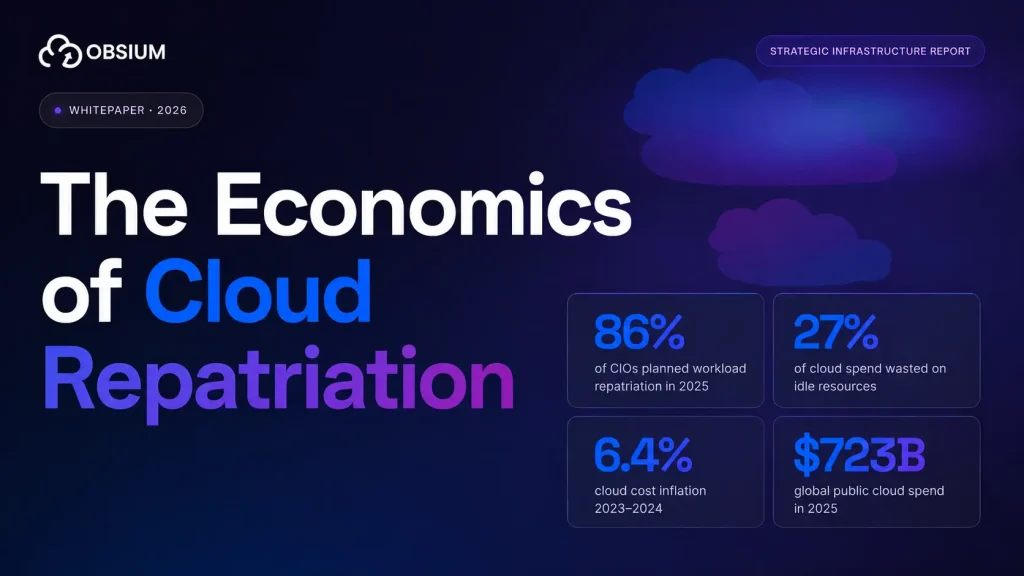
An honest look at where cloud economics break down, what on-premise infrastructure really costs, and how enterprises are making smarter workload-specific decisions in 2026.
Download Report