

Choosing a Google Cloud consulting company is mainly about finding the right fit for your project. A company that is excellent at AI and data may not be the best choice if you need help moving from VMware, fixing reliability problems, or completing a specific migration.
The market has also consolidated quickly. Several familiar Google Cloud specialists have been acquired or merged, which means older “best partner” lists can describe companies that no longer operate independently. Ownership matters because it can change staffing, commercial models, and the kind of work a firm prioritises.
At the same time, nearly every partner now talks about AI. That is useful when AI is the project, but buyers still need to distinguish AI/data specialists from infrastructure, migration, platform, and managed-service teams. The right shortlist depends on the problem you need solved.
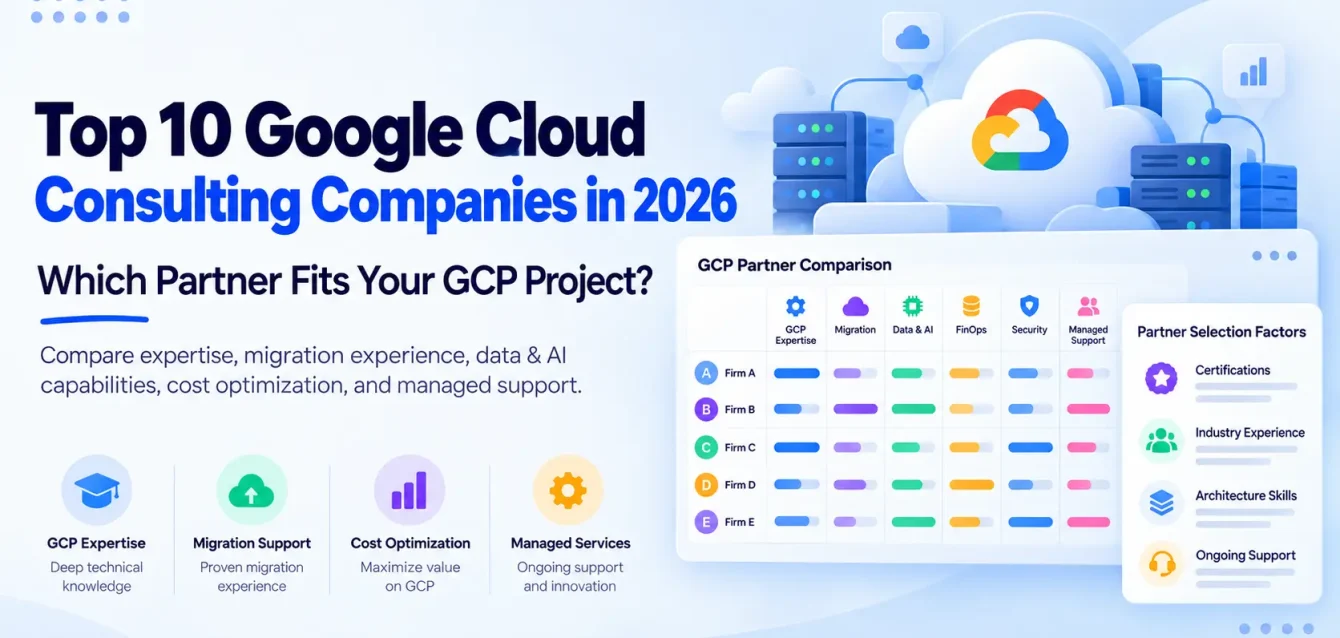
This guide compares ten Google Cloud consulting firms with a meaningful US presence, focusing on what each is best suited to, company scale, ownership, delivery model, and the trade-offs a buyer should ask about. The list is organised for comparison, not as a universal ranking.
How to shortlist a Google Cloud consulting company
- Decide whether you need a project finished or systems run. Firms are built for one or the other, and will happily sell you either.
- Check who owns them now. Several well-known Google firms have been acquired or merged in the last three years.
- Ask whether you’d be buying Google Cloud through them. Some partners resell Google Cloud consumption and bundle support into it. That can be good value. It also changes what leaving looks like.
- AI specialists and cloud infrastructure specialists are not always the same. Ask which type of work the firm does most often.
The first half below covers how to weigh all that up. The ten firms follow.
Jump to: How to choose · The 10 firms · All ten side by side · When a global consultancy fits · Firms that no longer exist on their own · FAQs
How to choose a Google Cloud partner
Do you need something finished, or something run?
A project has a clear finish line. For example, you may need to set up the basic Google Cloud environment, move systems from your own servers, or reduce an unexpectedly high BigQuery bill.
Managed services are different: the provider keeps helping after the initial project, with monitoring, maintenance, support, and incident response.
Firms are set up for one or the other. A rough test: if you can describe what “finished” looks like in one sentence, you probably need a project, not a monthly contract.
Are you buying Google Cloud through them?
This question matters more with Google partners than with most. Several of the larger Google partners resell Google Cloud: you pay your cloud bill to them instead of to Google, and support, tooling or a set amount of engineering time comes bundled with it.
That model can work well. You often get support you’d otherwise pay extra for. But ask three things before you sign:
- What exactly is included, and what is billed on top?
- What happens to your billing, support and tooling if you leave?
- Does the firm earn more when your cloud bill goes up? If so, how do they handle cost-reduction work?
None of these have wrong answers. You just want to know them upfront.
AI specialist or infrastructure specialist?
Most Google Cloud partners now promote AI services, including Gemini and AI agents. But their real strengths can be very different. Some mainly specialise in AI and data, while others are stronger at cloud migration, infrastructure, security, or day-to-day cloud operations.
Ask what they get called for most often. If the answer is data platforms and AI, they’re probably not the firm to rebuild your GKE networking. If it’s migrations and platforms, they may not be the firm for a production agent programme.
Size matters more than people expect
Company size affects how a project is staffed. A very large firm may give a smaller project less attention, while a very small firm may struggle if your project suddenly needs more people.
As a rough guide, smaller estates and tightly scoped projects often benefit from a smaller senior team, while large multi-business-unit environments usually need a deeper team and stronger programme-management capacity. Treat company size as a delivery-model signal, not a quality score.
Four questions worth asking on the first call
- Who will actually do the work? Names, and how much of their week you get. Put them in the contract.
- What do you get called for most? Listen for something specific.
- Who owns you, and has that changed recently? And what changed as a result.
- Can we speak to a client our size, in our industry, from the last year? A call, not a case study PDF.
The 10 Google Cloud consulting companies
All ten side by side
| Firm | Best for | Size | What sets them apart |
| SADA, an Insight company | Enterprises wanting a large Google-only team | ~1,200 | The best-known Google specialist in the US, now inside a Fortune 500 |
| Obsium | A specific GCP job, no retainer | Boutique | Project-based senior GCP and GKE engineering |
| Zencore | Migrations and core infrastructure | Small | Founded in 2021 by former Google engineers and executives |
| DoiT | Cost control across more than one cloud | Mid-size | Software platform plus engineers; 4,500 customers |
| 66degrees | AI and data programmes | Mid-size | 2026 Google Cloud Partner of the Year for AI |
| Egen | Data platforms and AI engineering | ~700 | Merged with SpringML in 2023 |
| Quantiphi | AI-first engineering at scale | Large | Four 2026 Google Cloud Partner of the Year awards |
| Onix | Moving large data warehouses to BigQuery | Mid-large | Google partner since 2002; own migration tooling |
| Promevo | Smaller firms on Google Workspace | Small | Workspace-first, with its own admin product |
| Slalom | Outgrown a boutique | ~13,000 | Big firm that staffs from local offices |
The numbers are reading order, not a ranking. Some of these firms have 30 people and some have thousands. They aren’t chasing the same work.
Obsium is included in the comparison. Its entry uses the same “best for / trade-off” structure as the other firms so buyers can compare fit rather than treat the order as a ranking.
1. SADA, an Insight company: the best-known Google specialist
HQ: Los Angeles, California · around 1,200 people Best for: Mid-sized and large companies that want a big, Google-focused team
SADA has been a Google partner for about 20 years and says it has served more than 4,000 clients. Insight Enterprises bought it at the end of 2023, when SADA had been named Google Cloud Partner of the Year six times.
The attraction is breadth. SADA covers Google Cloud infrastructure, data, AI, security and Workspace, and can resell Google Cloud with support attached. Being part of Insight adds hardware, licensing and a much larger services organisation behind it.
The trade-off is the usual one with a firm this size inside a bigger company. It’s worth asking who will staff your project, and how the Insight ownership has changed pricing and priorities since 2023.
A good fit when: you’re committed to Google Cloud and want one large partner for most of it. Probably not when: you want a small senior team for one specific problem.
2. Obsium: senior GCP help without the monthly contract
HQ: Pleasanton, California, with engineers in Kochi, India Best for: Growing companies that need serious Google Cloud help for a specific job
Obsium focuses on defined Google Cloud projects rather than long-term managed services. You bring us in to solve a specific cloud problem, complete the work, and hand it back to your team.
Six things, specifically:
- Architecture reviews. We check what you have against your own targets for uptime, security and cost, and hand you a written plan sorted by risk and effort.
- Cloud foundations. We set up the basic Google Cloud structure, access rules, networking, and policies so future projects can be launched more easily and consistently.
- Migrations. From your own servers, from AWS or Azure, or out of a GCP setup that grew sideways. One workload at a time: move it as-is where that’s right, rebuild it where that pays for itself.
- The goal is to identify and remove avoidable spend through better allocation, commitments, query patterns, storage choices, and workload adjusting resources to actual usage; the actual savings depend on the starting environment.
- Security and compliance. We help control who can access what, apply company-wide security rules, protect sensitive services, and keep the records needed for audits and compliance.
- Kubernetes and modern cloud applications. We build and improve Google Kubernetes Engine (GKE) and Cloud Run environments, with monitoring in place so teams can quickly see when something goes wrong.
We’ve done this for healthcare, fintech and SaaS teams.
What makes us different: most firms here are built to sell you a monthly service or cloud consumption. For a lot of companies, that’s the right thing to buy. If you already have a decent platform team and one specific problem, a retainer is an expensive way to solve it.
We tend to be a good fit when: you have your own engineers and want GCP and Kubernetes specialists working next to them. Probably not when: you want someone on call around the clock, or a team based only in the US.
3. Zencore: built by former Googlers
HQ: San Francisco, California · founded 2021 Best for: Companies moving to Google Cloud, or fixing the core platform once they’re there
Zencore was started in 2021 by former Google engineers and executives. It works only on Google Cloud, across migration, infrastructure, data, security and AI, and says it has won Google Cloud Partner of the Year four times.
The pitch is simple: people who worked inside Google and saw how cloud projects go wrong from that side. For migrations in particular, that inside knowledge of how Google’s services behave in practice is useful.
It’s a young, smaller firm, which cuts both ways. You’re likely to get senior people. You’re also likely to be one of fewer, larger clients.
A good fit when: you’re moving to Google Cloud and want Google-only specialists who’ve seen a lot of migrations. Probably not when: you run several clouds and want one firm across all of them.
4. DoiT: software plus engineers, across clouds
HQ: Santa Clara, California · 4,500 customers in 27 countries Best for: Companies that care most about cloud cost and run more than one cloud
DoiT combines a cloud cost and operations platform with a team of engineers. It works across Google Cloud, AWS and Azure, and covers FinOps, commitment management, Kubernetes and data platform costs.
It’s different from most firms here. DoiT is part software company, part services firm, and a lot of its value is in ongoing cost visibility and expert support rather than one-off projects.
Ask how the commercial model works for you specifically, including whether you’d be buying cloud through DoiT and what changes if you stop.
A good fit when: cost visibility and optimisation across clouds is your main problem. Probably not when: you need a large delivery team for a complex build.
5. 66degrees: the AI and data one
HQ: Chicago, Illinois, with an India headquarters in Bengaluru Best for: Mid-sized and large companies running AI and data programmes on Google Cloud
66degrees came out of a 2021 merger of Cloudbakers and Qwinix, rebranded in 2022 and added Pandera Systems the same year. It was named 2026 Google Cloud Partner of the Year for Artificial Intelligence, its fourth Partner of the Year award.
Its focus today is AI, agents and data, with cloud infrastructure, application development and managed services alongside. If your Google Cloud plans are mostly about Gemini, Vertex AI and BigQuery, it’s the kind of work Google’s own awards have recognised 66degrees for.
A good fit when: your main project is AI or data on Google Cloud. Probably not when: your problem is mostly infrastructure, networking or Kubernetes.
6. Egen: data and AI engineering
HQ: Naperville, Illinois, with offices in Pleasanton, California · 700+ people Best for: Companies building data platforms and AI products
Egen merged with SpringML in August 2023, backed by the investment firm Recognize. SpringML had been a long-standing Google Cloud data and ML partner. The combined company describes itself as one of the largest independent firms in the Google Cloud ecosystem, with more than 700 people across cloud, data, AI and platform engineering.
The strength is engineering depth in data. If you’re building a data platform on BigQuery or putting ML into production, this is the kind of work Egen and SpringML have done for years.
A good fit when: you need a serious data engineering team on Google Cloud. Probably not when: you want a small, quick infrastructure fix.
7. Quantiphi: AI-first, at scale
HQ: Marlborough, Massachusetts · founded 2013 Best for: Larger companies with ambitious AI programmes
Quantiphi calls itself an AI-first digital engineering company. It won four 2026 Google Cloud Partner of the Year awards, including Databases Partner of the Year for North America and a Gaming industry award.
It’s large, research-heavy and increasingly focused on Gemini-based engineering agents. If you’re a big company with a long AI roadmap, Quantiphi has the team for it.
A good fit when: AI and data are the centre of your Google Cloud plans, and the programme is large. Probably not when: you’re a smaller company with a narrow infrastructure need.
8. Onix: moving big data estates to BigQuery
HQ: Pune, India, with a US headquarters in Princeton, New Jersey
Onix has partnered with Google since 2002, longer than almost anyone. It says it has won 18 Partner of the Year awards. In 2023 it bought Datametica, a data migration specialist, and it now sells its own migration tooling alongside its services, including Raven for code translation and Pelican for data validation.
That tooling is the reason to look at Onix. Large data warehouse migrations are mostly about translating years of SQL and proving the numbers still match afterwards, and that’s exactly what those tools are for.
A good fit when: you’re moving a large legacy data warehouse to BigQuery. Probably not when: your project is mostly applications, Kubernetes or networking.
9. Promevo: for smaller companies on Google Workspace
HQ: Kentucky Best for: Small and mid-sized companies that run on Google Workspace and want some Google Cloud help too
Promevo is a Google Cloud partner that leans heavily on Google Workspace: licensing, migration, administration and support, plus its own gPanel admin product. It also offers Google Cloud services.
It’s here for a specific kind of company: one where Google Workspace is the main relationship with Google, and cloud infrastructure needs are modest. For that company, having licensing, Workspace and some cloud help from one firm is convenient.
A good fit when: Workspace is your main Google footprint. Probably not when: you need deep infrastructure, data or Kubernetes engineering.
10. Slalom: a big firm that sends local people
HQ: Seattle, Washington · around 13,000 people Best for: Companies that have outgrown a boutique but don’t want a global consultancy
Slalom works across all three major clouds and has a large Google Cloud practice. It was named 2026 Google Cloud Public Sector Partner of the Year for US state and local government, after a 2025 award for AI in the public sector.
Its model is local offices staffed by local people, which makes it feel smaller than it is. Good for companies that want a well-resourced firm that still shows up in person.
A good fit when: you want a large firm with a local team and experience across strategy, data and cloud. Probably not when: you want Google-only specialists or a very small senior team.
When a global consultancy makes more sense
If you’re a large enterprise running a multi-year, multi-country transformation, the global consultancies have scale none of the firms above can match. All of them have Google Cloud practices. [VERIFY all rows]
| Firm | Typical fit |
| Accenture | Very large transformations; runs a dedicated Google Cloud business group |
| Deloitte | Regulated industries; strategy and implementation together |
| Capgemini | Large migrations and SAP on Google Cloud |
| Wipro | Large-scale migrations and managed services |
| Kyndryl | Infrastructure services and mainframe-heavy estates |
The usual trade-offs apply: higher rates, more layers, and a real chance that the senior people in the pitch aren’t the ones doing the work. Ask for names.
Firms you will see on other lists that no longer exist on their own
Useful to know if you’re working from an older shortlist.
| Firm | What happened |
| Maven Wave | Acquired by Atos, completed February 2020 |
| Cloudbakers and Qwinix | Merged in 2021, rebranded as 66degrees in 2022 |
| Pandera Systems | Joined 66degrees in 2022 |
| SpringML | Merged into Egen in August 2023 |
| Datametica | Acquired by Onix in 2023 |
| Kin + Carta | Acquired by Valtech in 2024 |
| SADA | Still trades under its own name, but has been owned by Insight since late 2023 |
FAQs
What does a Google Cloud consultant do?
A Google Cloud consultant helps companies plan, build, migrate to and run systems on Google Cloud. Typical work includes architecture reviews, cloud foundation setup, migrations, cost optimisation, security and IAM, GKE and data platforms such as BigQuery.
How much does Google Cloud consulting cost?
It depends on the type of engagement. Project work is usually priced per project or per sprint, based on scope. Managed services are billed monthly. Some partners bundle services into the price of the Google Cloud consumption you buy through them. Ask for a scoped quote against your actual environment.
Should I buy Google Cloud through a partner?
It can make sense if the bundled support and tooling would cost you more on their own. Before you do, find out exactly what’s included, what happens if you leave, and whether the partner earns more when your bill goes up.
Does Google help pay for migrations?
Google runs a Rapid Migration and Modernization Program (RaMP) that can include funding and credits for eligible migrations, usually delivered with a partner. Ask any firm you speak to whether your project qualifies and what the conditions are.
How do I choose between Google Cloud consulting companies?
Start with whether you need a project finished or systems run. Then check who owns the firm, whether they’re an AI specialist or an infrastructure specialist, whether their size matches yours, and whether they’ll let you speak to a recent client like you.
Is Google Cloud consulting different from AWS or Azure consulting?
The approach is similar. The services, tools and partner programmes differ, and the Google partner market is smaller and more consolidated. If you run more than one cloud, see our lists of top AWS consulting companies and top Azure consulting companies.