

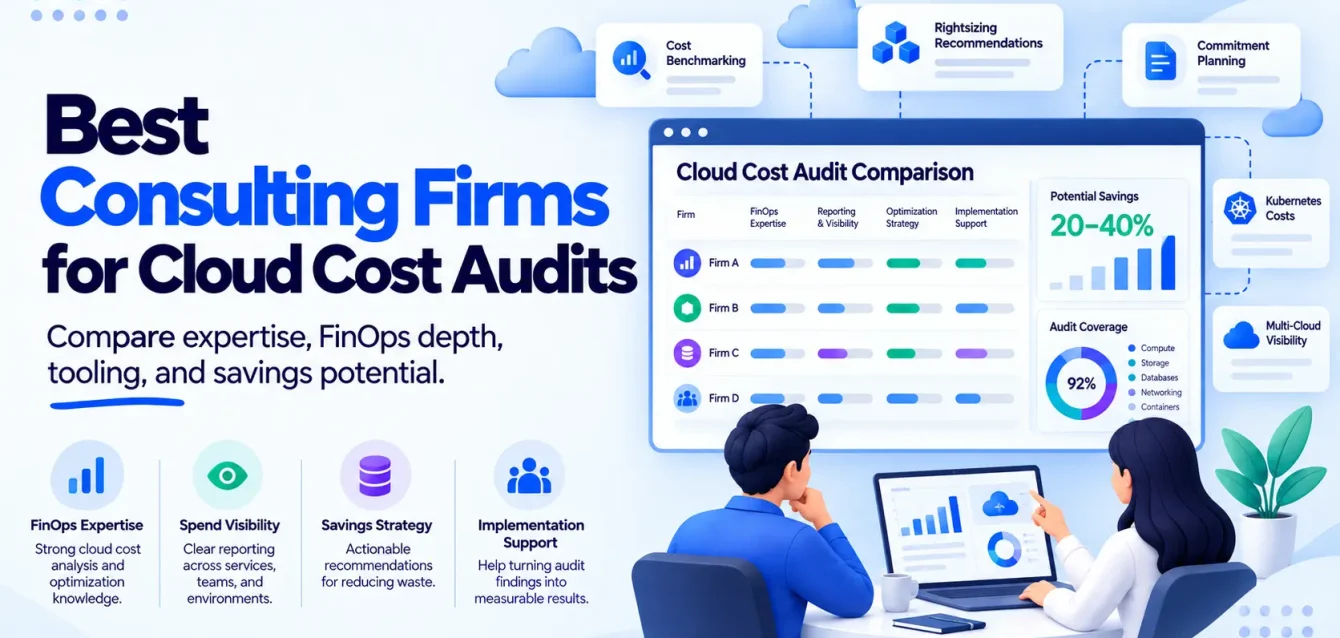
A cloud cost audit is a short, focused engagement. Someone looks at your cloud bill, tells you where the waste is, and hands you a report.
That’s different from hiring a full FinOps consultancy or an ongoing cost-optimization service. This page is specifically about the audit: what a good one looks like, and which firms do them well.
If you’re also weighing whether to build a full internal FinOps practice, that’s a bigger decision, covered in FinOps consulting: what to look for. If you want an ongoing service that keeps optimizing month after month, that’s a different purchase too, covered in Cloud cost optimization services: what you’re actually buying.
This page is narrower on purpose. Sometimes you just want a second pair of eyes on your bill before you decide what to do next.
What a cloud cost audit actually is
In plain terms, a cloud cost audit is a diagnostic, not a fix.
- Timeframe: usually one to four weeks.
- What they look at: your billing data, resource usage, tagging, and any existing commitments (reserved instances, savings plans).
- What you get back: a written report. It should rank issues by how much money they’re costing you, not just list everything that’s technically wrong.
- What it doesn’t include: actually making the changes. That’s a separate, follow-on engagement, and a good auditor will say so upfront.
Think of it like a home inspection before you buy a house. The inspector tells you what’s wrong and roughly what it’ll cost to fix. They don’t fix it themselves, and you shouldn’t expect them to.
How this is different from FinOps consulting or a managed service
Three different purchases get confused with each other constantly. Here’s the quick version.
| Purchase | What it is | How long it lasts |
|---|---|---|
| Cloud cost audit | A one-time diagnostic report | 1-4 weeks, then it’s done |
| FinOps consulting | Building an internal cost-management practice | Weeks to months, aims to end |
| Managed cost optimization | Someone else runs cost optimization for you, ongoing | Indefinite, a recurring service |
An audit is the cheapest and lowest-commitment of the three. It’s also the easiest for a vendor to use as a foot in the door for a bigger sale, which is something to watch for below.
What a good audit actually includes
Before you book one, check that it covers these:
- A real number, not a guess. “We estimate $40,000-$60,000 in annual waste” beats “significant savings opportunities identified.”
- Ranked findings. The report should tell you what to fix first, not just list every issue with equal weight.
- Specifics you can act on. “Right-size these 12 instances” is useful. “Optimize your compute” is not.
- A tagging and visibility check. If your cloud bill can’t be broken down by team or product, that’s usually the first thing worth flagging, before anything else gets fixed.
- Kubernetes coverage, if you run it. Your cloud bill stops at the node. If a chunk of your infrastructure is Kubernetes, ask directly whether the audit goes deeper than that. Most don’t.
- A clear line between “quick wins” and “bigger changes.” Quick wins are things you can do this week. Bigger changes usually mean an architecture decision, and take longer.
Red flags to watch for
A cost audit is a low-risk purchase, but a few patterns are worth knowing about.
- A savings number before they’ve seen your bill. Nobody can credibly promise “30% savings” before looking at your actual usage data.
- The audit is free, but only if you also buy their platform or reseller service. That’s not really an audit. It’s a sales funnel with a report attached.
- The report has no dollar figures at all. If every recommendation is qualitative (“consider right-sizing”), you paid for a checklist, not an audit.
- They push hard for a retainer before you’ve even read the findings. A good audit provider is confident enough in the findings to let you decide what happens next.
- They can’t explain how they’ll measure savings. Ask what the report’s numbers are measured against. If they can’t answer clearly, the number is made up.
Seven firms worth a look
This isn’t a ranking, and Obsium is on the list. We’re listed honestly, not first.
Revenant Systems
A small UK-based consultancy that does exactly one thing: fixed-price AWS cost audits.
- Price: starts at £4,950, agreed upfront.
- Timeframe: about two weeks from kickoff to report.
- What’s covered: compute right-sizing, idle capacity, storage, data transfer, orphaned resources, and commitment coverage.
- Good fit for: teams on AWS who want a clean, bounded engagement with no reselling and no upsell pressure, since they don’t sell any cloud products themselves.
Obsium
We run cloud cost audits with a specific angle: we look past the billing data and into your Kubernetes clusters.
- What’s covered: the usual billing-level review, plus namespace and pod-level cost attribution using Prometheus and Grafana, which most audits skip entirely.
- Good fit for: teams whose cloud bill shows a big number for compute, but where nobody can say which team or service is actually driving it.
- Where we’re not the right fit: a company running mostly VM-based workloads with no Kubernetes. Plenty of other firms on this list cover that better.
Caylent
An AWS-focused consultancy that runs cost assessments as the entry point to their broader FinOps practice, Caylent Calibrate.
- What’s covered: AWS environment audit, waste identification, rightsizing and commitment recommendations.
- Pricing: the audit itself isn’t separately priced in public materials. Their ongoing CloudOps service starts around $7,500/month, so ask directly whether a standalone audit is available before assuming it is.
- Good fit for: AWS-heavy teams who might want to continue into an ongoing engagement, and want a provider deep in the AWS ecosystem specifically.
DoiT International
Their consultants (they call them Forward Deployed Engineers) typically start any new relationship with an assessment phase before deeper work begins.
- What’s covered: AWS, Google Cloud, Azure, and Snowflake billing and usage review.
- Good fit for: multi-cloud organizations, since most audit-only providers focus on a single cloud.
- Worth knowing: DoiT is also a cloud reseller. Ask directly whether that affects how their audit findings are framed.
Kyndryl
Kyndryl runs cost and maturity assessments as a standard entry point for larger engagements.
- Notable example: one published engagement identified 1,264 optimization opportunities and produced a transformation roadmap in six weeks.
- Good fit for: large enterprises with complex, multi-cloud, or hybrid environments, where the audit needs to account for infrastructure Kyndryl may already be managing.
- Pricing: not published. Expect a scoped, fixed-fee proposal.
Virtasant
Virtasant’s consulting model is outcome-based across the board, which extends naturally to an audit: if they don’t find meaningful savings, the engagement costs you very little.
- What’s covered: billing and usage review, with findings tied directly to a proposed savings share for any follow-on work.
- Good fit for: teams who want the audit’s cost tied to whether it actually finds anything.
- Worth knowing: ask exactly how “savings” get defined and measured before signing, since outcome-based pricing lives or dies on that definition.
MeteorOps
A boutique firm with a pay-as-you-go model and no retainer requirement, which makes a standalone audit an easy, low-risk first engagement.
- Pricing: $100-149/hour, no lock-in.
- Good fit for: smaller teams who want senior engineering eyes on their bill without committing to anything beyond the audit itself.
- Worth knowing: they’re selective about who they take on, so availability isn’t guaranteed.
Quick comparison
| Firm | Audit-only pricing | Turnaround | Best for |
|---|---|---|---|
| Revenant Systems | From £4,950, fixed | ~2 weeks | AWS-only, no reselling |
| Obsium | Project-based | Varies | Kubernetes cost attribution |
| Caylent | Not published separately | Varies | AWS-heavy, may continue to a retainer |
| DoiT International | Not published | Varies | Multi-cloud |
| Kyndryl | Not published | ~6 weeks (example) | Large, complex enterprise |
| Virtasant | Outcome-based | Varies | Low-risk, pay-for-results |
| MeteorOps | $100-149/hr | Varies | Small teams, no commitment |
Questions to ask before you book one
- Is this audit fixed-price, or could it run over?
- What exactly will the report include? Ask to see a redacted sample from a past client.
- Will the findings include dollar figures, or just recommendations?
- Does this cover Kubernetes, or only cloud billing data?
- Do you resell any cloud services or earn a commission tied to what we spend?
- What happens after the audit? Are we obligated to continue with you?
Where Obsium fits
Most of our audits start the same way: a team’s cloud bill has a big number next to “compute,” and nobody can say which service is actually responsible for it.
We look past the billing data and into the cluster itself, using Prometheus and Grafana to show cost by namespace and workload, not just by node.
If that sounds like your situation, book a free 30-minute call. If your problem is somewhere else, we’ll say so.
Related reading: FinOps consulting: what to look for · Cloud cost optimization services: what you’re actually buying · 10 best FinOps consulting companies · How to choose a cloud consulting partner
FAQ
How much does a cloud cost audit cost?
It varies a lot. A boutique, fixed-scope audit can run from a few thousand dollars to the low five figures. Larger firms often don’t publish a standalone audit price, since they typically position it as the entry point to a bigger engagement.
How long does a cloud cost audit take?
Most run one to four weeks, depending on how many cloud accounts and services are in scope.
What’s the difference between a cloud cost audit and FinOps consulting?
An audit is a one-time diagnostic report. FinOps consulting is a broader engagement aimed at building a lasting cost-management practice inside your team. An audit is often the first step, not the whole thing.
Do I need a cloud cost audit if I already use a cost management tool?
Possibly still worth it. A tool reports what’s happening. An audit typically comes with a person interpreting that data and telling you what to actually do about it, which is a different kind of value.
Can a cloud cost audit cover Kubernetes?
Some can, most don’t. Standard cloud billing data stops at the node level and doesn’t show which team or service is driving the spend inside a cluster. Ask specifically before assuming any audit covers this.
Is a free cloud cost audit worth it?
Sometimes. Just check what’s attached to it. A free audit tied to buying a platform or switching cloud resellers is a sales tool first and a diagnostic second.