

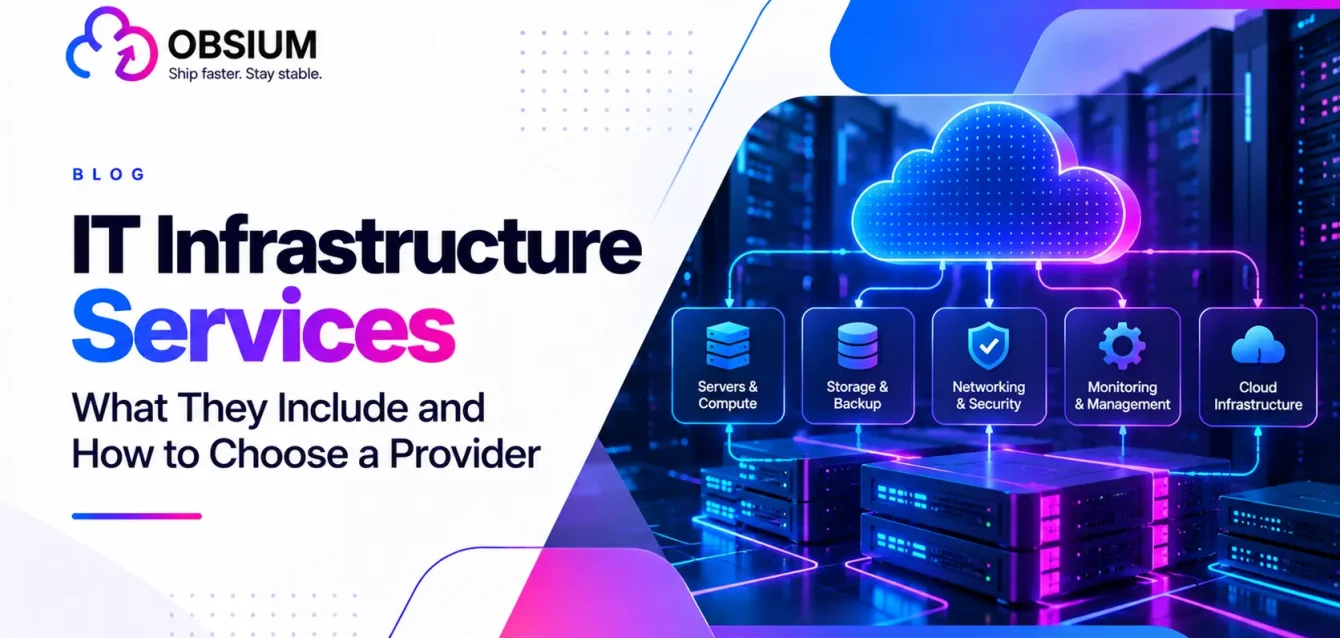
Every business depends on IT infrastructure, whether it’s an online retailer processing orders, a hospital accessing patient records, or a software company running applications in the cloud.
But keeping these systems secure, available, and efficient requires more than buying servers or subscribing to cloud services.
IT infrastructure services fill that gap. They help organizations build, maintain, monitor, and improve the technology behind everyday operations.
This guide explains the different types of infrastructure services, their benefits and costs, and how to choose a provider that fits your business.
What Are IT Infrastructure Services?
IT infrastructure services are professional services that help businesses design, deploy, manage, secure, and maintain their technology infrastructure.
Infrastructure and infrastructure services are not the same thing.
IT infrastructure refers to the technology itself: servers, networks, storage, cloud platforms, and supporting software. Infrastructure services are the activities required to keep those systems working effectively.
For example, a company might own its servers but hire a provider to monitor performance, install security updates, and respond to outages.
These services can be delivered by internal IT teams, managed service providers (MSPs), cloud providers, or a combination of all three.
What Are the Core Components of IT Infrastructure?
Most business IT environments have six connected components.
| Component | What it includes | Example |
|---|---|---|
| Hardware | Servers, computers, physical equipment | Dell PowerEdge servers |
| Software | Operating systems and management tools | Linux, VMware |
| Networking | Routers, switches, connectivity | Office and cloud networks |
| Storage | File systems, databases, backups | Amazon S3 |
| Data centers and cloud | Hosting and computing environments | AWS, Azure, private data centers |
| Security | Access controls and protection tools | Firewalls, IAM, endpoint security |
When one component fails, others can be affected, so infrastructure management has to look at the whole environment, not individual systems.
Traditional vs. Cloud vs. Hybrid IT Infrastructure
Businesses generally use three infrastructure models.
| Model | How it works | Best suited for |
|---|---|---|
| Traditional | Infrastructure hosted on company-owned or leased equipment | Organizations requiring direct hardware control |
| Cloud | Infrastructure provided through cloud platforms | Businesses seeking flexible capacity |
| Hybrid | Combines on-premises and cloud environments | Organizations with mixed requirements |
For example, a financial institution might retain certain systems in a private data center while running customer-facing applications in the cloud.
There’s no universally superior model. The decision depends on security requirements, existing investments, costs, and application needs.
Types of IT Infrastructure Services
Infrastructure services include office network maintenance and large-scale cloud operations.
1. Network Infrastructure Services
Network services keep devices, applications, and locations connected.
They cover local area networks (LANs), wide area networks (WANs), wireless connectivity, and content delivery networks (CDNs).
For example, a retail chain with 50 stores needs reliable connectivity between its locations, inventory systems, and central applications.
2. Server and Compute Services
These services manage the computing resources required to run applications.
They may involve physical servers, virtual machines, cloud instances, or edge computing systems.
A provider can help businesses choose suitable resources, maintain server performance, and increase capacity when demand grows.
3. Storage Infrastructure Services
Storage services ensure business data remains accessible and protected.
Common options include network-attached storage (NAS), storage area networks (SAN), cloud object storage, and backup systems.
The right choice depends on how frequently data is accessed, performance requirements, and retention policies.
4. IT Infrastructure Consulting and Assessment
Infrastructure consulting helps businesses evaluate their existing environments and identify improvements.
An assessment typically examines performance, security, capacity, architecture, operating costs, and potential risks.
It’s most useful before a cloud migration, major upgrade, or business expansion.
Explore Obsium’s cloud consulting services.
5. Infrastructure Management and Monitoring
Infrastructure management involves keeping systems operational, while monitoring tracks their health and performance.
Managed services may include continuous monitoring, automated alerts, patch management, and capacity planning.
For example, monitoring might identify unusually high server memory usage before customers experience slow response times.
Modern observability solutions go further by connecting metrics, logs, and traces to explain why problems occur.
6. IT Infrastructure Support and Maintenance
Support services handle incidents, troubleshooting, maintenance, and service restoration.
Providers may offer business-hours support or 24/7 coverage with agreed response targets.
Site reliability engineering (SRE) takes a more proactive approach. Rather than primarily fixing incidents, SRE uses automation, reliability targets, and engineering practices to reduce recurring failures.
Learn more about site reliability engineering.
7. Cloud Infrastructure Services
Cloud infrastructure services help organizations deploy and operate applications on platforms such as AWS, Azure, and Google Cloud.
Common service models include:
- IaaS: Virtual computing, networking, and storage resources.
- PaaS: Managed platforms for building and running applications.
- DRaaS: Cloud-based disaster recovery capabilities.
Modern infrastructure services also include container orchestration using Kubernetes.
For organizations operating containerized applications, Kubernetes consulting can help improve deployment reliability and scalability.
8. Infrastructure Automation and DevOps
Managing infrastructure manually becomes difficult as environments grow.
Infrastructure as code (IaC) tools such as Terraform allow teams to provision environments consistently. CI/CD pipelines automate application testing and delivery. If you’re weighing Terraform against Kubernetes-native tooling, see Terraform vs. Kubernetes.
For example, a software company can use automation to create similar development and production environments, reducing configuration differences.
Explore Obsium’s DevOps solutions.
9. Platform Engineering
Platform engineering builds reusable infrastructure capabilities that development teams can access independently.
Instead of requesting a new environment through an IT ticket, developers might use an internal platform to provision approved resources.
These standardized workflows, often called golden paths, help organizations reduce repetitive infrastructure work while maintaining governance.
Read more about platform engineering.
10. Security Infrastructure Services
Security services protect infrastructure against unauthorized access, malware, and other threats.
They include firewalls, identity and access management (IAM), endpoint protection, and security information and event management (SIEM).
A cloud security assessment can help identify weaknesses before they become incidents.
11. Backup and Disaster Recovery
Backup services maintain recoverable copies of critical data. Disaster recovery focuses on restoring systems following major failures.
For example, a business might replicate important data to another cloud region so operations can recover if its primary environment becomes unavailable.
Recovery plans should be tested regularly, not merely documented.
12. Cloud Migration and Modernization
Migration services help businesses move applications, databases, and infrastructure between environments.
Modernization goes further by improving how applications are designed or operated.
A migration may involve moving existing virtual machines, while modernization could include adopting managed databases or containers.
Explore cloud migration services, our on-premises to cloud migration strategy, and our guide to data center migration.
Benefits of IT Infrastructure Services
Infrastructure services prove their value when systems fail or operating costs rise.
Uptime Institute’s 2026 Annual Outage Analysis found that 57% of respondents said their most recent major outage cost more than $100,000, while one in five reported costs above $1 million.
Well-managed infrastructure can help organizations:
- Improve application availability and reliability.
- Detect problems before they escalate.
- Reduce repetitive maintenance work.
- Strengthen security and recovery readiness.
- Scale resources without unnecessary capital investment.
- Give internal teams more time for strategic work.
These benefits depend on what’s delivered and how well it’s managed.
In-House vs. Managed IT Infrastructure Services
Not every organization needs to outsource infrastructure operations.
| Factor | In-house team | Managed provider |
|---|---|---|
| Control | Direct operational control | Shared through contracts and processes |
| Expertise | Depends on internal hiring | Access to provider specialists |
| Availability | Depends on staffing | Can include 24/7 coverage |
| Costs | Salaries, tools, training | Contract and usage fees |
| Scalability | Requires internal planning | May offer flexible capacity |
Managed services can be valuable when businesses lack specialist expertise or require continuous operational coverage. Our guides to managed IT services and managed cloud services cover what that looks like in practice, and Obsium’s DevOps managed services handle the ongoing operations side.
However, outsourcing doesn’t eliminate accountability. Businesses still need clear service expectations, security responsibilities, and performance reporting.
Common Infrastructure Use Cases and Challenges
Infrastructure services support cloud adoption, disaster recovery, large-scale data processing, DevOps, and everyday IT operations.
For a large streaming platform, infrastructure must handle sudden traffic spikes without disrupting playback. Our JioHotstar infrastructure analysis explores this challenge.
Common difficulties include managing hybrid environments, maintaining 24/7 availability, controlling cloud spending, and securing multiple platforms.
According to Flexera’s 2026 State of the Cloud Report, 85% of respondents said managing cloud spend is a challenge.
AI applications add to the pressure because their computing demand is hard to predict.
IT Infrastructure Best Practices
Reliable infrastructure starts with a few practical habits:
- Document critical systems: Understand dependencies and business impact.
- Monitor continuously: Detect performance and availability issues early.
- Automate repetitive tasks: Reduce manual errors and configuration inconsistencies.
- Test recovery plans: Verify backups can actually restore operations.
- Review security regularly: Reassess access, vulnerabilities, and configurations.
- Track infrastructure costs: Identify idle and oversized resources.
Capacity planning matters even more for AI and hybrid workloads, because demand can swing widely between applications.
How Much Do IT Infrastructure Services Cost?
Pricing depends on infrastructure complexity, support requirements, and the delivery model.
| Pricing model | How it works |
|---|---|
| Fixed monthly fee | Predictable charge for agreed services |
| Per user or device | Pricing based on supported endpoints |
| Usage-based | Charges based on resources consumed |
| Project-based | One-time fee for assessments, migrations, or implementations |
A provider managing five cloud servers will have different requirements from one operating hundreds of applications across multiple regions.
Request quotes that clearly separate management fees, cloud consumption, software licensing, and additional support charges.
For further guidance, see cloud migration costs, FinOps best practices, and Obsium’s cloud cost optimization services.
How to Choose an IT Infrastructure Services Provider
Start by identifying what your business actually needs rather than comparing providers solely on their service catalogs.
Evaluate prospective partners using these criteria:
- Relevant experience: Have they supported environments similar to yours?
- Technical expertise: Do they understand your cloud platforms and applications?
- Support commitments: Are response times and escalation processes documented?
- Security practices: Can they explain access controls and incident handling?
- Cost transparency: Are all recurring and additional charges clear?
- Reporting: How will they demonstrate performance and improvements?
Ask how the provider handles a major outage, who owns infrastructure configurations, and what happens if you decide to change providers.
A warning sign is a provider promising guaranteed uptime without explaining dependencies, exclusions, or recovery procedures.
Our guide on choosing a cloud consulting partner explores these questions further, and what is cloud consulting covers the basics.
Frequently Asked Questions
What are IT infrastructure services?
They are services that help businesses design, operate, secure, monitor, and maintain their technology infrastructure, including servers, networks, storage, and cloud environments.
What does IT infrastructure support include?
Infrastructure support typically includes troubleshooting, maintenance, incident response, system updates, monitoring, and assistance with infrastructure failures.
What is IT infrastructure management?
IT infrastructure management is the ongoing process of maintaining technology systems to meet performance, availability, security, and business requirements.
When should a business outsource IT infrastructure?
Outsourcing can make sense when internal teams lack specialist expertise, need around-the-clock coverage, or spend too much time maintaining infrastructure instead of supporting business priorities.
Traditional vs. cloud infrastructure: What’s the difference?
Traditional infrastructure typically uses organization-owned or leased equipment, while cloud infrastructure provides computing resources through a service provider. Hybrid environments combine both.
What are examples of IT infrastructure services?
Examples include network management, cloud hosting, server maintenance, cybersecurity, monitoring, backup and disaster recovery, infrastructure automation, and cloud migration.
When to Bring in Infrastructure Help
Infrastructure challenges often overlap, but different problems require different expertise.
Obsium offers Cloud Consulting for infrastructure planning, DevOps Solutions for automation, and Kubernetes Consulting for container platforms.
Teams can also explore Site Reliability Engineering to improve availability, Platform Engineering to simplify developer workflows, and Observability Solutions to improve system visibility.
Explore Obsium’s Cloud Consulting Services to identify the right infrastructure approach for your business.