

In 2022, about 45% of large software engineering organizations had a platform team. By the end of 2026, Gartner predicts that number will hit 80% (Gartner: Strategic Trends in Platform Engineering 2025). That is a staggering adoption rate for something most engineers could not define three years ago.
But here is the other number that matters: up to 70% of those platform teams will fail to deliver measurable impact, and nearly half will be disbanded or restructured within 18 months (ByteIota: Platform Engineering 80% Adoption, 70% Fail).
So you have an industry racing to adopt something that fails more often than it succeeds. That is worth understanding before you reorganize your team around it.
What each one actually is
These terms get thrown around loosely, so let me be specific about what each one means in practice.
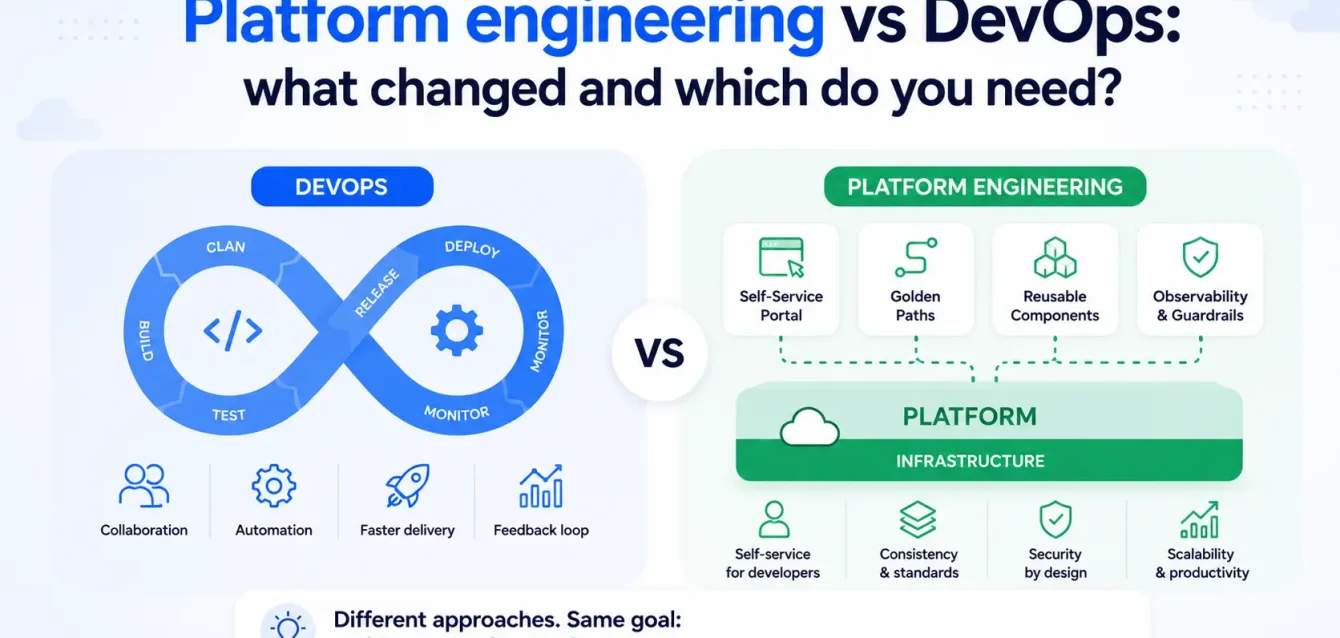
DevOps is a set of practices and a culture shift. The core idea: the people who build the software and the people who run the software should work together, share tools, share responsibility, and automate everything they can. DevOps is not a team or a tool. It is how your development and operations teams collaborate.
Platform engineering is a discipline where a dedicated team builds and maintains internal tools and infrastructure that other developers use to ship software.
The output is usually an Internal Developer Platform (IDP): a self-service layer where developers can provision environments, deploy code, manage databases, and monitor services without filing tickets or waiting for someone in ops.
Agile shows up in the keyword data here too, so let me address it quickly. Agile is a project management methodology focused on iterative development, customer feedback, and short release cycles.
It governs how you plan and build software. DevOps governs how you deliver and run it. They operate at different layers and most teams use both.
How they relate to each other:
| Approach | Question it answers | Who owns it |
|---|---|---|
| Agile | What gets built and in what order? | Product + engineering |
| DevOps | How does it get delivered and kept running? | Dev + ops (shared) |
| Platform engineering | What tools make the DevOps practices self-service? | Dedicated platform team |
What actually changed
Five years ago, “DevOps” was the answer to almost every delivery problem. Slow releases? DevOps. Too many production incidents? DevOps. Dev and ops teams not talking? DevOps.
That worked when you had 10 services, 20 engineers, and one Kubernetes cluster. Then companies grew:
- 50 services became 200
- One cluster became five across three cloud providers
- Every developer needed something from the DevOps team: a new environment, a pipeline change, a database provisioned, a secret rotated
The DevOps team that was supposed to eliminate silos became a silo.
Platform engineering emerged as a response to that scaling problem. Instead of a DevOps team that does things for developers, you build a platform that lets developers do things for themselves.
The timeline, roughly:
- 2015-2019: DevOps adoption accelerates. Teams build CI/CD pipelines, adopt infrastructure as code, start running Kubernetes.
- 2020-2022: Microservices and multi-cloud complexity outgrows what a centralized DevOps team can handle. Spotify publishes Backstage. “Platform engineering” starts appearing in job titles.
- 2023-2024: Gartner puts platform engineering on the hype cycle. Conference talks multiply. Backstage captures 89% of the IDP market.
- 2025-2026: 80% adoption. Reality sets in. Average IDP adoption rate sits at 10%. Teams discover that building a portal nobody uses is worse than having no portal at all.
Where they overlap and where they don’t
| DevOps | Platform engineering | |
|---|---|---|
| What it is | Culture + practices | Dedicated team + product |
| Goal | Faster, more reliable delivery | Self-service developer experience |
| Who does it | Shared responsibility across dev and ops | A dedicated platform team |
| Output | Pipelines, automation, monitoring, processes | An Internal Developer Platform (IDP) |
| How developers interact | Collaborate with DevOps on shared tools | Use the platform as a self-service product |
| When it breaks | Bottlenecks when the DevOps team can’t keep up | Low adoption when the platform doesn’t solve real problems |
The overlap is large. Both care about CI/CD, infrastructure automation, monitoring, and reducing manual work. The difference is organizational: DevOps is a shared practice, platform engineering is a product team that builds for internal customers.
Platform engineering does not replace DevOps. It is one way to implement DevOps principles at scale. You still need the culture of shared responsibility. You still need automation.
You still need monitoring. The platform team just packages those things into a product that other teams can use without understanding every layer of the stack.
Why 70% of platform teams fail
The failure rate is not because platform engineering is a bad idea. It is because most teams execute it incorrectly. The patterns are consistent:
| Failure pattern | What happens | The number |
|---|---|---|
| Build a portal instead of solving a problem | 95% of teams start with a developer portal. If it does not solve a real pain point, nobody uses it. | Average IDP adoption: 10%. In one case, 64% of engineers bypassed the platform entirely. |
| Treat it as a project, not a product | A project ships and is done. A product has users, feedback loops, and continuous iteration. | Platform teams without a product mindset see 41% lower success rates. |
| Measure the wrong things | Track logins instead of outcomes. Did cycle time improve? Did incidents decrease? | 30% of platform teams do not measure success at all. |
| Underinvest | Building a platform that replaces 5-10 DevOps engineers takes real money and runway. | Nearly half operate on less than $1M/year. |
How to decide what your team needs
This depends on the size of your engineering organization and where your bottlenecks are.
| Signal | What you need | Why |
|---|---|---|
| Fewer than 50 engineers, fewer than 20 services | DevOps practices | A platform team is overhead you cannot afford. Automate pipelines, adopt IaC, set up monitoring, build shared ownership. |
| Bottleneck is cultural (dev and ops do not collaborate) | DevOps practices | No amount of tooling fixes a culture where teams throw code over the wall. |
| 50-100+ engineers, DevOps team is a bottleneck for requests | Platform engineering | Developers wait for environments, pipeline changes, secret rotations. Self-service tooling gives everyone their time back. |
| 3+ teams deploying to the same Kubernetes clusters | Platform engineering | Shared infrastructure without a shared platform means every team reinvents the wheel. |
| Onboarding a new engineer takes more than 2 weeks | Platform engineering | The tooling is too complex for individuals to navigate. A platform abstracts it. |
| 100+ engineers with platform team but weak DevOps culture | Both | A portal nobody trusts because the underlying practices are broken helps nobody. |
Where observability fits in both models
Regardless of whether you go with DevOps practices or a full platform team, you need the same observability layer underneath.
The stack is the same either way: Prometheus for metrics, Loki for logs, Tempo for traces, Grafana for visualization, and OpenTelemetry for instrumentation. What changes is who runs it and how teams interact with it:
| DevOps model | Platform engineering model | |
|---|---|---|
| Who runs the observability stack | The DevOps team | The platform team (or a managed service) |
| How developers access it | Shared Grafana dashboards, ask DevOps for custom queries | Self-service: pre-built dashboards, alerting templates, log access baked into the IDP |
| What it measures | Service health, incidents, deployments | All of the above, plus platform adoption and developer experience |
Where Obsium fits
If your team needs that layer without the 10-20 hours a month of operational overhead, book a free 30-minute observability consultation. No sales deck, just an engineer-to-engineer chat about your stack.