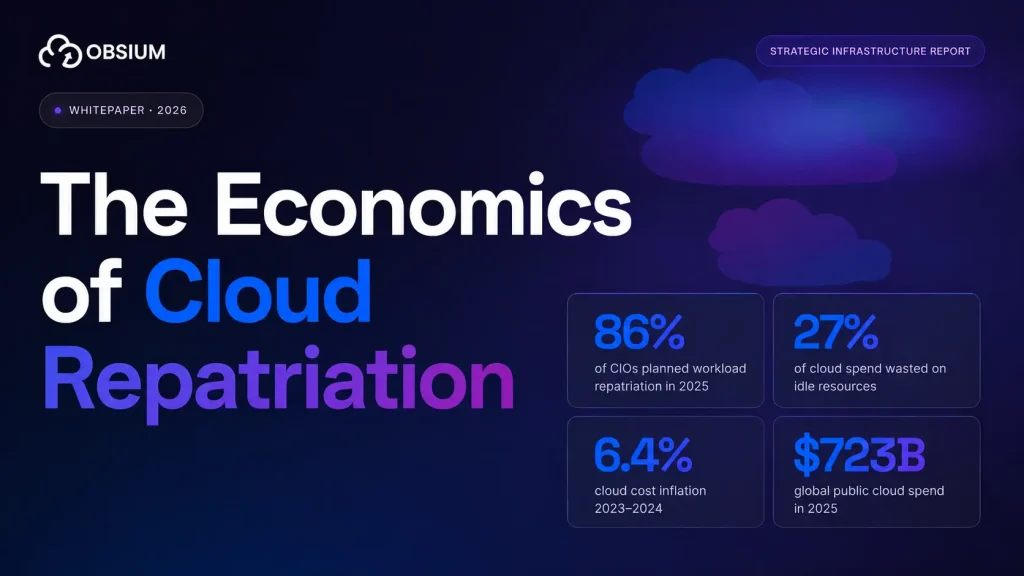


Understanding Cloud Repatriation
Cloud repatriation is the reverse of cloud migration: moving a workload that currently runs in a public cloud provider back to on-premises infrastructure or a private cloud. It’s a smaller but increasingly discussed trend, most notably publicized when Basecamp’s parent company, 37signals, detailed leaving AWS and projected multi-year savings by owning its own hardware for steady-state, predictable workloads.
Why Organizations Repatriate
- Unpredictable or high costs at scale – workloads with high, steady, predictable resource consumption can sometimes be run more cheaply on owned hardware once the capital cost is amortized, especially compared to on-demand or lightly discounted cloud pricing.
- Data egress fees – moving large volumes of data out of a cloud provider incurs per-gigabyte charges that can make certain data-intensive workloads, like analytics pipelines processing large datasets repeatedly, disproportionately expensive to keep in the cloud.
- Performance and latency – some workloads perform more predictably on dedicated hardware without the variability that can occur in multi-tenant environments.
- Compliance and data sovereignty – evolving regulatory requirements sometimes push organizations toward infrastructure they fully control.
- Vendor lock-in concerns – a desire to reduce dependency on a single provider’s proprietary services and pricing model.
How It’s Done
Repatriation mirrors migration in reverse: teams first identify candidate workloads, typically those with steady, predictable resource usage and high storage or egress costs, then calculate a realistic total cost of ownership comparison against continuing on public cloud. They procure hardware or colocation space, replatform services that relied on cloud-managed offerings, for example moving from a managed database like Amazon RDS to a self-hosted PostgreSQL cluster, transfer data back (a step that itself often incurs the very egress fees the exercise is trying to avoid), and execute a cutover with a validated rollback plan.
Example Scenario
A SaaS analytics company running a data-heavy pipeline on S3 and EMR calculates that its steady-state storage and compute costs, combined with egress fees for feeding data into downstream systems, would be substantially lower over three years if it owned equivalent hardware in a colocation facility. It builds a hybrid transition plan: repatriating the steady-state data warehouse and processing pipeline to owned hardware while keeping bursty, customer-facing application workloads in AWS where elasticity still adds clear value.
Trade-offs and Limitations
Repatriation is not free and reintroduces exactly the operational burdens cloud adoption was meant to remove: capital expenditure, hardware refresh cycles every few years, physical facility management, and dedicated operations staffing to replace what a managed cloud service previously handled. It also sacrifices cloud elasticity, so workloads with variable or unpredictable demand are typically poor repatriation candidates. Most successful repatriation efforts move a specific, well-understood subset of an organization’s workloads rather than the entire estate, since blanket repatriation usually reintroduces more cost and risk than it saves.
Best Practices
- Conduct a rigorous, multi-year total cost of ownership analysis that includes egress fees, staffing, hardware refresh cycles, and facility costs, not just a sticker-price comparison of monthly cloud bills versus hardware cost.
- Prioritize repatriation candidates with steady, predictable, high-utilization resource consumption, since these workloads see the clearest economic benefit from owned infrastructure.
- Consider a hybrid approach, repatriating steady-state workloads while keeping bursty or globally distributed workloads in public cloud, rather than an all-or-nothing move.
- Evaluate colocation as a middle ground between full on-premises ownership and public cloud, since it avoids some facility management burden while still reducing consumption-based costs.
Frequently Asked Questions
What is Cloud Repatriation?
Cloud repatriation is the process of moving workloads, applications, or data from public cloud back to on-premises or private infrastructure, typically driven by cost, performance, or compliance concerns.
How does Cloud Repatriation work?
Cloud Repatriation works by combining the components described in the sections above. The main page walks through the architecture, the typical use cases, and the trade-offs to weigh before adopting it.
Why does Cloud Repatriation matter?
Teams adopt Cloud Repatriation to ship faster, run more reliably, and reduce the cognitive load on engineers. The benefits, limits, and adjacent tools are covered in the body above.
When should you use Cloud Repatriation?
Use Cloud Repatriation when the problems it solves match what your team is hitting today. The page above outlines the signals that mean you should adopt it now, and the cases where a simpler approach is fine.