

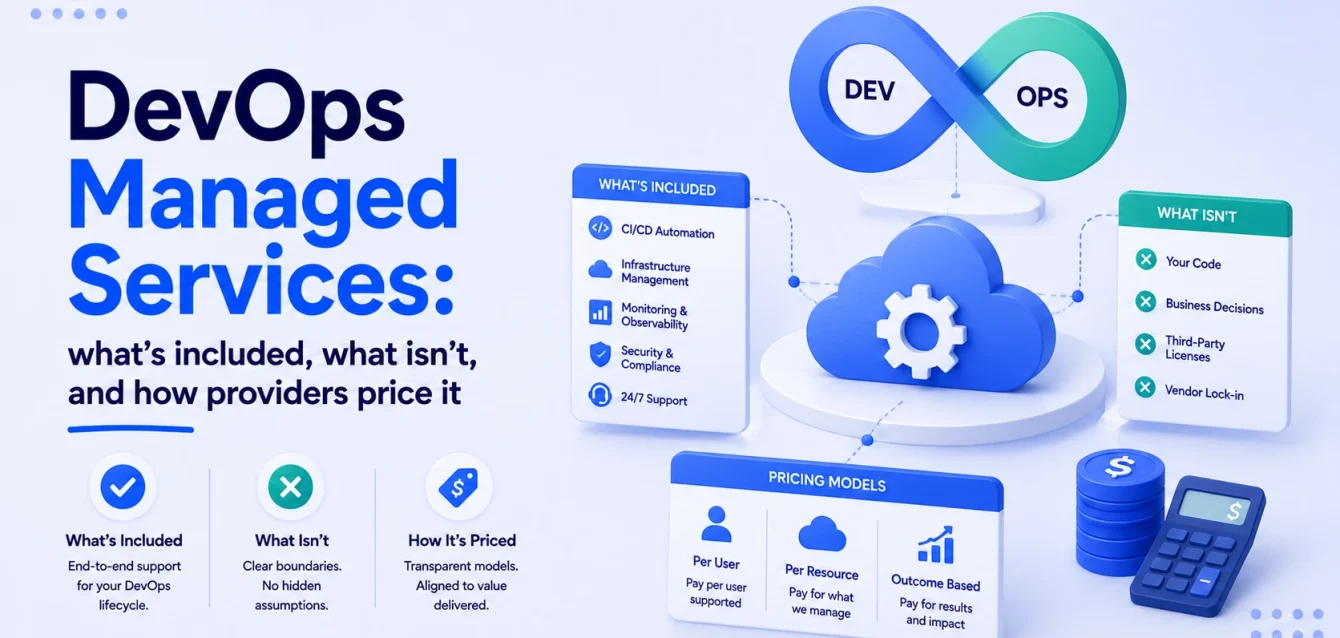
DevOps managed services are an ongoing contract where an external provider operates some or all of your delivery infrastructure: CI/CD pipelines, infrastructure-as-code, environment provisioning, monitoring, and often incident response. Unlike a consulting engagement, it has no end date and no handover. That is the whole point, and also the whole risk.
The category is genuinely useful and genuinely badly defined. Two providers can both sell “managed DevOps,” quote within 10% of each other, and be offering work that differs by an order of magnitude in scope. One is maintaining your Jenkins instance. The other is carrying your pager at 3am. The proposals look almost identical.
This is a scope teardown rather than a pitch. What’s nearly always included, what’s nearly always excluded, what sits in the ambiguous middle where disputes happen, and the clauses that decide whether this works out.
Key takeaways
- Pipeline maintenance is in scope everywhere. Incident response depth almost never is, by default. That gap is where most disappointment lives.
- “24/7 monitoring” and “24/7 response” are different products. Many contracts promise the first and are read as promising the second.
- Response time is not resolution time. Even AWS and Azure only commit to response, and only 5 to 60 minutes at the top severity, on their most expensive tiers.
- Cost governance is the most commonly excluded scope item and often the most expensive omission.
- Platform quality determines whether this works. DORA’s 2025 research found the effect of AI adoption on organizational performance is strong and positive when platform quality is high, and negligible when it isn’t.
- Ask who owns the Terraform state. The answer tells you more about your exit options than the termination clause does.
Why this category exists now
Two things happened at once.
Kubernetes went from a thing teams were evaluating to a thing they were running. The CNCF’s 2025 annual survey found 82% of container users now run Kubernetes in production, up from 66% in 2023, and 98% of organizations have adopted cloud native techniques in some form.
At the same time, the operational surface expanded faster than teams could staff it. The top barrier to cloud native adoption in that same survey wasn’t technology. It was cultural change with the development team (47%), followed by lack of training (36%). The Linux Foundation’s 2026 State of Tech Talent report frames the current market as a skills crisis rather than a jobs crisis.
So you have more infrastructure to run, a harder time hiring people to run it, and a market of providers offering to run it for you. Gartner forecasts IT services spending at $1,570 billion in 2026, growing 5.3% (Gartner, July 2026).
That’s the honest context. Now the scope.
What’s actually in scope
The table below reflects what typical mid-market managed DevOps contracts cover. Your mileage will vary, which is exactly the problem.
| Scope area | Usually included | Usually excluded | Frequently ambiguous |
|---|---|---|---|
| CI/CD pipelines | Maintenance, upgrades, runner capacity, break-fix | Writing new pipelines for new services | Who fixes a pipeline that broke because your team changed the app |
| Infrastructure as code | Applying changes, module upkeep, state management | Greenfield architecture design | Refactoring IaC that predates the contract |
| Environment provisioning | Standing up envs from existing templates | New environment types | Ephemeral/preview environments |
| Monitoring | Agent deployment, dashboard upkeep, alert routing | Deciding what to alert on | Alert tuning after a noisy week |
| Incident response | Acknowledging alerts, running documented runbooks | Debugging application code | Anything with no runbook, which is every novel incident |
| On-call | Business-hours coverage | 24/7 unless explicitly bought | Escalation path after the first hour |
| Security patching | OS and base image patching | Application dependency CVEs | Container images your team builds |
| Cost governance | Almost never | Almost always | The bill nobody was watching |
| Access management | Provisioning and deprovisioning | Designing the RBAC model | Break-glass procedures |
| Backup and DR | Running scheduled backups | Testing restores | Whether “backup” includes proving it restores |
Three rows deserve expanding, because they’re where the money is.
Incident response is the expensive one
Nearly every provider will acknowledge an alert and execute a runbook. Very few will debug a novel production failure at 2am, because doing so requires someone who understands your application, and that person costs what a senior engineer costs.
The contract language to watch: “incident response per documented runbooks.” That’s a real service and a reasonable one. It is not the same as “we’ll fix your outage.” Every genuinely bad incident is by definition one nobody wrote a runbook for.
Ask directly: what happens when an alert fires and there’s no runbook? The answer is either “we escalate to you” (fine, but know it) or “we engage an engineer to diagnose” (more expensive, and check what response time applies).
On-call coverage is sold ambiguously
“24/7 monitoring” means a system is watching. “24/7 response” means a human answers. These are priced very differently and described almost identically.
The hyperscalers set the reference points here, and they’re useful anchors because they’re published and specific. AWS Support commits to a 15-minute response for business-critical system-down on Enterprise Support, and one hour for production-system-down. After AWS’s December 2025 support restructure, the new Unified Operations tier goes further, engaging an Incident Management Engineer within five minutes. Azure commits to under one hour for Severity A on Standard and above, with Azure Rapid Response at under 15 minutes.
Two things to take from that. First, if a managed DevOps provider quotes better than 15 minutes at P1, ask how they staff it — AWS’s own fastest published commitment is five minutes, and only on its most expensive tier. Second, and more important: both vendors commit to response, not resolution. AWS’s own language is “every reasonable effort.” Any provider promising a resolution SLA is either charging for it properly or hasn’t thought it through.
A defensible severity structure looks roughly like this:
| Severity | Definition | Response target | Coverage |
|---|---|---|---|
| P1 | Production down, revenue-affecting | 15–60 min | 24/7 |
| P2 | Production degraded, workaround exists | 1–4 hours | 24/7 or extended hours |
| P3 | Non-production impaired, or minor production issue | 4–12 hours | Business hours |
| P4 | Questions, requests, minor bugs | 24 hours | Business hours |
Get the severity definitions in writing, not just the times. Who classifies an incident matters more than the SLA attached to it. If the provider classifies, every ambiguous incident becomes a P3.
Cost governance is the omission that costs the most
This is the one worth arguing about, and it’s the scope item most often missing entirely.
A managed DevOps provider running your Kubernetes clusters controls the levers that determine your bill: node types, autoscaling configuration, resource requests, cluster sizing. If the contract doesn’t make cost an explicit responsibility, the rational behaviour for the provider is to over-provision, because over-provisioned infrastructure is stable infrastructure and stability is what they’re measured on.
The numbers make this concrete. Cast AI’s 2026 State of Kubernetes Resource Optimization report measured average CPU utilization at 8% and memory at 20% across tens of thousands of production clusters, with CPU over-provisioning at 69%. Cast AI sells the remedy and measures clusters before optimisation, so treat it as directional rather than a universal average, but the direction is not in dispute.
Datadog’s State of Cloud Costs 2024 put it differently and arrived somewhere similar: 83% of container costs are associated with idle resources, split between 54% cluster idle (over-provisioned infrastructure) and 29% workload idle (excessive resource requests).
Cluster idle is exactly the thing your managed provider controls. If nobody has made it their job, it will not be anybody’s job.
Fix in the contract: an efficiency target. Something like “maintain cluster CPU utilization above X% and report monthly,” or at minimum “provide monthly cost-per-namespace reporting.” Obsium’s guide to Kubernetes cost optimization covers what’s actually measurable here.
Key insight: The scope items providers compete on (pipeline uptime, deployment frequency) are the ones that are easy to measure and cheap to deliver. The ones that decide whether the contract was worth it (novel incident handling, cost discipline, knowledge retention) are hard to measure and expensive, which is precisely why they end up outside the SOW.
How providers price it
Four models dominate. None is inherently better, but they fail differently.
| Model | How it works | Aligned when | Fails when |
|---|---|---|---|
| Fixed monthly retainer | Flat fee, defined scope | Scope is stable and well-specified | Your estate grows; everything new becomes a change order |
| Per-resource / per-cluster | Priced by nodes, clusters, or environments | Your footprint is the honest cost driver | You’re incentivised to under-count, they’re incentivised to over-provision |
| FTE pool / dedicated capacity | You buy N engineers’ time | You need flexibility and have someone to direct it | Nobody internally directs it, and you pay for idle capacity |
| Outcome / SLA-based | Priced against uptime or delivery metrics | Metrics are unambiguous and instrumented by you | The provider instruments the metrics they’re paid on |
The percentage-of-spend variant deserves specific caution. Some providers bundle managed DevOps with cloud reselling and take margin on your consumption. That’s a legitimate business model, and it means the party operating your clusters earns more when those clusters are bigger. Ask directly whether they resell your cloud capacity or receive partner rebates tied to your spend, and get the answer in writing. The same question applies in FinOps consulting, for the same reason.
On published pricing: almost nobody in this category publishes rates, and the market-sizing figures you’ll find for “DevOps managed services” specifically come from aggregator research firms with no visible methodology. I’d treat any specific dollar benchmark you read online, including in competing articles, as invented. Ask three providers for a quote against an identical written scope. That comparison is real; a published benchmark isn’t.
The four clauses to pin down
Everything above collapses into four contract questions. If you get these right, the rest is negotiable.
1. Who owns the Terraform state, and where does it live?
This is the single most revealing question you can ask, and it takes ten seconds.
If the answer is “in our account,” or “in our tooling,” you have an exit problem that no termination clause fixes. State files, module repositories, pipeline definitions, and runbooks should live in your version control and your cloud account from day one, with the provider granted access. Not copied to you at the end.
Providers who do this well volunteer it. Providers who don’t will explain why their way is more efficient.
2. What happens when there’s no runbook?
Covered above. Get the escalation path, the response time that applies to undocumented incidents, and who pays for diagnostic time. The answer “we’d engage our senior engineer” is fine as long as you know what that costs and how fast they arrive.
3. Who classifies severity, and can you override it?
You want the right to declare a P1. Providers reasonably want protection from customers who declare everything a P1. The workable compromise is that you can classify, the provider can dispute after the fact, and repeated misclassification is handled commercially rather than in the moment. What you must avoid is a structure where the provider alone decides how urgent your outage is.
4. What are the exit terms, in operational rather than legal language?
Notice period is the easy part. The real questions: how long do they support you after notice is given, what documentation is delivered, who runs the transition, and is there a defined period where both parties overlap. A 30-day notice period with no transition support is functionally a hostage clause, because you cannot rebuild operational knowledge of your own estate in 30 days.
Warning: Watch for scope defined by tool rather than by outcome. “We manage your Jenkins, Terraform, and Datadog” sounds concrete and commits the provider to nothing about whether your deployments work. Scope should be defined by what stays up, what ships, and what it costs.
When managed DevOps is the right call
It works when:
- The capability is genuinely commodity for you. Running CI infrastructure is undifferentiated work for most companies. Outsourcing it is rational.
- You have someone internal who owns the relationship. Not a procurement contact. An engineer with the standing to say “no, do it differently.”
- Your platform is in reasonable shape. This one is backed by data: DORA’s 2025 research found that when platform quality is high, the effect of AI adoption on organizational performance is strong and positive, and when platform quality is low, that effect is negligible (DORA, platform engineering). Outsourcing the operation of a bad platform buys you a bad platform someone else operates.
- You’re buying coverage, not judgment. Managed services are good at doing the known thing reliably. They’re poor at deciding what the thing should be.
There’s a supporting data point worth knowing. Google Cloud’s platform engineering research with Enterprise Strategy Group found developers in co-managed platform environments spent 47% of productive time on innovation, versus 38% in fully internally-managed platforms. Co-managed, not fully outsourced. That distinction is the whole argument for keeping platform ownership while contracting out operation.
And it fails when:
- Nobody internally wants to own reliability. Outsourcing is not a substitute for ownership. If your engineers don’t care whether the deploy works, a vendor won’t either.
- You’re outsourcing because you can’t hire. Understandable, but if the reason you can’t hire is that the work is miserable, the vendor’s engineers will churn too. You’ll just experience it as inconsistent service.
- You need architectural decisions made. That’s consulting, and it’s a different purchase. Obsium’s rundown of top DevOps consulting companies covers that side.
Managed services vs consulting vs staff augmentation
| Managed services | Consulting | Staff augmentation | |
|---|---|---|---|
| Duration | Ongoing, no end date | Bounded, ends | Ongoing but you direct it |
| You get | Operational coverage | Judgment and a build | Hands |
| Knowledge lands with | The provider | Your team, if the SOW says so | The contractor |
| Best for | Commodity operations | A capability gap you’ll close | Known work, insufficient capacity |
| Main failure mode | Permanent dependency | Deck with no implementation | Contractor with no authority |
Most teams that think they want one of these actually want a different one. If the phrase in your head is “we need someone to figure out how we should be deploying,” that’s consulting. If it’s “we need this to keep running without waking anyone up,” that’s managed services.
How to evaluate providers
Six questions, in order of how much they reveal:
- Where does our Terraform state live during the engagement?
- Walk me through your last P1 for a client like us. What happened in the first thirty minutes?
- What happens when an alert fires and there’s no runbook?
- Do you resell our cloud capacity or receive rebates tied to our spend?
- Who on your team will we actually work with, and will they be here in month six?
- What’s in scope for cost efficiency, and how do you report on it?
Question two is the most useful and the hardest to fake. A provider who has genuinely operated production will tell you a specific story with specific mistakes in it. A provider who hasn’t will describe a process.
What to take away
Managed DevOps is a real category doing real work, and the contracts are less standardised than the marketing suggests.
- Compare exclusions, not prices. Two quotes within 10% of each other can differ enormously in what they actually cover.
- Incident response depth is the expensive part. Runbook execution and outage resolution are different services.
- 24/7 monitoring is not 24/7 response. Confirm which one you bought.
- Response time is not resolution time. Neither AWS nor Azure promises resolution. Be suspicious of anyone who does.
- Cost governance is scope, or it’s nobody’s job. With cluster idle at over half of container waste, this is the omission that pays for itself.
- Terraform state location is your best single diagnostic. Ask it early.
- Co-managed beats fully outsourced on the one comparison where there’s data: 47% of developer time on innovation versus 38%.
Where Obsium fits
Obsium works with teams that want their platform operated well without giving up ownership of it. Our bias is toward open-source foundations, Prometheus and Grafana rather than a licence you can’t leave, and toward leaving the state, the runbooks, and the dashboards in your accounts from day one.
We also treat cost as in-scope by default, because we mostly get called in after somebody discovered that stable and efficient were not the same thing.
If you’re evaluating providers, book a free 30-minute consultation. No sales deck. An engineer will go through your scope document and tell you what’s missing from it, including if that means telling you not to outsource this.
Related reading: Top DevOps consulting companies · DevOps best practices · DevOps metrics that actually matter · Platform engineering vs DevOps · Kubernetes cost optimization · Managed cloud services: what they are and how they help
FAQs
What are DevOps managed services?
An ongoing contract where an external provider operates your delivery infrastructure: CI/CD pipelines, infrastructure-as-code, environment provisioning, monitoring, and usually some level of incident response. Unlike consulting, there is no defined end date or handover.
What’s the difference between managed DevOps and DevOps consulting?
Consulting is bounded work that ends with a capability transferred to your team. Managed services are ongoing operations with no handover. If you want someone to decide how you should deploy, that’s consulting. If you want deployments to keep working without internal effort, that’s managed services.
What’s usually excluded from a DevOps managed services contract?
Most commonly: cost governance, debugging application code during incidents, 24/7 response unless explicitly purchased, designing new architecture, and testing that backups actually restore. Check each one explicitly rather than assuming.
How much do DevOps managed services cost?
Providers don’t publish rates, and the benchmark figures circulating online come from research vendors with no stated methodology. The reliable approach is to write one scope document and get three quotes against it. Compare the scope exclusions as carefully as the numbers.
What SLA should I expect for managed DevOps?
Use the hyperscalers as reference points. AWS Enterprise Support commits to 15 minutes for business-critical outages and Azure to under an hour for Severity A. Both commit to response, not resolution. Expect the same structure and be skeptical of resolution guarantees.
Do managed DevOps providers handle on-call?
Sometimes, and it’s the item most often misread. “24/7 monitoring” means a system watches. “24/7 response” means a human answers. Confirm which you’re buying, and confirm what happens on an incident with no documented runbook.
Can a managed DevOps provider also manage our cloud costs?
Only if you make it explicit scope with a reported metric. By default, providers are measured on stability, and over-provisioning is the cheapest route to stability. Add an efficiency target or monthly cost-per-namespace reporting to the SOW.
Should we use a managed service or hire internally?
Hire when the capability is permanent and differentiating. Use managed services when it’s commodity operations you’d rather not staff. The deciding question isn’t cost, it’s whether the work is something your team should be getting better at.