

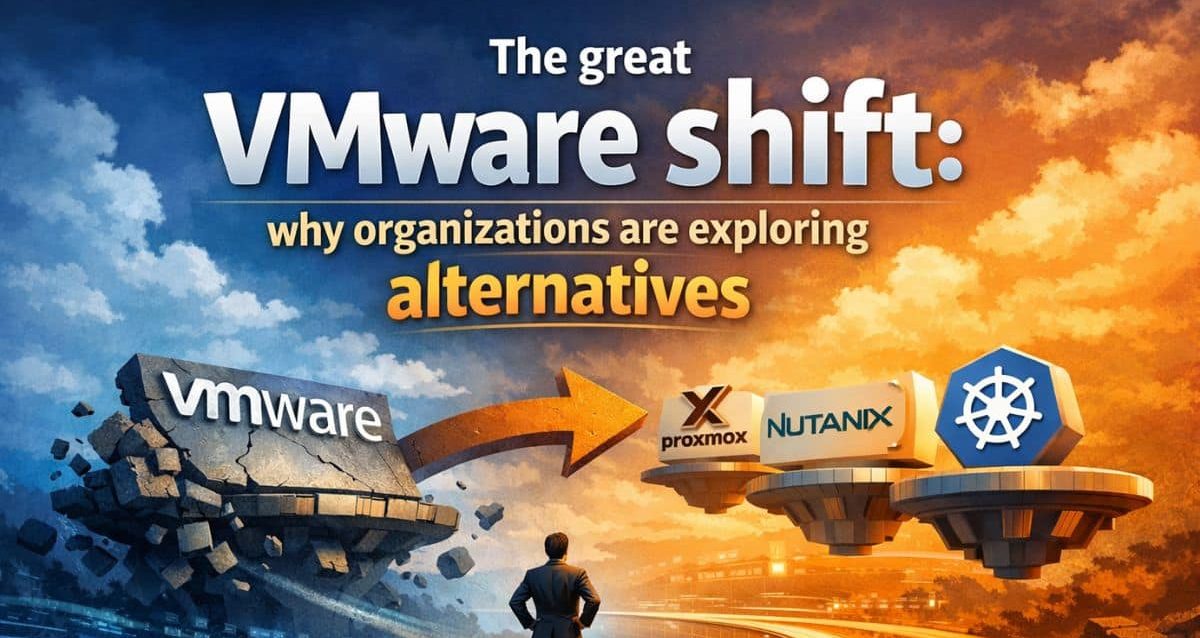
For more than two decades, VMware was the default answer to a simple question: “How do we virtualize our data center?” It worked. It worked extremely well. And for most of that time, nobody had a serious reason to look elsewhere.
That changed in November 2023, when Broadcom closed its $61 billion acquisition of VMware. What followed wasn’t a gradual evolution. It was a pricing and licensing upheaval that left over 300,000 VMware customers scrambling to understand their new reality.
This blog breaks down what happened, what the numbers actually look like, who’s moving away, and what they’re moving to.
What Broadcom actually changed (and why it matters)
Let’s get specific, because the details matter more than the headlines.
After the acquisition closed, Broadcom made several moves that hit customers hard:
Perpetual licenses are gone. VMware no longer sells them. Every customer must now subscribe, which means recurring annual fees instead of one-time purchases. Existing perpetual licenses still technically work, but you can’t renew support unless you had a pre-existing contract.
Product bundling replaced modular purchasing. Broadcom reduced VMware’s catalog from roughly 8,000 individual SKUs down to a handful of bundles, primarily VMware Cloud Foundation (VCF) and vSphere Foundation (VVF). If you previously bought just vSphere and vCenter, you now have to buy a bundle that includes NSX networking and vSAN storage whether you need them or not. IDC documented this consolidation in their August 2024 analysis, noting that customers who previously purchased individual products now face unavoidable bundle costs (IDC, 2024).
The minimum core requirement jumped from 16 to 72. Starting April 2025, VMware enforces a minimum 72-core license subscription for products like vSphere Standard. If you’re running a small deployment, maybe an edge location with a couple of servers, you’re paying for 72 cores whether you use them or not (ColocationPlus, 2025).
The partner channel got gutted. Broadcom reduced authorized VMware Cloud Service Providers from over 4,500 globally to a much smaller pool. By mid-2025, only 13 VCSPs remained active in the US under the rebranded program. Many long-standing resellers lost their ability to sell VMware products entirely (Intelisys, 2025).
Late renewal penalties now sit at 20%. Miss your anniversary renewal date, and Broadcom tacks on a 20% surcharge on the first-year subscription price.
The real cost impact: not 2x, not 5x, but up to 15x
The price increases aren’t hypothetical. They’re documented across multiple industry reports.
Customers have reported cost increases ranging from 150% to 1,500%, depending on their previous setup. Organizations that relied on standalone products like vSphere Essentials Plus (which Broadcom discontinued) were hit hardest. Forte Systems reported that mid-market customers experienced increases of 800% to 1,500% (Forte Systems, 2025). AT&T publicly stated it received a 1,050% price increase offer from Broadcom, which eventually ended up in court (IT Brew, 2025).
A CloudBolt Software report found that 99% of VMware customers expressed concern about the acquisition’s impact on their IT strategy, with 76% being extremely or very concerned (Assured Digital Technologies, 2024).
In Europe, the situation prompted the Cloud Infrastructure Service Providers in Europe (CISPE) to file an appeal to the European General Court, seeking to annul the European Commission’s approval of the acquisition entirely (IT Brew, 2025).
The numbers don’t lie: customers are leaving
This isn’t just complaining. Organizations are actually pulling the trigger on migration.
A Foundry and CIO.com survey of over 550 enterprise IT leaders found that 56% plan to decrease their VMware usage over the next year, with 71% actively evaluating on-premises alternatives (Virtualization Howto, 2025). Gartner’s Peer Community data shows 74% of IT leaders are currently exploring VMware alternatives (HorizonIQ, 2026).
Looking further out, Gartner predicts that by 2028, cost concerns will drive 70% of enterprise-scale VMware customers to migrate at least 50% of their virtual workloads to alternative platforms. A separate Gartner prediction puts 35% of VMware workloads migrating to alternative platforms by that same year (VMblog, 2025).
The vendor lock-in problem nobody talks about until they try to leave
Here’s the part that catches people off guard. A typical VMware environment isn’t just a hypervisor. It’s an entire stack:
- vSphere handles compute
- vSAN handles storage
- NSX handles networking
- Aria / vRealize handles management and monitoring
These components are deeply integrated with each other. They share APIs, management consoles, and operational workflows. Your backup tools, your monitoring, your automation scripts, your DR playbooks, all of it assumes VMware underneath.
So when someone says “let’s just switch hypervisors,” the actual work involved includes network redesign, storage migration, backup tool replacement, disaster recovery reconfiguration, and team retraining. It’s not a weekend project. For large enterprises, it’s a multi-year initiative.
This is exactly why organizations are now prioritizing open standards, portability, and vendor-neutral architectures going forward. The lesson from the Broadcom acquisition is clear: deep dependency on a single vendor’s proprietary stack is a business risk.
The foundation behind most alternatives: KVM
Almost every serious VMware alternative today runs on the same underlying technology: KVM (Kernel-based Virtual Machine).
KVM is built directly into the Linux kernel. It turns any Linux system into a hypervisor capable of running virtual machines at near bare-metal performance. It’s not a startup project or an experiment. AWS, Google Cloud, and most major cloud providers run KVM under the hood.
DigitalOcean, Linode, and hundreds of hosting providers have been running KVM-based infrastructure in production for years, often managed through panels like Virtualizor and SolusVM.
The advantages over proprietary hypervisors are straightforward:
- No licensing fees. KVM is open-source and free.
- Proven at massive scale. The world’s largest cloud providers rely on it.
- Near bare-metal performance. VT-x/AMD-V hardware acceleration is fully supported.
- Strong ecosystem. QEMU, libvirt, and dozens of management tools build on top of it.
Where KVM gets interesting for enterprises is in the platforms built on top of it, each taking a different approach to packaging KVM with the management, networking, and storage capabilities that production environments require.
The top 10 VMware alternatives, with real-world context
1. Proxmox VE
Proxmox has had the most dramatic growth story in this space. What was once a niche open-source tool for homelabs and small hosting companies is now running on over 1.5 million hosts across 140+ countries, according to Proxmox Server Solutions GmbH. That’s a roughly 650% increase in deployment over seven years (Saturn ME, 2025).
PeerSpot’s 2025 survey places Proxmox at 16.1% global market mindshare in server virtualization, up from around 10% in 2023 (Stackscale, 2025). In August 2025, Proxmox launched version 9.0 based on Debian 13, and in December 2025, they released Datacenter Manager 1.0, a centralized management tool for multiple Proxmox clusters. The Register noted that this product “opens the floodgates” for wider enterprise adoption (The Register, 2025).
One enterprise cited a $2.3 million VMware licensing quote they avoided by switching to Proxmox (HorizonIQ, 2026).
Proxmox combines KVM virtualization with LXC containers, built-in Ceph storage, clustering, high availability, and a clean web interface. It’s free to use, with optional paid support tiers.
Best for: SMBs, hosting providers, and organizations with Linux expertise who want maximum cost savings.
The catch: Enterprise support depth doesn’t match VMware’s ecosystem. Organizations rushing into migration without proper patching practices are creating new security risks. A runZero analysis found that many Proxmox deployments are running outdated or end-of-life versions (Open Source For You, 2025).
2. OpenStack
OpenStack is the heavy hitter for private cloud deployments. It’s highly modular (separate projects for compute, networking, storage, identity, and more) and scales to thousands of nodes. Telcos, large enterprises, and research institutions run OpenStack in production.
Best for: Large enterprises and service providers building private clouds with full IaaS capabilities.
The catch: Operational complexity is real. You need a skilled team to deploy and maintain OpenStack. This isn’t something you set up over a weekend. Forrester’s Naveen Chhabra notes that OpenStack aligns more with private cloud offerings similar to what VMware or Nutanix provide, not just simple hypervisor replacement (TechTarget, 2025).
3. Nutanix AHV
Nutanix offers the closest experience to VMware for organizations that want a familiar feel. AHV (Acropolis Hypervisor) is integrated into Nutanix’s hyperconverged infrastructure (HCI), combining compute, storage, and virtualization management in a single platform.
Nutanix has been actively courting VMware refugees. Their migration tooling and VMware-like management experience make the transition relatively smooth.
Best for: Organizations that want an enterprise-grade, commercially supported platform with minimal disruption during migration.
The catch: You’re trading one vendor lock-in for another. Nutanix’s ecosystem is proprietary, and while it’s well-built, you’re still dependent on a single vendor’s roadmap and pricing decisions.
4. Red Hat OpenShift Virtualization
Red Hat’s approach is different from the others. OpenShift Virtualization brings VMs into Kubernetes, running them alongside containers on the same platform. It’s built on KubeVirt (more on that below) and backed by Red Hat’s enterprise support.
At Red Hat Summit 2025, VMware migration was a dominant theme. Red Hat offers a Migration Toolkit for Virtualization (based on the open-source Forklift project) that can inventory VMware environments and perform cold or warm migrations to OpenShift.
Best for: Organizations already invested in Kubernetes that want to consolidate VMs and containers on a single platform.
The catch: This requires serious Kubernetes expertise. If your team’s experience is primarily in traditional virtualization, the learning curve is steep.
5. KubeVirt
KubeVirt is the open-source project that makes OpenShift Virtualization possible, but it also runs independently on any Kubernetes cluster. It treats VMs as native Kubernetes resources, which means you manage them with kubectl, YAML manifests, and the same CI/CD pipelines you use for containers.
Adoption has accelerated significantly. According to a 2025 survey by Spectro Cloud, 86% of Kubernetes adopters are now aware of KubeVirt, and 26% are using it in production. Among companies with over 5,000 employees, that production usage figure rises to 52% (Spectro Cloud, 2025). Red Hat’s Sachin Mullick confirmed “a multiple fold increase in adoption and usage of KubeVirt and its ecosystem over the last year” (Network World, 2025).
The 2024 Voice of Kubernetes Experts report from Portworx found that 58% of surveyed organizations plan to migrate some VMs to Kubernetes management using KubeVirt, and 65% of those plan to do so within two years (Spectro Cloud, 2025).
Best for: Cloud-native teams that want unified infrastructure for VMs and containers.
The catch: 45% of users cite difficulties with persistent storage setup, 43% struggle with VM conversion, and 38% report internal pushback from teams with deep VMware expertise (Spectro Cloud, 2025).
6. SUSE Harvester
Harvester is a modern HCI platform built on Kubernetes, combining virtualization and container workloads. It uses Longhorn for distributed storage and integrates with Rancher for multi-cluster management.
Best for: Organizations looking for a Kubernetes-native HCI platform as an alternative to VMware’s HCI offerings.
The catch: Relatively new compared to other options, with a smaller ecosystem and community.
7. oVirt / Oracle Linux Virtualization Manager (OLVM)
oVirt is an open-source virtualization management platform that runs on KVM. It follows a traditional virtualization architecture similar to VMware, with a management server and multiple hypervisor hosts. Oracle’s OLVM is a commercially supported distribution of the same technology.
Best for: Organizations that need a traditional virtualization platform with familiar concepts and don’t want to jump straight to Kubernetes.
The catch: Red Hat deprecated Red Hat Virtualization (which was based on oVirt) in favor of OpenShift Virtualization, creating uncertainty about oVirt’s long-term community momentum.
8. Microsoft Hyper-V / Azure Stack HCI
Hyper-V ships with Windows Server, which means many organizations already have it licensed. Azure Stack HCI extends this with hybrid cloud capabilities tied to Microsoft Azure.
Forte Systems and other IT consultancies have pointed to Hyper-V as the most immediately accessible alternative for Windows-heavy environments. Windows Server 2025 brought improvements to GPU partitioning and scalability that make it a stronger contender (Forte Systems, 2025).
Best for: Organizations already deep in the Microsoft ecosystem. The cost advantages are significant if you’re already paying for Windows Server licenses.
The catch: Limited appeal outside Windows-centric environments. Linux workloads run fine on Hyper-V, but the management tooling and ecosystem assume Windows.
9. Apache CloudStack
CloudStack is a simpler alternative to OpenStack for building IaaS clouds. It’s been around since 2010 and is widely used by service providers and hosting companies. The learning curve and operational overhead are lower than OpenStack.
Best for: Service providers and organizations that want private cloud capabilities without OpenStack’s complexity.
The catch: Smaller community and slower innovation pace compared to OpenStack or Kubernetes-native alternatives.
10. Public cloud (AWS, Azure, GCP)
Some organizations are skipping the “find a new hypervisor” conversation entirely and moving workloads to public cloud platforms. AWS offers VMware Cloud on AWS for organizations that want to extend their VMware environments into the cloud. Microsoft provides Azure VMware Solution (AVS) for a similar purpose.
Best for: Organizations that want to eliminate infrastructure management entirely and are comfortable with cloud economics.
The catch: Long-term costs can exceed on-premises alternatives, especially for steady-state workloads. And you’re trading VMware vendor lock-in for cloud provider lock-in.
Honorable mention: HPE VM Essentials
HPE released VM Essentials in December 2024, providing a KVM-based hypervisor alternative that integrates with the HPE GreenLake cloud platform. Built on technology from Morpheus Data (which HPE acquired in August 2024), it aims to serve customers considering a transition from VMware while staying within the HPE ecosystem (TechTarget, 2025).
Real-world migration stories
Michelin
Michelin’s platform engineering team completed one of the most notable VMware migrations to date. They moved 450 applications from VMware’s Tanzu Kubernetes Grid to an in-house Kubernetes platform. One of Michelin’s engineers explained their approach: because they already had experience with the technology, they could “move rather quickly out of Tanzu, maybe quicker than moving to another vendor solution.” The migration also let them refocus on features that mattered most to their end users (Virtualization Howto, 2025).
AT&T
AT&T’s dispute with Broadcom became one of the most public confrontations. After receiving a reported 1,050% price increase offer, AT&T took the matter to court. The case highlighted how even the largest enterprises can find themselves with limited negotiating leverage against a determined vendor (IT Brew, 2025).
The $2.3 million Proxmox switch
One enterprise (not publicly named) received a $2.3 million VMware licensing quote and chose to migrate to Proxmox instead. They now run clusters on shared NetApp storage and Cisco UCS blades without issues, using Proxmox Backup Server for disaster recovery (HorizonIQ, 2026).
Migration reality: why this takes years, not months
Reading about alternatives is easy. Actually moving production workloads off VMware is not.
The challenges include:
- VM compatibility. Not every workload migrates cleanly. Guest OS drivers, hardware compatibility, and application-level dependencies all need testing.
- Network redesign. If you’re running NSX, your entire network virtualization layer needs to be rebuilt on a different platform.
- Storage migration. vSAN data needs to be moved to a new storage backend, which can be technically complex and time-consuming for large datasets.
- Backup and DR. Your entire backup and disaster recovery infrastructure likely assumes VMware APIs. Migrating means replacing or reconfiguring these tools.
- Team retraining. A team with 10 years of VMware experience doesn’t become proficient on Proxmox or Kubernetes overnight.
Most organizations that are actually doing this (rather than just talking about it) adopt a phased approach: they run hybrid environments, migrate non-critical workloads first, build confidence, train their teams, and gradually shift production workloads over 12 to 36 months.
As Forrester’s Naveen Chhabra puts it, the timelines for deciding on a new virtualization technology and actually adopting it “will still take many years” (TechTarget, 2025).
The bigger picture: virtualization is being redefined
The VMware exodus is a symptom of something larger. The way organizations think about infrastructure is changing.
Virtual machines are no longer the only unit of compute. Containers and Kubernetes have become the standard for deploying modern applications. The question isn’t “which hypervisor should we use?” anymore. It’s “do we even need a traditional hypervisor, or should our platform run both VMs and containers natively?”
Open source has reached enterprise grade. Proxmox’s 1.5 million installed hosts, OpenStack’s deployment in major telcos, and KubeVirt’s 26% production adoption rate among Kubernetes users all point to the same conclusion: open-source infrastructure is no longer a compromise. It’s a viable (and increasingly preferred) choice.
Vendor neutrality is now a strategic priority. The Broadcom acquisition taught organizations an expensive lesson about the risks of deep dependency on a single vendor. Open standards, portable architectures, and multi-vendor strategies are no longer nice-to-haves. They’re risk management.
Planning for what comes next
The real question isn’t whether VMware is still a capable platform. It is. The question is whether it’s still the right platform for where your organization is headed over the next 5 to 10 years.
Organizations making this decision today are evaluating based on:
- Total cost of ownership over 3 to 5 years, not just current licensing
- Operational flexibility to avoid repeating the vendor lock-in problem
- Platform capabilities that support both traditional VMs and modern containerized workloads
- Team expertise and the realistic timeline for retraining
At Obsium, we’ve been helping organizations work through exactly these questions. Some are still early in the evaluation phase. Others are already halfway through a migration and running into the kinds of problems that only show up when theory hits production. The specifics vary, but the underlying goal doesn’t: build infrastructure that won’t force you into another emergency rethink because a vendor decided to change the deal.
If you’re staring down a VMware renewal and the numbers don’t make sense anymore, or if you’ve already decided to move and need a plan that won’t blow up in production, that’s the kind of work we do. KVM, Kubernetes, phased migrations, whatever the path looks like for your specific situation.