

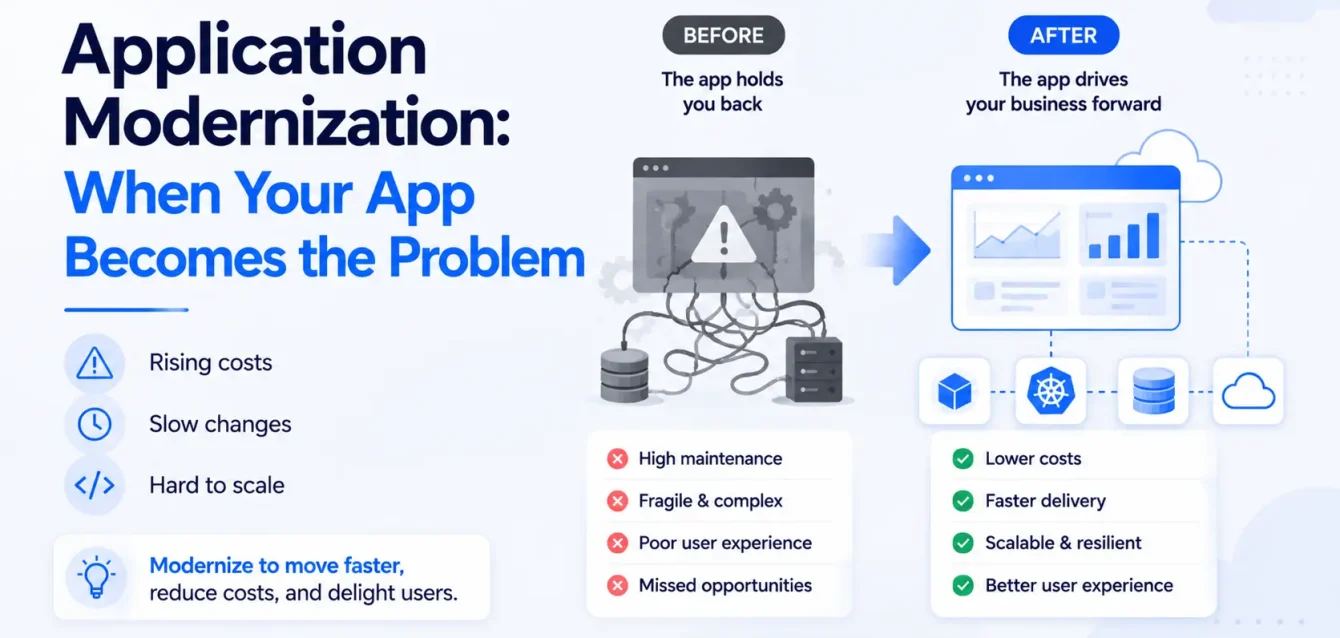
Picture your favourite e-commerce site running on the same setup it had in 2014. One big application. One database. One server that someone provisioned for a normal Tuesday.
Then Black Friday hits.
Millions of people mash Buy Now at the same second. The frontend dumps every order straight into the database. The database, sized for a normal Tuesday, starts choking. Response times crawl from milliseconds into seconds. Errors appear. Then more errors. Then the whole thing falls over.
Customers see a broken page. Orders vanish. The biggest revenue day of the year becomes the one people screenshot for their group chat.
Now run the same scenario with a decoupled setup.
The frontend doesn’t talk to the database directly anymore. It drops orders into a queue and goes back to taking the next one. Traffic spikes, the frontend scales out, a separate worker pulls from the queue at whatever pace the database can comfortably handle. Nothing floods. Nothing crashes. People check out and move on.
That’s application modernization in plain terms. Not a buzzword. An architectural choice that decides whether your worst day breaks you, or just shows up in the post-mortem as “handled.”
The best architecture is the one nobody notices, because it keeps working.
What modernization actually means
It’s moving legacy applications onto modern infrastructure (usually cloud and Kubernetes) with modern operational practices. What that looks like depends on where you’re starting from.
- Lift and shift — move it as-is. Fast, low risk, but you don’t get most of the cloud-native upside.
- Re-platforming — more targeted. Swap your self-managed Postgres for a managed service, containerize a few things, keep the bones.
- Re-architecture — the full version. Break the monolith, rebuild for scale. Biggest payoff, biggest project.
Not every app needs the full rebuild. Some apps are fine sitting in the cloud as a VM.
The trap is assuming you have to pick the most ambitious option to count as “modernizing.” You don’t.
Why teams actually do it
Usually one of four reasons.
- Scale. Legacy apps assume fixed infrastructure. So when demand grows you’re stuck either over-provisioning hardware that mostly sits idle, or watching things buckle when real traffic shows up. Cloud lets you scale up when you need it and back down when you don’t.
- Delivery speed. When everything in the application is wired to everything else, a small change in one place quietly breaks something else. People stop moving fast because moving fast feels dangerous. Releases drag from days into weeks. Good engineers get frustrated and start looking around.
- Operational drag. Older infrastructure needs babysitting. Hardware upgrades, manual patching, deployment scripts that one person on the team knows how to run. That work crowds out the actual product work.
- Cost. On-prem costs the same whether you use it or not. Cloud, when you actually right-size it, lets you pay closer to what you use.
The defaults will not save you money. That “when you actually right-size it” part is where most cost-savings stories live or die.
What gets in the way
Modernization projects fail more than people expect, usually for the same boring reasons.
- Trying to do everything in parallel. That’s how teams burn out and how rollbacks turn into incidents. Phase it. Start with something small and non-critical. Learn from it. Then go bigger.
- Hidden dependencies. Legacy apps are never as simple as the architecture diagram makes them look. Over the years they’ve grown connections to other systems, shared databases, internal jobs nobody remembers building. Half of those only show up mid-migration, and almost always at the worst time.
- Observability as an afterthought. Plenty of teams modernize the platform and only realize after the first incident that they have no idea what’s actually happening inside it. No useful metrics, no good logs, no traces. Build it in from the start.
- Unclear ownership. This probably kills more projects than any technical issue. When responsibility is split across teams and vendors, decisions slow down, priorities drift, momentum dies.
If no one’s name is on it, no one is driving it.
Are you actually ready
A few honest questions before you commit.
- Do you know what you have? Application inventory, dependencies, where the technical debt lives. If you can’t sketch it on a whiteboard, start with discovery and nothing else.
- Is there a business reason the people holding the budget actually care about? Faster releases, lower infra cost, better reliability, whatever. Pick one, make it measurable, report against it. Programs without a visible business outcome quietly lose support around month four.
- Does your team have the skills to run a cloud-native platform once it exists? Kubernetes is great until it isn’t, and “isn’t” usually means 3am on a Sunday. If the in-house knowledge is still being built, plan for training, hiring, or working with someone who’s done it before.
Done well, modernization isn’t a tech upgrade. It’s the difference between an engineering team that can move and one that’s permanently maintaining the past.
The teams that get this right aren’t the ones with the biggest budget or the most aggressive timeline. They’re the ones who treat it as a program, phase the work, and stay honest about how much they actually signed up for.
What you get on the other side is infrastructure that scales with the business instead of fighting it, and a team that spends its time building forward instead of holding the past together.
Thinking about modernization but not sure what it’d cost, how long it’d take, or whether you even need the full rebuild? That’s the conversation we’re good at. Obsium helps engineering teams design, migrate, and operate modern cloud and Kubernetes platforms, and we’ll tell you honestly if you don’t need us yet.