

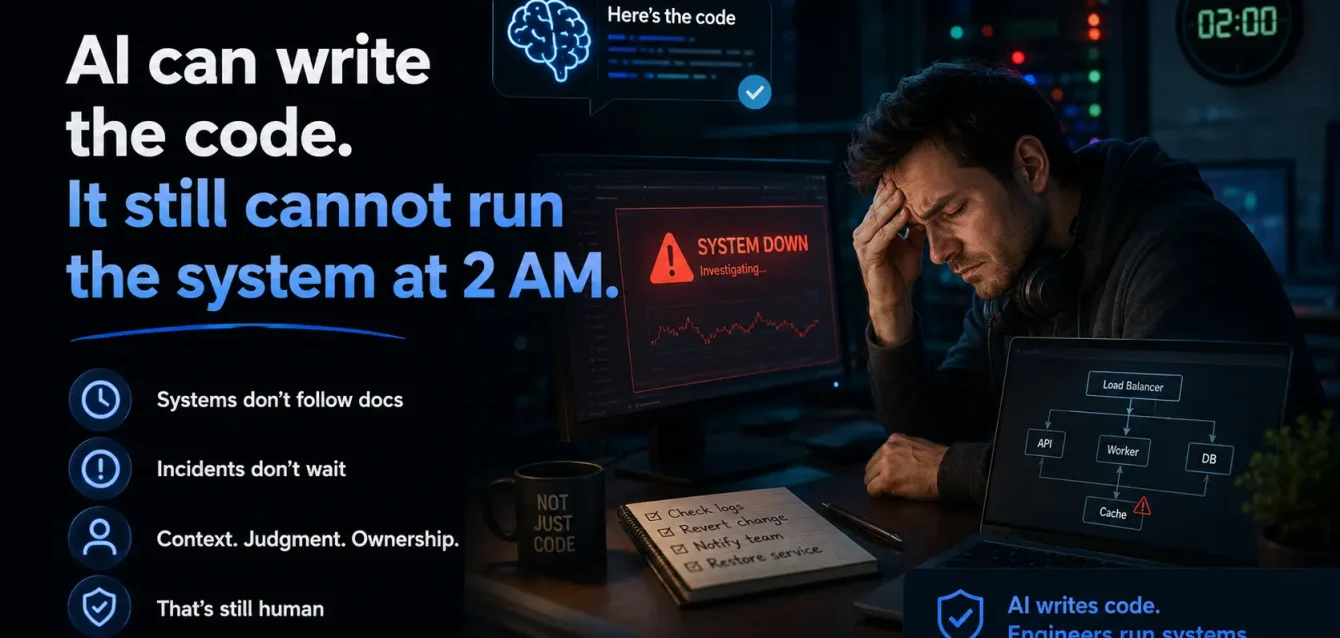
It is 2:14 AM. Checkout is down. The pager has gone off four times in eleven minutes. Three dashboards disagree about what is broken. The on-call engineer is staring at a Slack thread where two senior people are politely arguing about whether to roll back or wait for more data. Revenue is leaving at roughly $7,000 a minute.
Now imagine an AI agent in that room.
It can write code. It can read logs. It can summarize the runbook. What it cannot do is the thing the human is about to do in the next thirty seconds: decide.
This is the gap nobody in the AI-for-DevOps pitch deck wants to talk about. And it is the reason your SRE team is not going anywhere in 2026, no matter how good the coding agents get.
TL;DR
AI coding agents have become genuinely good at writing software. They pass benchmarks, refactor legacy code, and ship boilerplate that compiles. But a Sev-0 incident at 2 AM is not a coding task. It is a decision under uncertainty, with partial information, while revenue is bleeding out.
This post breaks down the gap between code generation and operational judgment, why distributed systems do not have a clean “SWE-bench” equivalent, and what the realistic role of AI in SRE looks like in 2026.
What an AI coding agent is good at
If you have spent a few weeks with Cursor or Copilot, you already know the shape of it. The good ones can:
- Writing first-draft code that compiles and passes type checks
- Refactoring within a single repo when the scope is well defined
- Generating tests, config files, infrastructure-as-code stubs
- Closing the boring 60% of a ticket where the work is mechanical
- Reading a stack trace and proposing a plausible patch
This is real. I am not in the “AI is a parlor trick” camp. We use these tools internally at Obsium when we build Kubernetes tooling for clients, and they save hours per week on the work that nobody enjoys doing anyway.
But there is a category error happening in the industry right now. People are watching coding agents close PRs and concluding that the same pattern will eventually run production. That is not how the work breaks down.
Why incident response is a different problem from coding
A Sev-0 starts with an alert. It rarely starts with the right alert.
The first page might say “p99 latency exceeded threshold on checkout-service.” It does not say “a config change rolled out 40 minutes ago caused a memory leak in the third pod replica, which is now exhausting connection pools upstream, which is why the latency alert fired on a service that is not actually broken.”
The actual cause is buried across:
- Logs from six services, half of which are sampled
- Metrics with five-minute aggregation windows that smooth over the spike
- Distributed traces that only got captured for 1% of requests
- A dashboard somebody built two years ago that nobody trusts anymore
- A Slack thread where three engineers are politely disagreeing about root cause
- A runbook that documents a slightly different version of the same outage from 2024
- Tribal knowledge in the head of the engineer who is currently on vacation
This is not a data analysis problem. The information is not just incomplete. It is contradictory, noisy, and arriving in real time while the situation changes underneath you.
Coding benchmarks like SWE-bench give the model a frozen repo, a specific bug report, and a clear pass/fail signal. None of that is true during an incident. The repo is the entire production system.
The bug report is whatever the alert said, which is usually wrong. And there is no pass/fail until customers stop complaining, which can lag the actual fix by ten minutes.
What an experienced SRE actually does in the first 15 minutes
I have watched senior SREs work on incidents at three different companies now. The pattern is consistent and almost nothing like what a coding agent does.
They stabilize before they investigate.
A good on-call engineer with five years of experience will:
- Roll back the most recent deploy first, even if they are not sure it caused the incident, because rollback is reversible and investigation is not blocking customers
- Fail over to the secondary region if availability is below SLO, because customer experience matters more than understanding why the primary failed
- Throttle non-critical traffic to protect the checkout path, because a degraded experience is better than no experience
- Page in the person who built the affected service, because tribal knowledge compresses 30 minutes of log spelunking into one Slack message
Only after the bleeding stops do they start root cause analysis. This sequencing is not in any runbook. It is operational instinct, and it is the single most important skill in SRE. It is also the thing AI coding agents are worst at, because they are trained to find the correct answer rather than to choose the action with the best risk profile under time pressure.
There is a quote I keep coming back to, originally from a Google SRE talking about the difference between Dev and Ops culture: “Devs optimize for new features. SREs optimize for not getting paged again.” Those are not the same goal, and they do not produce the same decisions.
The MTTR numbers are real, and they are why this matters
A few data points worth knowing if you are evaluating AI for incident response:
- Restore time: The 2023 DORA State of DevOps Report found that elite teams restore service in under an hour, but even they face multiple incidents per month.
- Outage cost: The Uptime Institute’s 2025 Annual Outage Analysis shows two-thirds of outages now cost more than $100,000, and nearly a quarter exceed $1 million.
- Per-minute downtime: A widely cited Ponemon Institute study from 2013, commissioned by Emerson Network Power, put the average cost of an unplanned outage at $7,900 per minute. The trend since has been upward as systems become more critical, not less.
- Current MTTR: Per the 2025 State of DevOps benchmarks summarized by SquareOps, average enterprise MTTR sits at 4-6 hours. Teams piloting LLM-driven triage are reducing that by 40-70%, and Rootly’s 2026 analysis reports a similar 40% reduction across the teams it has measured.
That is the money side of the conversation, and it explains why the AI vendor pitch lands so hard right now.
Those numbers are real, but the framing matters. The 40-70% MTTR reduction is happening on the parts of incident response that look like data retrieval: pulling logs, correlating alerts, summarizing runbooks, searching past incidents for similar patterns. That is the work AI is genuinely good at right now, and we are deploying it for clients ourselves.
It is not happening on novel failures. It is not happening in the parts that require judgment. Anyone selling you a fully autonomous AI SRE in 2026 is selling a research demo with a product wrapper.
Why distributed systems do not have an SWE-bench
This is the part that gets glossed over in most AI-for-infrastructure pitches, so it is worth slowing down on.
SWE-bench works because software bugs have a clean structure. There is a repo. There is a failing test. There is a passing test. You apply the patch, run the tests, and get a binary signal. The benchmark is meaningful because the task it measures is the task developers actually do.
There is no equivalent for SRE because distributed systems do not produce that signal. A Kubernetes cluster under load is a stochastic system:
- The same workload run twice produces different latency distributions
- The same config change deployed twice produces different cascading failures depending on cluster state
- The “ground truth” of whether a fix worked is “did the next 24 hours produce fewer pages,” which is too slow a feedback loop to train against
You cannot simulate it well, either. Chaos engineering tools like Gremlin and Chaos Mesh can inject specific failures, but the failures that matter in production are usually the ones nobody knew to simulate:
- The 2021 Facebook BGP outage
- The 2022 Atlassian deletion incident
- The 2024 CrowdStrike kernel driver issue
None of these were in anyone’s chaos test plan because nobody had thought of them yet.
That is the asymmetry. Coding agents get to learn from millions of public repos. SRE agents would need to learn from the long tail of catastrophic incidents that companies almost never publish in detail, for legal and competitive reasons. The training data simply does not exist in the same form.
What AI is actually good for in operations today
Setting the marketing aside, here is the honest map of where AI actually helps in 2026 operations work, based on what we have deployed at Obsium for cloud and Kubernetes clients.
Alert correlation and noise reduction.
Modern observability platforms generate more pages than humans can read. LLMs are good at clustering related alerts and surfacing the one signal that matters out of fifty redundant ones. This is the highest-leverage win, and the one most teams should adopt first.
Runbook retrieval.
If your team has good runbooks, an LLM with retrieval over them can answer “what do we do when X happens” faster than the human can find the wiki page. The catch is that most teams do not have good runbooks. AI does not fix that problem; it amplifies whichever direction your documentation already tilts.
Post-incident write-ups.
The first draft of an incident report is the kind of structured summarization task LLMs handle well. A human editor still needs to clean it up, but you can stop spending two hours per Sev-2 on the writing.
Suggested remediation, not autonomous remediation.
AI can propose the rollback command. A human still pulls the trigger. That is the right pattern for anything touching production until the reasoning gap closes, and that is not happening this year.
What AI is not good for yet:
- Deciding which signal to trust when two metrics disagree
- Choosing between stabilization options when both have business risk
- Recognizing that the runbook is wrong because the architecture changed
- Knowing when to escalate to the original service owner rather than burning 40 minutes trying to fix it solo
Those are still human jobs, and they will be human jobs for a while.
What the next frontier actually looks like
The interesting research direction is not “give the LLM more tools and let it run on production.” It is closer to “give the LLM the ability to maintain state and reason about that state over hours, the way a human operator does.”
A human SRE on a long incident is doing something cognitively unusual:
- Holding a hypothesis about what is wrong
- Updating it as new evidence comes in
- Weighing the cost of acting on it versus gathering more data
- Tracking which threads of investigation are still open
That working memory and updating loop is what current LLM agents do badly. They confabulate, they lose track, they get stuck in plans that no longer match reality.
If you want to track where this is actually heading, the work to watch is in agentic reasoning under uncertainty, not in coding benchmarks. Things like:
- Long-horizon planning with rollback (the agent commits to a hypothesis and revises it when evidence contradicts)
- Tool-use chains where the next call depends on uncertain results from the previous one
- Multi-agent setups where one model proposes and another critiques, similar to how senior engineers backstop juniors in a real on-call rotation
This is closer to research than product right now. That is fine. Most useful technology starts that way.
So what should you do this year?
If you run an infrastructure team and you are getting AI pitches every week, here is the practical filter:
- Buy what automates alert correlation and incident summarization. Real wins, the vendors deliver, and they will pay back the contract inside a quarter for any team with non-trivial pager load.
- Be skeptical of autonomous remediation claims. Read the case studies carefully. The ones that look impressive are almost always running on staging, or with a human approval step the marketing copy does not mention.
- Invest in the boring stuff that makes humans faster. Better runbooks, cleaner dashboards, fewer noisy alerts, well-scoped on-call rotations, real postmortems that feed back into the system. This is still where the leverage is.
The next few years of infrastructure work are going to look like human operators with AI assistance, not AI operators with human approval. The teams that figure out the right division of labor early are going to spend a lot less time on call.
FAQ
Can AI replace SREs in 2026?
No. AI coding agents are good at writing software, but incident response requires real-time judgment under uncertainty, which current LLM-based systems handle poorly. AI in 2026 is best used to assist human SREs with alert correlation, runbook retrieval, and post-incident summarization, not to autonomously remediate production systems.
What is the difference between an SRE and a developer using AI tools?
A developer writes code that will eventually run in production. An SRE keeps that code running once it is in production, which involves on-call response, capacity planning, observability, and incident management. AI coding tools accelerate the developer’s work but do not address most of what an SRE actually does day to day.
Why is SWE-bench not a good benchmark for SRE work?
SWE-bench measures whether an AI can patch a bug in a frozen code repository given a clear test signal. SRE work happens on live distributed systems where the bug report is usually wrong, the data is incomplete, and the success signal lags by minutes or hours. The task structure is fundamentally different, which is why coding benchmark performance does not transfer to operations work.
How much can AI realistically reduce MTTR in 2026?
For teams adopting AI for alert correlation, log summarization, and runbook retrieval, MTTR reductions of 40-70% on common incident classes are achievable based on early production data from vendors like Rootly and SquareOps. These gains come from automating the data-gathering parts of triage, not from autonomous decision-making. Novel and complex incidents still require human judgment.
What is the best way to introduce AI into an SRE workflow?
Start with alert noise reduction and post-incident summarization. Both are low-risk, high-leverage uses of LLMs where errors are recoverable, and the workflow improvement is measurable. Avoid giving AI agents write access to production systems until you have several quarters of evidence that the reasoning is reliable in your specific environment.